A Tiger in the Zoo — Class 10 English First Flight: Analysis & Q&A
This work has been verified by our teacher: 6.02.2026 at 16:21
Type of homework: Analysis
Added: 4.02.2026 at 16:28
Summary:
Explore an in-depth analysis and Q&A on A Tiger in the Zoo from Class 10 English First Flight to understand its themes and symbolism clearly.
The Enduring Echo of “A Tiger in the Zoo”: Exploring Symbolism and Relevance in Class 10 English
The intertwining of wildlife and human life has always been central to Indian consciousness, with nature revered across literature, mythology, and daily existence. Poetry, as a mirror to society, often immortalises this bond, seeking not only to celebrate the wonders of nature but also to spotlight the ethical dilemmas emerging from our interactions with the wild. “A Tiger in the Zoo”, included in the Class 10 English First Flight textbook, stands as a moving example of such poetry—inviting readers to reflect on freedom, captivity, and the consequences of our choices upon the innocent creatures sharing this planet. Against the backdrop of India’s rich ecological heritage, this poem resonates powerfully, employing vivid imagery and stark contrasts to inspire awareness and empathy. This essay delves into how the poem’s literary techniques and symbolic depth highlight crucial issues of wildlife conservation, human morality, and the pressing need to respect nature’s sovereignty.
---
Context and Background of the Poem
The poem “A Tiger in the Zoo” was penned by Leslie Norris, a celebrated poet known for his sensitive portrayals of animals and nature. In India, where the tiger is not merely an animal but a living symbol of strength—dominating folk tales, festival art, and even the currency—the poem assumes an even deeper relevance. The central premise of the poem pivots around the tragic plight of a tiger transported from the freedom of jungle to the desolate confinement of a zoo. As readers, especially students in India, we are compelled to consider how modern progress and indifference have led to shrinking forests, reducing proud predators to mere exhibits. The poem serves as a timely reminder for students, situated in a country that has witnessed both the near-extinction and revival of its tiger population, of their stake in India’s ongoing conservation story.---
Imagery and Descriptions of the Tiger in the Wild
The poet employs a lush repertoire of verbs and adjectives to conjure the tiger’s prowess in its natural habitat. Words such as ‘lurking’, ‘sliding’, and ‘snarling’ do not merely describe actions—they paint a portrait of an agile predator in its realm, moving with a blend of grace and lethality. One almost hears the rustle of tall grasses as the tiger crouches, eyes blazing with primal energy, ready to claim its place atop the food chain. The description of the tiger’s stripes, both ‘brilliant’ and burning against the wilderness, symbolises not only its beauty but also its untamed spirit.Furthermore, the poet’s selection of sensory details deepens the engagement: the humid aroma of forest earth, the soft pad of massive paws in moonlit silence, and the low, warning growl that reverberates through the otherwise sleepy jungle. This wild imagery is not accidental; it is a deliberate celebration of freedom—evoking the tiger as it ought to be, unchained, roaming in its territory, master of its domain. The very mention of waterholes and deer reminds us of the delicate web of life to which the tiger belongs, a web sustained only in its natural form.
---
Imagery and Descriptions of the Tiger in Captivity
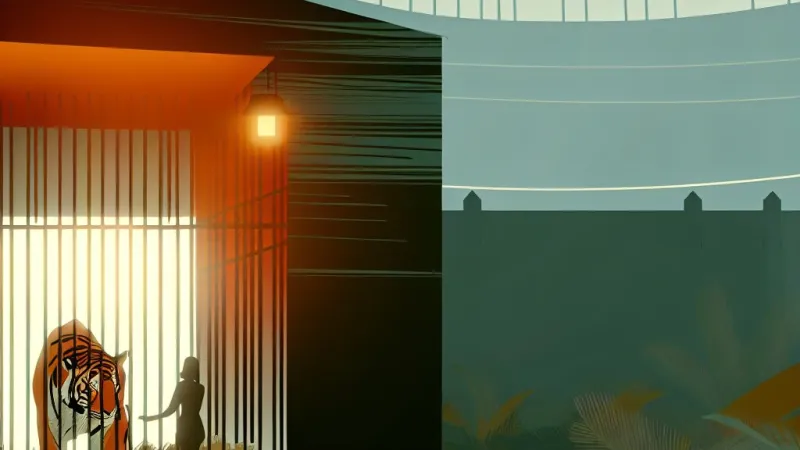
In jarring contrast, the poem’s depiction of the tiger in a cage draws upon a different lexicon entirely. Here, we find phrases like ‘few steps of his cage’, ‘locked in concrete cell’, and ‘behind bars’. These are words heavy with the weight of lost liberty. The tiger, once a terror in the forest, is now reduced to repetitive pacing, its movement limited to a small, unnatural circuit. The very environment—hard, unfriendly concrete—serves as a symbol of all that is artificial and repressive.The poem’s tone takes on a note of muted despair. The phrase ‘quiet rage’ perfectly encapsulates the emotional response of the animal; deprived of its natural habitat, it neither lashes out nor accepts its fate. Instead, a simmering anger is suggested, combined with an almost mournful dignity. The tiger’s ‘ignoring visitors’ speaks volumes about its indifference to human curiosity—its spirit too proud to beg for attention, yet too broken to roar in protest. This shift from the dynamic imagery of the wild to the stagnant monotony of the zoo spotlights the psychological torment wrought by such captivity.
---
The Contrast Between the Wild and the Zoo Environment
The poet intentionally structures the poem to highlight this duality—juxtaposing the tiger’s rightful home with its imposed prison. The recurring use of certain words amplifies this effect: ‘quiet’ in the jungle is a prelude to deadly action, a sign of focussed predation; in the cage, it is an enforced passivity, a lull born of defeat and resignation. Similarly, ‘brilliant’ stripes dazzle in the sunlight of the forest, but lose their lustre under the sterile tube lights of the cage.This contrast is not merely visual but deeply emotional. For Indian readers, trained to revere the tiger as the ‘King of the Jungle’, seeing it reduced to a spectacle for human amusement is both shameful and stirring. The poem’s structure almost demands that readers weigh these environments against each other, eliciting a sense of empathy and righteous anger. The modern student finds in this contrast a powerful call to contemplate humanity’s role as protectors—or oppressors—of the natural world.
---
Symbolism and Deeper Meanings
Tigers hold immense symbolic significance in Indian culture. From the majestic images of Maa Durga riding her tiger to the central role played by the Royal Bengal Tiger as India’s national animal, the creature represents power, valor, and resilience. Thus, the caged tiger is not just an individual animal but becomes emblematic of all that stands to be lost when human ambition overrides ecological wisdom. The confines of the zoo morph into a metaphor for the broader cages built by deforestation, poaching, and indifference.Moreover, the poem invites reflection on the ethics of zoos and the entertainment industry. It raises uncomfortable questions: Do we cherish wildlife, or merely desire to control and display it? Are our actions motivated by genuine concern or mere curiosity? The caged tiger, in its silence, becomes a mirror for our moral choices, urging readers to advocate for a world where animals are valued for their intrinsic right to freedom, not merely for our fleeting amusement.
---
Language, Literary Devices, and Stylistic Features
Leslie Norris’s craft in the poem is evident in his careful use of literary devices. The contrasting imagery, as described above, sharpens the divide between freedom and captivity. Alliteration—such as in ‘brilliantly bold’ or ‘quietly caged’—imbues the poem with a rhythmic cadence, making the lines memorable and emphatic. Repetition of key concepts and words, notably the movement of the tiger and references to its stripes or environment, anchors the poem’s tone and themes in the reader’s mind.Another powerful device is juxtaposition. The tiger ‘should be lurking’ but ‘is locked’. This sharp opposition draws readers into the emotional turmoil of the animal, illustrating vividly the distance between what is and what ought to be. The tone, too, shifts subtly—from an almost reverential awe as the tiger prowls in the jungle, to a bleak melancholy within the cage, and finally a simmering anger that underlies the poem’s entire structure.
---
Moral and Educational Value for Students
The poem is not just a literary artefact; it is a moral lesson disguised in verse. For students, it is a call to awaken their sense of responsibility towards animals and nature. Through the tiger’s mournful silence, they learn that every creature desires and deserves dignity. The poem dovetails naturally with present-day concerns in India, where Project Tiger and the establishment of wildlife sanctuaries fight against the backdrop of urbanisation and shrinking green spaces.Furthermore, literature such as this builds empathy—teaching readers not merely to know about wildlife, but to feel for it. In a society where animals often fall victim to human greed, the poem reminds future citizens to regard conservation as their duty. Importantly, it prompts critical thinking: should zoos exist, or is there a better way to balance human curiosity with animal welfare? As education evolves to prioritise holistic development, such literary experiences shape not only minds, but hearts.
---
Conclusion
“A Tiger in the Zoo” transcends its simple narrative to become a profound commentary on the cost of human progress. Through powerful contrasts and evocative symbolism, Leslie Norris urges readers to consider the fate of those who cannot speak for themselves. For Indian students, the poem’s relevance is underscored by their cultural inheritance and the ongoing struggle to protect India’s vibrant wildlife. Ultimately, it is a call to build a society where human advancement does not trample upon the rights of the wild, and where the god-given freedom of every creature—tiger or otherwise—is both celebrated and defended.---
Rate:
Log in to rate the work.
Log in