10 Simple Lines on Charles Babbage, the Father of Computers
This work has been verified by our teacher: 12.02.2026 at 10:15
Type of homework: Essay Writing
Added: 10.02.2026 at 16:04
Summary:
Discover 10 simple lines on Charles Babbage, the Father of Computers, to learn about his life, inventions, and impact on modern technology.
10 Lines on Father of Computer (Charles Babbage) – An Original Essay
If you try to imagine one day without your smartphone, your computer, or the internet – everything seems to come to a halt. From a student working on a Science project to a doctor checking a patient’s report in the hospital, computers play a crucial role in our daily lives. Today, it is nearly impossible to visualise modern life without computers, but all this progress began with the vision of one extraordinary man – Charles Babbage. Known across the globe as “the father of the computer,” his pioneering ideas led to inventions that planted the first seeds of the digital age. In this essay, I will discuss Charles Babbage’s personal journey, his inventive spirit, and how his dreams shaped the world we live in today.
---
I. Early Life and Introduction to Mathematics
Charles Babbage was born on 26 December 1791 in London, England, into a family where education and curiosity were encouraged. His father worked as a banker, which ensured the family could provide Charles with good schooling. From an early age, Babbage was fascinated by numbers and puzzles. When he joined Trinity College, Cambridge – an institution known for its rich tradition in mathematics (famous Indian mathematician Srinivasa Ramanujan also joined later, though in a different period) – Babbage was captivated by the world of numbers.He often found the process of manual calculations slow and filled with mistakes, a problem not very different from what many Indian students face when solving complex maths sums in class. His sharp analytical skills and passion for finding solutions to such problems eventually made him think more deeply about the process itself.
---
II. Identifying the Need for Mechanical Calculation
During Babbage’s time, all calculations, whether for building railways or for navigating ships, had to be done by hand and written down in lengthy tables. One small error could lead to disastrous consequences, something which the Indian mathematician Aryabhata also worried about when he created astronomical tables centuries earlier. Babbage recognised that relying solely on human calculation restricted scientific progress and could even endanger lives.He envisioned replacing this system with a machine that could speed up these calculations and reduce the possibility of errors. Today’s class calculators and computers in Indian schools are a direct reflection of this vision. His revolutionary thought was simple yet profound: “Machines can do maths better than humans!”
---
III. The Dream of a Programmable Calculation Machine
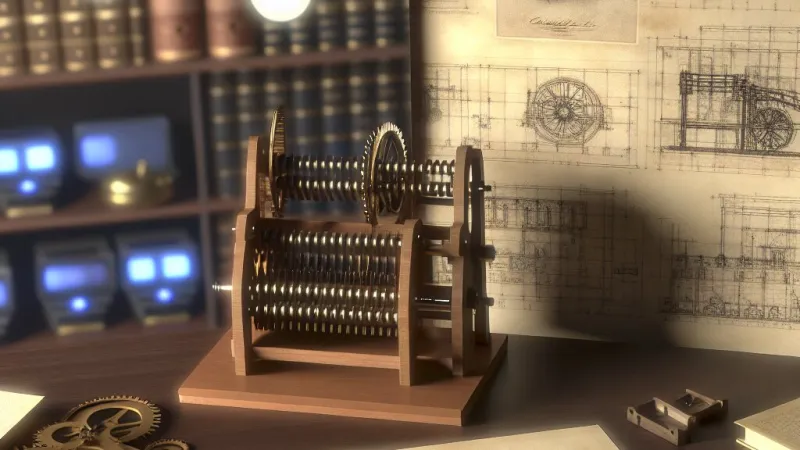
Charles Babbage was not content with just identifying the problem; he went on to find a solution. His first major project was the Difference Engine, designed in 1822. Imagine a gigantic, complex machine made of metal gears and levers, designed not to play music or tell the time, but to automatically calculate mathematical tables, invaluable for things like algebra, trigonometry, and navigation.Though the Difference Engine was never fully completed due to technical and financial issues (which will be discussed later), Babbage’s mind was already racing ahead. He soon thought – “Why stop at just one kind of calculation?” This led to his most significant idea, the Analytical Engine, a device that could be programmed to do any calculation, much like today’s computers.
He borrowed the idea of punch cards – small pieces of paper with holes in patterns – from weaving looms (Jacquard looms). This allowed the Analytical Engine to be ‘told’ what to do, paving the way for programmable computers. This was a fantastic leap, much as when Indian teacher Dr. APJ Abdul Kalam dreamed of satellites while still in a small fishing village.
---
IV. Facing Challenges: Technology, Money, and Misunderstanding
Babbage’s genius was ahead of its time. The metals and tools needed in the 19th century were not precise enough to build such delicate and complex machinery. Funds were also hard to come by – even though the British government supported Babbage at first, they soon withdrew the money when the project stretched on for years without completion.Society too did not understand his vision. Some even laughed at him, suggesting he was wasting time and resources. Similarly, we remember how Indian scientist Jagadish Chandra Bose had to fight for support when inventing the wireless radio. Like many visionaries, Babbage worked alone, often discouraged, but never giving up hope.
---
V. Babbage’s Enduring Legacy
Charles Babbage died in 1871, with none of his machines fully built while he was alive. But history has a way of rewarding true innovation. Years after his death, his drawings and notes inspired many. The Science Museum in London now proudly displays his partially built engines.More importantly, Babbage’s work inspired future pioneers. Ada Lovelace, a contemporary and friend, is considered the world’s first computer programmer for her detailed notes on how the Analytical Engine could solve complex problems. The basic ideas of “input,” “storage,” “calculation” and “output” became the foundation on which great mathematicians and engineers built the modern computer.
Today, Indian students read about him in their school Science and Computer textbooks, and his life is depicted in educational television shows and illustrated biographies. Like C.V. Raman in Physics or Kalpana Chawla in space exploration, Babbage is celebrated as a true pioneer.
---
VI. Computers: From Babbage’s Era to Everyday India
The journey from Babbage’s mechanical engines to today’s sleek laptops is truly amazing. In present-day India, computers are everywhere – at railway ticket counters, in bank offices, at smart classrooms, and even in small urban shops through point-of-sale systems. Students use computers for online learning, competitive exam preparations, coding competitions like those held by NPTEL or Codechef, and even for interacting with teachers through virtual classrooms.The “Digital India” campaign launched by the Government thrives on the very possibilities Babbage first saw. Even in villages, computers are helping farmers access real-time weather updates and market prices. Just as Babbage imagined, his machines have become an indispensable tool for progress.
---
VII. Lessons from Babbage’s Life for Indian Students
What does Babbage’s story teach us? Firstly, that even if people laugh at your dreams, persistence and creativity can change the world. Scientific progress is rarely quick or easy; it takes years of hard work and resilience. Indian history is also full of such visionaries – from Dr. Homi Bhabha, who dreamt of India’s nuclear programme, to youngsters today who compete in robotics and coding Olympiads.Secondly, every question or “Why not?” can lead to ground-breaking discoveries. Babbage’s approach to solving everyday problems with scientific curiosity is something students should adopt in their own studies and future careers.
Lastly, it is our responsibility to remember and honour those who laid the path before us. As Rabindranath Tagore once wrote, “Let us light the lamp at the entrance so their names are never swallowed by darkness.”
---
Conclusion
Charles Babbage’s life was one of vision, struggle, and enduring inspiration. Against all odds, he conceived the first machines capable of solving problems automatically, giving birth to the field of computer science. Though he faced many setbacks, his ideas paved the path for every computer and smartphone we use today—even in far corners of India’s rural heartlands.As students, we owe respect to pioneers like Babbage and must learn from their persistence and creative thinking. The next great invention could begin as a spark in a young mind in a school classroom, just as it once did in Babbage’s. Let us celebrate the “father of the computer” by not only remembering his name but also by carrying forward his passion for discovery in our own lives.
---
FAQs
Q. Who is considered the father of the personal computer? Ans: While Babbage is the father of the computer, the personal computer’s development is linked to innovators like Steve Wozniak, though not usually part of Indian school curriculum.Q. Who is known as the mother of the computer? Ans: Ada Lovelace is often called the “mother of computer programming” for her work with Babbage.
Q. What made the Analytical Engine unique? Ans: It was the first design for a programmable, general-purpose computing machine, using concepts like memory, control flow, and punched cards.
Q. Why did Babbage’s machines remain unfinished? Ans: Due to lack of advanced manufacturing, financial support, and societal understanding at the time.
---
Glossary
- Difference Engine: A mechanical device invented by Babbage to automatically calculate mathematical tables. - Analytical Engine: Babbage’s later design for a true programmable computer using punch cards. - Programmable Computer: A machine capable of carrying out instructions given by a user or programmer. - Punch Card: A piece of paper with holes representing data, used in early computers for input.---
Suggested Activities
- Build a simple “calculator” with cardboard wheels to show how machines can add or subtract. - Write a paragraph on how computers help your family or community. - Research Indian computing pioneers like Dr. Vijay Bhatkar (creator of PARAM supercomputer) and compare with Babbage.---
May the spark of curiosity and innovation continue to light the path for all young minds, just as Babbage’s ideas illuminate the digital age today.
Rate:
Log in to rate the work.
Log in