10 Major Problems Women Face in India Today
This work has been verified by our teacher: 16.01.2026 at 11:39
Type of homework: Essay Writing
Added: 16.01.2026 at 11:23
Summary:
Esej o 10 problemach kobiet w Indiach: dyskryminacja, brak edukacji, przemoc, posag, selekcja płci i nierówność; apel o edukację i reformy. 📚
10 Lines on Problems Faced by Women in India — Detailed Essay
Introduction
It is often said, “If you educate a man, you educate an individual, but if you educate a woman, you educate a family and a nation.” Despite forming almost half of India’s population, women in India continue to confront numerous social, economic, and cultural hurdles. The story of India's progress remains incomplete while half our citizens face obstacles from the time they are born. What are these barriers, and why do they persist even in modern India?Over centuries, rapid economic growth and social reforms have certainly changed the landscape, but traditional gender norms still cast a long shadow. While women like Rani Lakshmibai and Sarojini Naidu have become symbols of courage and leadership, the daily realities faced by millions of women in villages and cities reveal a different picture. This essay highlights ten major problems faced by women in India, explores their causes and consequences, reviews how the government is responding, and suggests practical steps toward change.
Thesis Statement
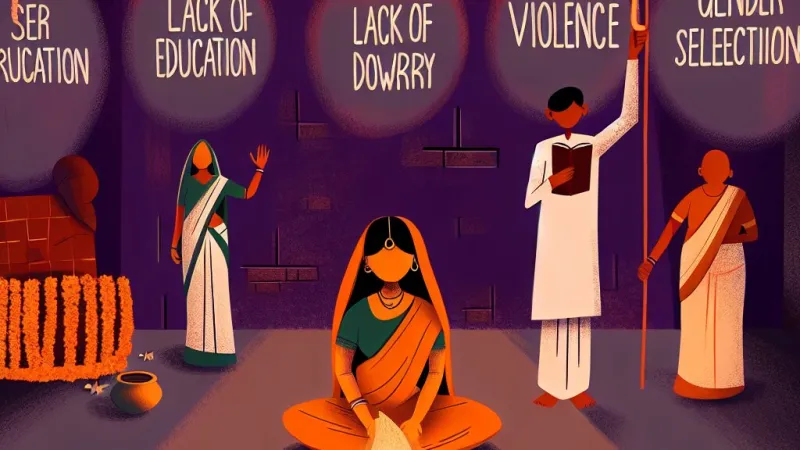
Although India has made notable progress in some areas, women still encounter entrenched problems—social, economic, legal, and related to safety—that not only limit their personal freedom but also hinder the nation’s development.10 Core Problems: Short Version
1. Gender bias and son preference prevail in many families. 2. Many girls struggle to access quality education and skill training. 3. Child and early marriage continue to affect young girls. 4. Domestic violence and family abuse remain widespread. 5. Women face sexual harassment in public spaces and workplaces. 6. Dowry-related harassment and deaths still occur. 7. Female foeticide and sex-selective practices distort population balance. 8. Economic inequality and workplace discrimination persist. 9. Health and nutrition disparities disadvantage women, especially in rural India. 10. Social superstitions, honour-based violence, and exclusion restrict women’s freedom.Expanded Explanation of Each Point
1. Gender Bias and Son Preference
Traditionally, Indian society has valued male children over female children. Even today, families may invest more in boys’ education and health, while girls can be treated as liabilities, partly due to practices like dowry. The 2011 Census, for example, revealed a child sex ratio of only 919 girls per 1,000 boys, reflecting both son preference and the lack of equal care.2. Limited Access to Education and Skill Training
Though there has been improvement, girls' enrolment rates, especially in secondary and higher education, lag behind those of boys. Early marriage, household duties, and lack of safe transport often lead to girls dropping out of school. According to the Annual Status of Education Report (ASER), attendance among girls decreases significantly after Class VIII, particularly in rural districts.3. Child and Early Marriage
Despite the legal age of marriage being 18 for women, the practice of marrying off girls early continues in states like Rajasthan and Bihar. Early marriage causes girls to leave school and exposes them to early pregnancies, which are dangerous for both mother and child. Poverty and social customs drive this problem.4. Domestic Violence and Family Abuse
Domestic violence, whether physical, emotional, or economic, is sadly common. Many women do not report abuse due to fear, stigma, or lack of support, making the problem hard to measure. The National Crime Records Bureau reports lakhs of cases every year, though experts believe the true numbers are much higher.5. Sexual Violence and Harassment
Women face threats of eve-teasing, sexual assault, and harassment in markets, buses, workplaces, or even within educational institutions. Such incidents severely affect women’s mobility and mental wellbeing, discouraging them from seeking jobs or higher education. The Nirbhaya case in Delhi (2012) led to nationwide protests, highlighting this grave issue.6. Dowry-Related Harassment and Deaths
Though giving and taking dowry is illegal, dowry continues to be demanded. Some women face harassment, physical abuse, or even death if their natal families fail to meet dowry demands. Dowry deaths still account for thousands of reported fatalities each year.7. Female Foeticide and Sex-Selective Practices
Misuse of technology for prenatal sex determination has led to widespread female foeticide in certain regions. This, combined with son preference, has skewed the sex ratio, putting future generations at risk of social turmoil.8. Economic Inequality and Workplace Discrimination
Women are paid less for similar work, rarely reach top management, and often work in informal sectors without job security or social benefits. Unpaid care work at home goes unrecognised. Barriers to entrepreneurship, such as lack of credit or property ownership, further limit women’s economic independence.9. Health and Nutrition Disparities
Inadequate maternal healthcare and awareness of reproductive health, along with poor access to hospitals, especially in rural areas, make women vulnerable to diseases and malnutrition. Anaemia is widespread among women, as reported by the National Family Health Survey.10. Social Superstition, Honour-Based Violence, and Community Exclusion
Certain regions report witch-hunts, where women are accused of practising “witchcraft” and attacked. Cases of honour killings occur when women defy social norms regarding marriage or dress. Fear of exclusion often curtails women's choices in education, dress, work, and relationships.Causes and Interconnections
The roots of these issues run deep. Patriarchal social structures favour men, assign women secondary status, and restrict their mobility. Low literacy, poverty, and lack of awareness among both men and women worsen the situation. Weak enforcement of progressive laws allows violators to evade punishment. Economic systems often overlook or undervalue the massive unpaid labour women perform at home. Media images sometimes glorify sacrifice or submission, rather than self-reliance and leadership, further normalising gender-based discrimination.Consequences
Individual Level
Women may suffer trauma, injuries, mental health issues, missed educational or career opportunities, and even loss of life. Young girls denied education are more likely to remain trapped in intergenerational cycles of poverty.Community and National Level
The impact goes beyond individuals. Families and communities which suppress women’s voices see less progress. Social backwardness persists. Nationally, the loss of women’s contributions, whether in science, business, or public life, means slower economic and social development.Demographic Impact
Distorted sex ratios lead to increased trafficking, forced marriages, and social instability, as seen in states like Haryana and Punjab.Governmental, Legal, and Institutional Responses
India has various laws and schemes aimed at protecting and empowering women. The Dowry Prohibition Act (1961), Protection of Women from Domestic Violence Act (2005), and Prohibition of Child Marriage Act (2006) are some examples. The Pre-Conception and Pre-Natal Diagnostic Techniques (PC&PNDT) Act tackles sex-selective abortions. Welfare schemes like Beti Bachao Beti Padhao, Sukanya Samriddhi Yojana, and reservation for women in Panchayati Raj institutions seek to change social attitudes and improve access to education and opportunities. However, challenges remain in strict implementation and awareness.Practical Solutions and Recommendations
Education and Empowerment
Ensuring girls stay in school by providing safe transport, scholarships, and girl-friendly infrastructure is vital. Vocational training and encouragement for STEM (Science, Technology, Engineering and Mathematics) education will open better career opportunities. Local role models like Kalpana Chawla and Mary Kom can inspire the next generation.Legal and Institutional Reforms
Fast-tracking cases related to gender violence, strengthening women’s police cells, and increasing the number of women in the police force will encourage more women to seek help. Helplines and legal aid centres must be accessible everywhere.Economic Measures
Enforce equal pay for equal work. Expand support for women’s self-help groups, like those seen in Kerala’s Kudumbashree programme, and ensure women have easy access to credit and entrepreneurial grants.Social Change Initiatives
Promote community dialogue on gender bias, and organise workshops in schools and colleges to challenge stereotypes. Media campaigns need to highlight successful women from diverse backgrounds, not just celebrities from urban areas.Infrastructure and Support Services
Cities and towns must have better street lighting, safe public transport, functional CCTV in public places, and well-publicised helplines. Shelters and mental health counselling services should be readily available to survivors of violence.Conclusion and Call to Action
The problems faced by women in India are complex and interconnected, often rooted in centuries-old attitudes and practices. However, change is possible—and happening—when society, government, and individuals work together. To build a truly inclusive and progressive India, every citizen must challenge gender bias, support girls' education, and stand up against discrimination and violence. After all, when women rise, the nation rises with them.Checklist for Exam Answers (Short Version)
- Start with a concise introduction - List 10 distinct, specific problems - Avoid repetition and sensational language - Support points with simple facts or examples - End with a hopeful or solution-oriented closing lineSample 10-Line Version (For Memorisation)
1. Women form half of India’s people but face many serious problems. 2. Families often prefer sons, leading to unequal care for girls. 3. Girls’ education is sometimes neglected and dropout rates are high. 4. Child marriage is still seen in many regions, harming girls’ futures. 5. Domestic violence and family abuse often go unreported. 6. Women encounter sexual harassment in public and at work. 7. The dowry system leads to harassment and tragic deaths. 8. Female foeticide has created an unbalanced sex ratio. 9. Economic and health inequalities keep women behind. 10. Strong laws, education, and social reform are essential for change.---
With collective effort, India can ensure that every woman gets the chance to live, learn, lead, and thrive. This is not only a question of justice, but also of the nation’s future prosperity and wellbeing.
Rate:
Log in to rate the work.
Log in