Explore how popular opinion influences lawmaking but differs from justice, helping students understand key concepts in democracy and legal ethics.
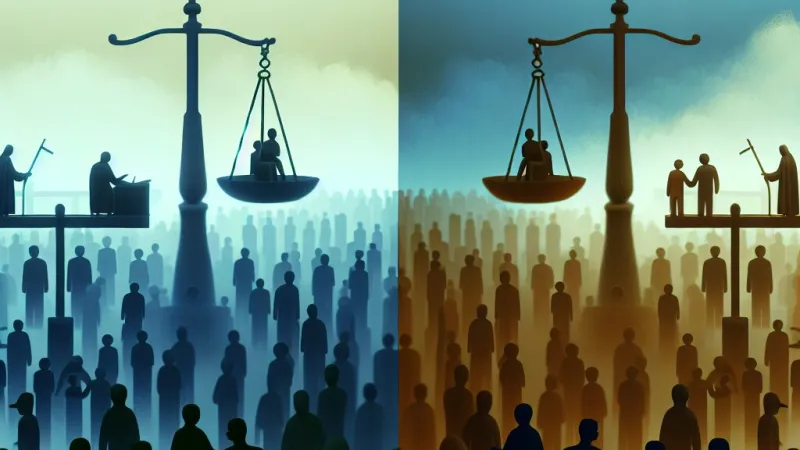
“Popular will may shape law, but it cannot be the foundation of justice.”
In democratic societies, it is often said that "vox populi, vox dei"—the voice of the people is the voice of God. India, the world's largest democracy, stands testimony to the power of common citizens shaping the letters of law through their collective will. Legislative assemblies, Parliament, and even judicial activism are frequently steered by prevailing social attitudes and urgent public demands. However, the deeper question persists: Is justice merely what most desire, or does it transcend temporary moods and majority consensus? While rule of law may be steered by popular will in a democracy, justice itself is rooted in timeless ethical values, fairness, and the enduring duties that bind humanity. True justice serves as a moral compass—one that does not sway with the unpredictable tides of public sentiments. Thus, while popular will certainly influences law-making, the essence of justice rests on more stable and universal principles.
Popular Will and Its Influence on Law
The Nature of Popular Will
Popular will is essentially the aggregate opinion or preference of the public at a given moment. This collective consciousness often finds expression in elections, protests, and mass movements. However, popular will is inherently fleeting. It is subject to shifting social moods, persuasive campaigns, emotional waves, and sometimes even mass hysteria. The Indian freedom struggle, for example, was powered by popular will during key moments like the Salt Satyagraha or the Quit India Movement, galvanising legal and political action. Yet, the same popular will can turn conservative under different circumstances, resisting progressive change.
Democracy and Its Emphasis on Popular Will
Democracy derives legitimacy from participation and representation. Regular elections, referenda, and even digital opinion polls allow citizens a voice in shaping laws and governance. For instance, public demand spurred the Right to Information Act in 2005, reflecting people’s craving for transparency. Similarly, anti-corruption movements found expression in the Lokpal and Lokayuktas Act. The will of the collective can be a powerful catalyst for reform.
Limitations and Dangers
But history warns us that majoritarian sentiment is not always synonymous with justice. Popular perceptions are often clouded by incomplete information, prejudice, and transient anger. The demand for the death penalty in high-profile criminal cases, for instance, is sometimes driven more by outrage than by deliberation. Social attitudes have often supported discriminatory laws—consider the once widely accepted practice of untouchability, or the regressive Section 377 of the Indian Penal Code, which criminalised homosexuality for decades despite changing global standards. The majority might support policies that suppress minorities, as seen in the imposition of Emergency in 1975 or caste-based discrimination long accepted as normative.
Popular Will: A Tool, Not a Foundation
Popular will, therefore, is a vital mechanism for gauging public needs and steering societal priorities, but it lacks the consistency and fairness to serve as the bedrock for justice. Basing law solely on prevailing opinion courts instability and moral hazard, as public perspectives can undergo abrupt shifts influenced by populist leaders, misinformation, or sudden events.
Justice: Rooted in Timeless Values
Justice as a Philosophical and Moral Concept
Justice is not simply a reflection of what people desire but is an aspiration of what society ought to be. Rooted in timeless values such as fairness, equality, and dignity, justice serves as the highest standard by which human conduct and institutional frameworks are measured. The Ramayana and Mahabharata repeatedly foreground the importance of Dharma—a balanced approach to duty and righteousness, often at odds with mass sentiment.
Philosophical Underpinnings
Philosophers across millennia have grappled with the question of justice. Plato, in his ideal state, argued that justice comes from each individual fulfilling their rightful role, not from the mob’s whims. Immanuel Kant held that moral principles must be universal and unchanging, irrespective of whether they enjoy public approval. In the Indian context, the principle of Dharma—as taught in the Gita—compels individuals and rulers to rise above transient moods and pursue a higher, impartial good. Swami Vivekananda asserted the primacy of truth, even when it runs counter to mass consensus: “Truth does not pay homage to any society, ancient or modern. Society has to pay homage to truth or die.”
Justice and Protection of the Marginalised
Justice, to be just, must protect the voices and rights of minorities—even when the majority disapproves. The Indian Constitution abolished untouchability in Article 17, despite centuries of entrenched social sanction for the practice. The Supreme Court’s recognition of the transgender community, or its decriminalisation of homosexuality, similarly embodies the principle of justice pursuing the right thing, not the popular thing.
Challenges of Popular Will in a Rapidly Modernising India
Media, Social Trends and Public Opinion
The landscape of public opinion in India is increasingly shaped by digital platforms—WhatsApp forwards, viral Twitter hashtags, and 24x7 news cycles. While social media can amplify crucial issues like violence against women, it can also manufacture outrage or spread misinformation, undermining reasoned debate. Trial by media sometimes substitutes serious judicial process with shrill public conviction, pressuring lawmakers into knee-jerk responses.
Populism: A Double-Edged Sword
Populist politics have a long history in India. Demands for outright bans (on films, on books, on food habits), or competitive welfarism (loan waivers, free electricity) often win elections, but rarely consider long-term justice or equity. When leaders trade ethical governance for mass popularity, the law risks becoming a mere echo chamber of noisy majorities, neglecting critical structural reforms.
Constitutional Morality as a Safeguard
India's framers foresaw this weakness of majoritarian rule. Dr. B.R. Ambedkar, architect of the Constitution, warned that democracy without constitutional morality was hollow. The Constitution embeds checks and balances, fundamental rights, and the power of judicial review precisely to ensure that the law doesn't devolve into tyranny of the majority. It is this constitutional morality that empowers the judiciary to strike down laws, even if they have widespread public support, on grounds of injustice.
Balancing Empathy and Justice
Governing with empathy does not simply mean bowing to popular pressure. True empathy demands understanding the suffering of the voiceless and standing by principles even when it is unpopular. Welfare schemes, police reforms, and affirmative action are at their best when rooted in careful reasoning and empathy—balancing popular needs with justice.
The Interplay: Law, Popular Will, and Justice
Law as a Dynamic Interface
Laws must respond to people’s needs, evolve with time, and adapt to changing realities. The decriminalisation of adultery, expansion of reservation policies, or new privacy laws demonstrate how evolving popular will shapes legislation. Yet, for a law to be enduring and fair, it must be sifted through principles of justice.
Justice as the Guiding Light
Ultimately, justice must illuminate the legislative process. Legal reforms should be measured by whether they preserve human dignity, advance equality, and protect individual liberty—not merely whether they suit public opinion. The abolition of triple talaq, for instance, responded to a genuine call for gender justice, even as it divided opinion.
Listening to Dissent
A vital feature of justice is its capacity to begin in dissent. From Raja Ram Mohan Roy’s struggle against sati, to the women’s movement challenging patriarchal laws, dissenters have often been voices of conscience. Social progress is born from debate, not capitulation to the loudest majority.
The Stability of Principles
Popular opinion is like the river: always flowing, always changing. Justice is the riverbed—steady, guiding the flow and preventing floods. By anchoring law in justice, societies find both stability and the capacity for genuine, durable progress.
Conclusion
Though the will of the people is the engine that often drives legislative change, it cannot, on its own, be relied upon to define or deliver justice. True justice springs from a well of moral universality—fairness, dignity, equality, and protection for the least powerful. In times when public opinion sways toward extremes, it is the unwavering foundation of justice that keeps society humane. Justice demands that we occasionally stand firm against popular clamour, guided by conscience and the courage to defend what is right for all—even, and especially, when it is unpopular. As Indians, cherishing our constitutional values, let us remember that while popular will may shape our laws, it is justice—timeless and universal—that must shape our society and soul.
Frequently Asked Questions about AI Learning
Answers curated by our academic expert team
How does popular opinion shape law but not define justice?
Popular opinion influences the creation of laws, but justice is based on timeless values like fairness and equality, not changing public preferences.
What is the main message of 'How Popular Opinion Shapes Law but Cannot Define Justice'?
Laws may reflect popular will, but justice depends on stable, ethical principles rather than majority sentiment.
Why is justice not determined by popular opinion according to the essay?
Justice relies on universal moral values and fairness, while popular opinion can be unstable and influenced by emotion or misinformation.
How does democracy relate to popular opinion and the law in this essay?
Democracy allows public opinion to influence law-making through elections and reforms, but it cannot make crowd opinion the base of true justice.
What examples from Indian history illustrate how popular opinion shapes law but cannot define justice?
Events like the RTI Act and anti-corruption movements show popular will shaping laws, but issues like untouchability and Section 377 reveal flaws when justice is ignored.
Rate:
Log in to rate the work.
Log in