Hima Das: From Assam Village to India's Sprinting Star
This work has been verified by our teacher: 12.02.2026 at 11:37
Type of homework: Essay Writing
Added: 11.02.2026 at 11:52
Summary:
Discover Hima Das’s inspiring journey from an Assam village to becoming India’s sprinting star, learning resilience, dedication, and athletic excellence. 🚀
Hima Das – The Sprinting Star of India
Sports have long held a special position in the Indian psyche, reflecting the nation’s diversity and indomitable spirit. Cricket may dominate headlines, but India has a rich tradition of athletics, from the legendary Milkha Singh’s era to ancient wrestling villages in Haryana and Punjab. In recent years, a new generation of athletes is rewriting India’s sporting narrative, and among these rising stars, Hima Das shines with a brilliance that has inspired millions. The story of Hima Das, fondly called “Dhing Express”, is remarkable not just for her athletic achievements but also for what she represents. Emerging from the bucolic landscapes of Assam, Hima Das’s journey mirrors the dreams of countless Indian youth who strive to overcome adversities. Her meteoric rise from a modest background to the international athletic stage is a testament to grit, self-belief, and the transformative power of opportunity. Above all, her legacy is an emblem of hope, especially for young Indian women who dare to dream beyond social constraints.
---
Early Life and Background
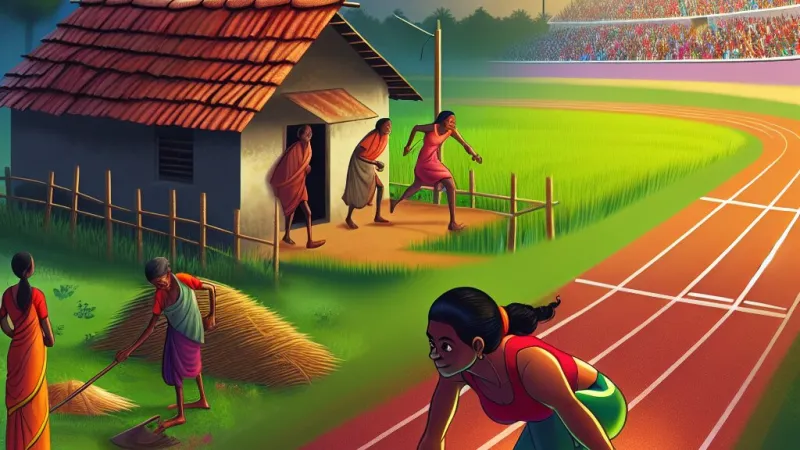
Hima Das was born on 9th January 2000 in Kandhulimari village, near Dhing town of Nagaon district in Assam. Growing up in a large family of rice farmers, Hima’s formative years were marked by hard work and limited means. Her father, Ranjit Das, and mother, Jonali Das, toiled daily in the fields, teaching her the values of discipline and perseverance. The culture of Assam, where sports is often an afterthought compared to cultural festivals like Bihu, offered little by way of infrastructure or encouragement for athletics. Yet, Hima’s energy found its first outlet in football, a favourite pastime in many parts of rural Assam. Playing barefoot with boys much older and stronger than herself, she displayed both stamina and uncanny speed.It was a perceptive school teacher, Shamsul Hoque, who first noticed her extraordinary running abilities. Recognising her potential, he encouraged Hima to take up athletics. The transition was neither easy nor smooth—sports shoes and tracksuits were luxuries her family could ill afford. The nearest proper playground was several kilometres away, and at times, the fields beside her home had to suffice. Despite these obstacles, the local community and school played a subtle but crucial role; informal competitions and moral support provided the first taste of sporting camaraderie and achievement to young Hima.
---
Athletic Career Beginnings
Hima’s early training began at the Nagaon Sports Association, where coaches like Nipon Das and Nabajit Malakar provided initial guidance. Her very first serious competition at the district-level meet saw her outpace older runners. These area-level victories brought her not only recognition but also the attention of those willing to guide her towards state and national platforms.Her regimen involved hours of practice, often before dawn and after dusk, squeezing training between schoolwork and household chores. Coaches observed not just speed, but a remarkable will to improve—she reportedly ran hundreds of laps with relentless enthusiasm. At the 2017 National Inter-State Championships, her impressive timings caught the eye of selectors and set the stage for her ascent. Hima’s family, despite facing their own struggles, stood solidly behind her decisions—her father even sold part of their land to support her budding career. Sponsorship was modest but gradually improved as word of her talent spread, and government recognition gave her access to better facilities at the Sports Authority of India camp. Her rise proved that, despite economic hardship, Indian sports talent can shine if given a sliver of support.
---
Major Achievements and International Recognition
The turning point in Hima Das’s career came in July 2018 at the IAAF World Under-20 Championships in Tampere, Finland. Running in the 400 metres final, amidst stiff global competition and cold European weather, she blazed past the finish line with a time of 51.46 seconds. This feat made her the first Indian athlete—male or female—to win a gold medal in a track event at a global international meet. The entire nation celebrated: newspapers from The Hindu to Assam Tribune splashed her image on their front pages, and social media buzzed with pride.Following her world under-20 gold, Hima’s career soared. At the 2018 Asian Games, she won silver in the 400 metres and gold in the 4x400 metres relay, clocking her personal best of 50.79 seconds. Her European training stint in 2019 became legendary, as she clinched five gold medals in international meets within 20 days in Poland and the Czech Republic. Her resilience repeated itself when she trained hard to come back from minor injuries, displaying admirable recovery and determination.
Hima’s achievements brought a torrent of honours: she was awarded the Arjuna Award, one of India’s most prestigious sports recognitions. Brands lined up for endorsements, with Adidas making her one of the faces of Indian sports, reflecting her mass appeal and positive image. She was named Youth Ambassador of UNICEF India and became an official ambassador of sports for Assam, showcasing both her reach and sense of responsibility towards younger aspirants. Her success drew admiration from icons such as Sachin Tendulkar and Mary Kom, as well as leaders like Prime Minister Narendra Modi, who acknowledged her as a symbol of new India.
---
Hima Das as a Role Model and Symbol of Women Empowerment
Hima’s journey is more than just a list of medals. Coming from a region often at the margins of Indian mainstream discourse, and being a woman in a country where female athletes face unique challenges, her success reverberates far deeper. She has become an icon for girls not just in Assam but across rural India, inspiring them to defy gender stereotypes and dream beyond traditional confines.Her positive attitude—often summed up in her smiling, grounded interviews—reflects humility and optimism. She has spoken out about the importance of girls’ education and sports participation, often encouraging the government and private sector to support female athletes. Her involvement in UNICEF demonstrates her commitment to social causes, while her public persona continues to motivate young athletes, especially from underprivileged backgrounds, to pursue excellence.
By spearheading a growing sports consciousness among young people in the Northeast, Hima has catalysed state governments and NGOs to invest more in grassroots sports development, especially for girls. Her very presence in a national-level conversation has begun to alter perceptions, giving hope to thousands of dreams still blossoming in forgotten villages.
---
Challenges and Hardships Overcome
The road to stardom for Hima Das was not lined with roses. Sporting infrastructure in Assam has historically lagged behind other states, and her early years were hampered by basic hurdles—lack of proper tracks, shoes, or diet. These material disadvantages were compounded by financial anxiety; balancing education with six-hour-long training routines demanded immense willpower.Hima’s quick rise brought public attention and expectations; she found herself coping with the double pressure of representing India abroad and passing her 12th board exams, which she did with dignity and calm. Injuries—an inevitable part of any sports career—tested her patience, but with expert rehabilitation and advice, she bounced back. Notably, amidst growing fame, she continued to avoid complacency and remained focused, her teammates often remarking on her unwavering concentration—even during media frenzies.
---
Future Prospects and Hopes
Now in her early twenties, Hima Das stands at a promising juncture. Having shifted focus to shorter sprints due to nagging injuries, she is rebuilding her form under experienced coaches. Much is expected from her at future Asian Games, Commonwealth Games, and possibly the Olympics. With youth on her side, she aims to break further records and bring global laurels to India.Beyond the track, Hima’s long-term dream is to mentor the next wave of athletes, and perhaps contribute to sports administration. She has spoken about the need to build better facilities in Assam and the North-East, hoping to give upcoming athletes what she once lacked. Her potential as a transformative figure for Indian athletics remains significant.
---
Lessons and Takeaways
Hima Das’s story offers plenty of insight for budding sports enthusiasts as well as policymakers. Her journey tells us that Indian talent abounds in every village and town, if we have systems to nurture it. Coupled with the inspiring fact that Hima balanced sports with education, her story reiterates the importance of holistic development. Consistent efforts, family and mentor support, and belief in one’s abilities can transform the ordinary into the extraordinary.For a society seeking inclusivity and eager to shine on the world stage, nurturing rural and female athletes like Hima is no longer a choice but a necessity. She exemplifies the new face of India—confident, hardworking, ambitious—and underscores the need for every stakeholder to come together to support the next Dhing Express.
---
Rate:
Log in to rate the work.
Log in