Dev Deepawali: Significance and Traditions of Varanasi's Divine Festival
This work has been verified by our teacher: 27.02.2026 at 15:02
Type of homework: Essay Writing
Added: 24.02.2026 at 14:54
Summary:
Explore Dev Deepawali’s significance and vibrant traditions in Varanasi, learning how this divine festival lights up the city and celebrates spirituality.
Paragraph on Dev Deepawali
Festivals in India are not just occasions for celebration; they reflect the country’s profound spiritual roots, vibrant traditions, and the seamless unity of mythology with daily life. Amidst the vast array of Indian festivals, Dev Deepawali holds a place of remarkable distinction, especially in the sacred city of Varanasi. Unlike the widely-known Diwali celebrated across India by lighting lamps to welcome Lord Rama home, Dev Deepawali, literally “The Diwali of the Gods,” is observed fifteen days later, on the auspicious Kartik Purnima—the full moon night of the month of Kartik according to the Hindu lunar calendar. The festival is celebrated in November when the cool northern air wraps riverbanks in a mystical veil, and the sky is bathed in silvery moonlight.Dev Deepawali is deeply entwined with ancient mythological beliefs. One prominent legend forms the heart of the celebration: it is said that on this day, after the spiritual dormancy of the four-month Chaturmas, Lord Vishnu wakes from his cosmic slumber. Moreover, Kartik Purnima is renowned in scriptures for marking the victory of Lord Shiva over the demon Tripurasura in Kashi—Varanasi’s timeless name. According to the Shiv Purana, Tripurasura had become a menace to the three worlds, and Lord Shiva, with his divine powers, vanquished the demon. The gods, filled with gratitude, celebrated on the banks of the Ganga, lighting countless diyas (oil lamps) to commemorate this triumph of good over evil. Dev Deepawali, therefore, acts as a symbolic bridge between the celestial and mortal realms. The ritual of lighting lamps signifies not only the end of darkness and ignorance but also the awakening of divine consciousness among human beings—an enduring motif echoed in Hindi literature and local folklore.
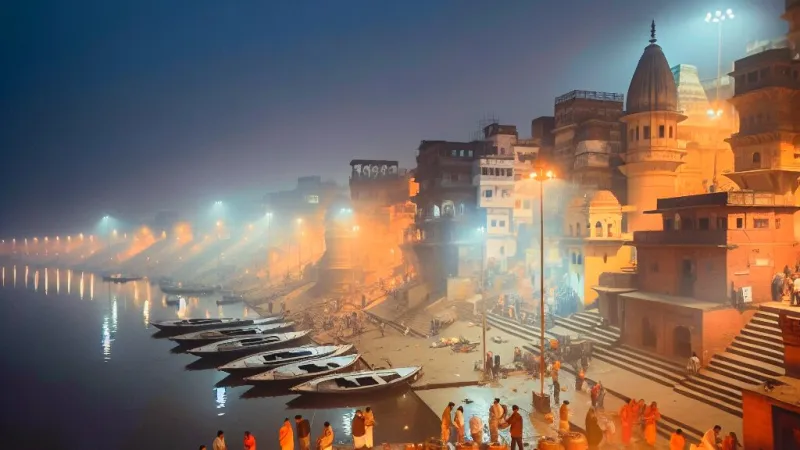
Perhaps what most sets Dev Deepawali apart is the grandeur and devotion displayed at the ghats of Varanasi. As dusk approaches, the entire city seems to hold its breath. On this singular night, the famed ghats—such as Dashashwamedh, Assi, and Rajghat—transform into a dazzling ocean of light. Hundreds of thousands of earthen lamps, mostly filled with mustard oil, are meticulously arranged by locals, pilgrims, and volunteers, illuminating every step and ledge along the riverbanks. The river Ganga, considered the holiest of rivers in Hinduism, mirrors the shimmering universe of lamps, creating the illusion of stars descending to earth. If one gazes from a boat on the river or wanders among the ghats, the spectacle feels transcendental—a blend of spirituality, art, and devotion. The tradition of using mustard oil is not arbitrary; it is rooted in environmental wisdom, as mustard oil emits a pleasant aroma and is naturally biodegradable, unlike synthetic diyas or wax candles.
Central to the celebration is the majestic Ganga Aarti performed by priests dressed in dazzling silk dhotis and shawls, accompanied by the rhythmic chanting of Vedic hymns, ringing bells, and the deep resounding conch shells. This collective worship is meant not just to honour the river as a living goddess but also to thank her for her boundless gifts. The aarti commences only after crowds of devotees take ritual dips in the cold water, believing that bathing on Kartik Purnima purifies the soul and washes away accumulated sins. Alongside, local musicians fill the air with bhajans and classical ragas, street vendors sell sweets like malaiyo and kachori, and children run about clasping sparklers—the city is alive with joy and spiritual fervour.
While Varanasi takes centre stage, Dev Deepawali is also celebrated with varying intensity in other sacred towns such as Haridwar, Rishikesh, Prayagraj, and Ayodhya. Each region tempers the festival to its local traditions, but the core rituals remain steadfast—decorating riverbanks with lamps, reciting prayers, and engaging the community in acts of devotion. The presence of tourists—both Indian and foreign—adds to the diversity, transforming the celebration into a festival of human unity alongside its divine theme. For instance, in Haridwar, devotees throng the ghats with their families, singing aartis and releasing small boats made of banana leaves with lamp offerings onto the Ganga, signifying the flow of aspirations and prayers towards heaven.
The festival’s timing is spiritually significant, as Kartik is considered the holiest month in much of Indian tradition. Several important religious events precede Dev Deepawali, such as Dev Uthani Ekadashi, further enhancing the aura of sacredness. For Jains, this period commemorates Lord Mahavira’s attainment of nirvana, while for Buddhists, it recalls King Ashoka’s conversion to Buddhism. Such overlapping associations exemplify India’s plural spiritual fabric, where one day carries manifold meanings and attracts varied communities.
Crucially, Dev Deepawali has become a platform for environmental consciousness amidst festivity. In recent years, community groups and municipal bodies have launched campaigns for plastic-free ghats and sustainable decorations. Volunteers gather to clean up after the celebrations so that the river remains unpolluted—a responsibility stressed in ancient texts as well. There is a conscious shift towards organic lamps, natural flowers, and biodegradable materials, underlining that reverence for nature is central to Hindu worship. This stewardship also echoes the Upanishadic verse “Tamaso mā jyotir gamaya”—“Lead me from darkness to light”—where enlightenment is holistic, covering both the spiritual and ecological.
At the societal level, Dev Deepawali becomes a vibrant tapestry where faith, art, history, and local economy meet. It sustains many traditional artisans who craft intricate earthen lamps, floral garlands, and ceremonial flags. The festival also provides opportunities for local musicians, folk artists, and boatmen. The entire city of Varanasi is drawn into a communal act, showing how Indian festivals help retain the bonds of social harmony and mutual support. Schoolchildren, guided by parents and teachers, take part in processions, lamp arrangements, and cultural programmes, allowing living traditions to pass from generation to generation. Such engagements bear immense educational value, encouraging young minds to probe the layers of meaning behind rituals, connecting them to history, art, and ecology instead of mere outward celebration.
Dev Deepawali also boosts cultural and religious tourism. Images of the lamp-lit ghats and floating diyas have become iconic in media coverage, inspiring documentaries and travelogues. Visitors from Mumbai, Chennai, Kolkata and even from abroad, flock to the city for this special night, eager to experience the mystical aura immortalised in the poems of Kabir and the travelogues of Banaras’s chroniclers. According to many locals, the festival is a medium to foster a sense of pride in the rich and unique heritage of India’s spiritual capital.
In the end, the significance of Dev Deepawali cannot be confined merely to the spectacle of lights or the ancient myths it celebrates; it is a dynamic expression of India’s enduring wisdom. It stands as a reminder that faith and festivities can coexist with environmental stewardship, communal cooperation, and the continual re-interpretation of tradition. In today’s fast-changing world, festivals like Dev Deepawali offer an anchor to our roots, a luminous proof that amidst modernity, India has not lost sight of its timeless soul. As the ghats of Varanasi glow under millions of lights and the river Ganga sparkles in renewed purity, one realises that the festival’s greatest gift is its power to unite, uplift, and illuminate—not only the night, but the hearts of all who witness it.
Rate:
Log in to rate the work.
Log in