Top 10 Lines on Ox: Role and Importance in Indian Agriculture
This work has been verified by our teacher: 29.03.2026 at 16:01
Type of homework: Essay Writing
Added: 27.03.2026 at 11:00
Summary:
Discover the top 10 lines on ox, highlighting its vital role and importance in Indian agriculture to enhance your homework and essay writing skills.
The Ox: An Essential Companion in Indian Agriculture and Rural Life
It is impossible to imagine the landscape of rural India without the gentle, enduring presence of the ox. For countless generations, this humble animal has accompanied farmers at dawn, helped feed entire villages, and become woven into the traditions and economy of the country. An ox, sometimes called a bullock in Indian English, is a male cattle, usually castrated, strong and sturdy, trained carefully from its early years to assist with heavy farm work. Learning about the ox is not just about knowing another domestic animal—it's about understanding a vital thread in India's agricultural past and present. It is through the lens of the ox that we can better appreciate the resilience of rural communities and the unique harmony between humans and animals that underpins our culture. In this essay, we will discuss the physical characteristics, habits, uses, cultural and economic significance, and the present-day challenges faced by the ox, all in the context of Indian society.
---
Physical Characteristics of the Ox
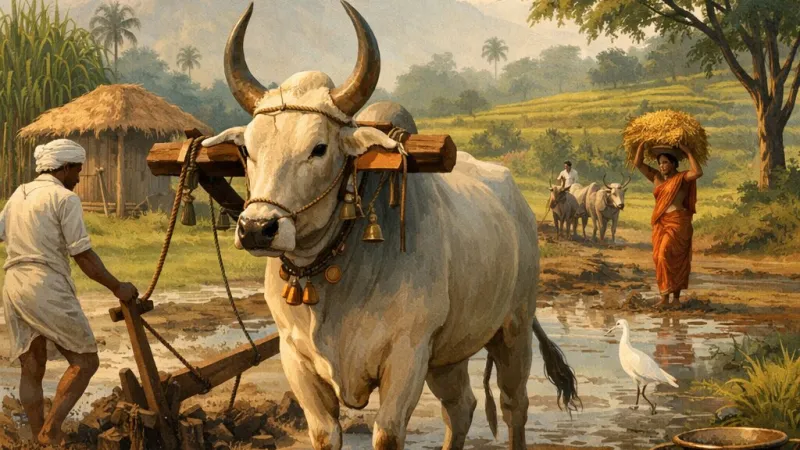
The ox is easily recognised by its robust and muscular frame, well-suited to the challenges of Indian farms. Standing on four powerful legs, each tipped with a hard hoof, an ox can walk for hours over fields, rough tracks, and through muddy paddy lands. The size and shape of the ox can differ by breed—Indian oxen, such as those from the Ongole or Kankrej breeds, often sport a prominent hump on their back, which is a distinguishing feature of zebu cattle. This hump contains muscle and fat reserves, supporting the animal’s strength for days of work under the sun.One can observe the ox's two curved horns, which may be long and sweeping or short and thick depending on the region and lineage. The horns provide not only a striking appearance but are also a means of self-defence and, in some regions, markers of ceremonial importance. The ox’s coarse, short hair helps to regulate its temperature through the heat of Indian summers and the chill of northern winters. A long, flexible tail, constantly in motion, helps to swat away flies and other insects, offering a small respite from pests during grazing or labour.
From calf to full-grown adult, an ox takes around three to four years to mature. If cared for well, they can live up to fifteen years, spending the majority of their lives as working companions to rural families. The durability of the ox is key; its entire physique is built for continuous, sustained effort, rather than brief spurts of speed.
---
Habitat and Behaviour
The ox is not a wild animal; it thrives in the company of humans. In Indian villages, oxen are housed in cattle sheds, simple but sturdy structures usually adjacent to farmers’ homes. These sheds are designed to protect the animals from harsh weather—be it the monsoon's pounding rains, the searing summer heat, or the chilly winds of winter.The ox’s diet is entirely plant-based. Commonly, it grazes on natural grass in nearby pastures for several hours a day, ensuring a supply of green fodder rich in nutrients. During dry seasons or when green fodder is scarce, they are fed with dry paddy straw, hay, or cattle feed made from oil cakes and grain mixtures. In many households, kitchen scraps like vegetable peelings or left-over chapatis are also lovingly provided. This flexibility in diet means the ox is economical to keep for the small farmer.
In temperament, the ox is renowned for its calmness and willingness to learn. Unlike many large animals, oxen rarely display aggression, making them ideal as working animals for farmers of all ages. Training begins early in a calf’s life, and by adulthood, the ox esteems its handler, responding to verbal commands or simple signals—a relationship of mutual trust that stands at the heart of rural life.
---
Uses and Economic Importance
For millennia, the ox has been the backbone of Indian agriculture. In an age where powerful tractors have begun to appear in wealthier farms, millions of small landholders still rely on their oxen for daily work. The most visible use is in ploughing: a pair of oxen, fitted with a wooden or iron plough, toil up and down the field, turning the earth in preparation for sowing seeds. This ancient partnership between man and beast is still considered the lifeblood of the kharif and rabi seasons in many regions.Beyond the plough, oxen are indispensable for threshing—the process by which harvested crops such as wheat or paddy are separated from their stalks. In villages from Maharashtra to Odisha, oxen circle around a wooden pole, trampling harvested sheaves to free the grain. Ox carts, or “bullock carts,” remain a symbol of rural India and continue to ferry harvests, building materials, firewood, and even people on narrow dirt roads where no motor vehicle can pass.
Oxen also power water-wheels and traditional irrigation equipment, such as the Persian wheel or ‘rahat’ in older villages. Their slow, steady strength, considered more reliable in many cases than an electric pump, is essential in water-scarce areas.
The contribution of the ox does not end with labour. After its working life, the skin is processed into durable leather, widely used in footwear, belts, and bags—industries that sustain craftspeople in places like Kanpur and Kolkata. The horns are carved into buttons or decorative items, while bones, though less commonly now, have been used in traditional medicines. While beef is not commonly consumed due to religious and cultural sensibilities, in some communities, the ox’s entire life and body remain a source of utility and respect.
---
Cultural and Historical Significance
No description of the ox in India is complete without reference to its deep-rooted cultural symbolism. In Hindu mythology, Nandi, the sacred bull, is considered the vehicle of Lord Shiva, and sculptures of Nandi adorn the entrances of innumerable temples across South India. During the harvest festivals of Pongal in Tamil Nadu and Makar Sankranti in Maharashtra and Karnataka, oxen are bathed, decorated with bright fabrics and ornaments, and worshipped for their role in ensuring a good yield.History tells us that oxen have been domesticated in the Indian subcontinent since the Indus Valley Civilisation. Paintings and seals from Harappa depict humped zebu bulls, a testament to the animal’s longstanding bond with humans. Even today, folkloric proverbs abound—“Gai hamari mata hai, bakri paltu bhai; bail hamara sahara hai, kheti ka yeh bhagwan” (The cow is our mother, the goat our companion, the oxen our support—the god of our fields).
Every region takes pride in its native breeds—Hallikar in Karnataka, Gir in Gujarat, and Khillar in Maharashtra—each adapted to local terrain, climate, and tasks, further highlighting the animal's prominence in regional identity.
---
Modern Relevance and Challenges
In the present scenario, while many farms have shifted to tractors and harvesters, there are compelling reasons why oxen continue to be relevant. For small and marginal farmers, oxen are affordable, require minimal maintenance compared to machines, and can access terrains too difficult for vehicles. Furthermore, ox-driven agriculture is more eco-friendly, producing neither noise nor pollution, and ensures soil health by avoiding the compaction caused by heavy machinery.Yet, this age-old ally is facing modern challenges. With mechanisation and increasing urbanisation, the number of working oxen is declining. Many farmers find it difficult to provide proper veterinary care, leading to diseases or injuries going untreated. There are ongoing debates regarding animal welfare—overwork without rest, lack of nutritious food, or exposure to harsh weather.
Addressing these issues will require multiple approaches: spreading awareness of humane treatment, ensuring regular veterinary visits, and government support for preserving indigenous breeds. Celebrating cattle festivals and involving school children in animal care campaigns can foster empathy and keep alive the traditional respect for the ox.
---
Conclusion
The ox, with its mighty frame and patient spirit, remains more than just a draught animal for Indian farmers—it is a silent partner in the age-old quest for food and prosperity. Our exploration has shown how their anatomy, habits, and adaptability make them irreplaceable, while their economic contribution and cultural imprint shape the everyday lives and festivals of rural India. As we move towards rapid modernisation, it is vital not to lose sight of the ox’s role in connecting us to our heritage and reminding us of the values of patience, strength, and coexistence that it symbolises. Each of us, especially students, should recognise and respect the ox not just as a beast of burden, but as a stalwart companion whose story is entwined with our own.In my view, as India's future rests equally in the hands of science and the wisdom of tradition, remembering and caring for the ox is not just sentiment but a responsibility towards both our roots and sustainability.
Rate:
Log in to rate the work.
Log in