How to Introduce Yourself Confidently in a Librarian Job Interview
This work has been verified by our teacher: 31.03.2026 at 17:55
Type of homework: Essay Writing
Added: 28.03.2026 at 6:24
Summary:
Master how to introduce yourself confidently in a librarian job interview. Learn tips to highlight skills, experience, and passion for libraries in India. 📚
Self Introduction for Job Interview for Librarian
A job interview is not just an assessment of academic qualifications or professional experience—it is, at its heart, a conversation where a candidate’s personality, values, and intentions come to the fore. Nowhere is this more vital than in the field of librarianship in India, a profession that stands at the confluence of tradition and technology. With educational reforms, digitisation of resources, and increased emphasis on user-centric services, the modern librarian is not a mere custodian of books but a facilitator of knowledge. Hence, delivering an impactful self-introduction during a librarian job interview is often the first and most essential step in communicating one’s suitability for such a multifaceted role. In this essay, I will explore why self-introduction matters for aspiring librarians in India, outline effective approaches to structuring your introduction, and discuss ways to customise your pitch for different librarian positions.
---
Understanding the Role of a Librarian
To introduce oneself effectively, it is crucial first to understand the diverse spectrum of the librarian’s responsibilities in the Indian context. Traditionally, librarians were seen as "guardians of the granthas" (books) in temples, gurukuls, or universities like Nalanda. Today, the image has transformed. The role encompasses managing vast collections that include not just printed books and periodicals but also multimedia resources, digital archives, and online reference platforms.In various settings—schools, colleges, universities, public libraries, or specialised research centers—librarians help users discover information efficiently. This means guiding a young child towards Amar Chitra Katha for a project, assisting a researcher in finding the latest journal through INFLIBNET, or helping a community member navigate online government portals. Organisation, curation, cataloguing using modern software like Koha or Libsys, preservation, reference service, and sometimes event planning (such as ‘Book Week’ celebrations or author meets) all fall under a librarian's responsibilities.
Furthermore, soft skills such as patience, clear communication, and adaptability have become non-negotiable. As institutions embrace e-resources and digital catalogues, technical proficiency goes hand in hand with an eagerness to stay updated about evolving trends in information science. In short, when facing an interview panel—often comprising principals, heads of departments, or administrative officers—candidates are expected to articulate not only their resume but their passion for information services and libraries as community-centric spaces.
---
Preparing Your Self-Introduction: Key Elements
1. Greeting and Personal Introduction
An Indian interview panel values decorum and respect. Thus, a graceful “Good Morning, Sir/Madam” sets a positive tone. Clearly state your full name and mention your city or hometown—this fosters familiarity and grounds your identity.2. Educational Background
Education forms the backbone of your professional claim. Mention your highest relevant qualification, such as a Bachelor’s or Master’s in Library and Information Science (BLIS/MLIS), which many recognised universities in India like IGNOU, Delhi University, or Banaras Hindu University offer. You may also highlight any certifications—such as digital libraries from NISCAIR or short courses on information management—that set you apart.3. Professional Experience
Work experience should be summarised with clarity and relevance. State how many years you have worked, your current/previous roles, and the nature of the institution—was it an ICSE/CBSE school, an autonomous college, or a government public library? Highlight distinctive responsibilities: Did you supervise library assistants? Conduct orientation sessions for first-year students? Implement barcoding or RFID? Such details connect your experience to the job at hand.4. Skills and Strengths
Demonstrate both your technical and soft skills. Familiarity with management systems like Libsys, Koha, or EGranthalaya is often expected. Equally vital is multitasking, teamwork (especially in busy or resource-constrained environments), and communication—such as explaining online catalogue searches to users in regional languages if needed. Share examples if possible.5. Passion and Motivation
What drives you as a librarian? Is it your love for books, your satisfaction in seeing students become lifelong readers, or your belief that libraries can bridge the digital divide? A personal note—such as how volunteering at a community library or organising a reading drive shaped your outlook—leaves a lasting impression.6. Alignment with the Organisation
Employers want to know “why here?” Research the institution: Does it focus on STEM education? Is it a heritage library? Cite your knowledge of their vision and how your skills align. For example—“Your college’s recent initiative on digital resources interests me, and I am eager to contribute to its successful implementation.”7. Closing Statement
End with a polite expression of gratitude—“Thank you for this opportunity,” reinforced with your enthusiasm to contribute further.---
Structuring the Introduction
A logically sequenced self-introduction is easier for the panel to follow and reflects on your organisational skills.- Begin with greeting and personal information. - Move to educational background and relevant certifications. - Then, detail your professional journey, focusing on roles and major achievements. - Describe your skills and strengths with relevant examples. - State your motivational drive and career alignment with the particular institution. - End with a thank-you and an affirmation of your interest.
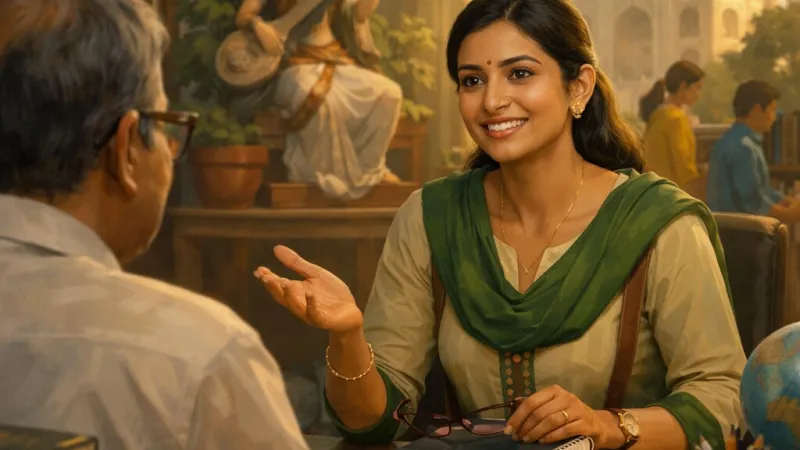
In an in-person interview, the introduction should take about one or two minutes. Maintain eye contact, speak clearly, avoid running sentences, and smile gently. In Indian settings, it is better to err on the side of formality than being casual—the difference between saying “I handled library records” and “I took responsibility for maintaining accurate library records using Koha software” can be striking.
---
Customising the Self-Introduction for Different Librarian Positions
School Librarian
Here, focus on experience with children—the ability to make reading enjoyable through storytelling sessions, knowledge of children’s literature like Panchatantra or Sudha Murthy’s works, and collaboration with teachers for subject-related resources. Mention if you have run literary clubs or summer reading programmes.College/University Librarian
For these roles, highlight your familiarity with academic databases such as INFLIBNET, Shodhganga, JSTOR, or handling referencing tools like Zotero, EndNote, or Mendeley. Emphasise supporting students’ research projects, training them in using e-resources, or assisting faculty with sourcing research material. Experience in managing large academic collections or guiding users on plagiarism and citation tools can be highlighted.Public/Community Libraries
Emphasise experience working with diverse age groups and backgrounds. Community library work in India often involves promoting literacy among adults or weaker sections, hosting workshops (like digital literacy for senior citizens), and outreach initiatives on national festivals or book fairs.Senior or Managerial Roles
If the position is for Chief Librarian or Library-In-Charge, discuss leadership—team supervision, budget planning, space reorganisation, policy development, digitisation drives, or implementing QR code systems. Narrate examples where you led change or solved chronic operational bottlenecks.---
Tips to Enhance Impact
- Anecdotes: Briefly share an incident—such as helping a visually-impaired student gain access to braille resources—that illustrates your commitment. - Use Numbers: “Managed a catalogue of 25,000 volumes” or “Trained 120 students in digital research methods.” - Authenticity: Avoid exaggerated claims; sincerity resonates more. - Practice: Rehearse your introduction multiple times, possibly with a colleague or in front of a mirror, to fine-tune flow and confidence. - Prepare for Deeper Questions: If you mention digital library experience, be ready to answer specifics—like “How does Koha’s OPAC benefit users?” - Body Language: Maintain open posture and pleasant demeanour.---
Common Mistakes to Avoid
- Skipping the greeting or jumping into content abruptly. - Making the introduction too lengthy, unfocused, or cluttered with technical jargon unfamiliar to all panelists. - Ignoring the specific requirements of the job or not showing knowledge about the employer. - Sounding too memorised or rehearsed, which may feel inauthentic. - Forgetting to mention motivation and alignment with the job's purpose.---
Sample Framework for Self-Introduction
Here is a practical template, customisable to the specific role:> Good Morning, Sir/Madam. My name is Lakshmi Srinivasan and I am from Chennai. > I hold a Master’s in Library and Information Science from Madras University and a diploma in Digital Library Management from Anna University. > I have worked for over five years as a librarian at Sriram Matriculation Higher Secondary School, where I managed an active collection of 13,000 books, supported curriculum enrichment programmes, and introduced e-book access for senior students. > I am well-versed in Koha and Libsys, and enjoy training both students and teachers in utilising digital resources for project-based learning. > What motivates me most is seeing students develop a genuine love for reading and learning, and being able to facilitate that journey. I am particularly inspired by your institution’s recent efforts in digital transformation, and I look forward to contributing with my experience. > Thank you for your time and consideration.
---
Rate:
Log in to rate the work.
Log in