MCQ Guide for The Snake and the Mirror – NCERT Class 9 English Chapter 5
This work has been verified by our teacher: 10.04.2026 at 11:24
Type of homework: Essay Writing
Added: 8.04.2026 at 13:01
Summary:
Master MCQs from The Snake and the Mirror – NCERT Class 9 English Chapter 5 with clear summaries, themes, and exam tips for confident learning. 🐍
A Deeper Look: Mastering MCQs from “The Snake and the Mirror” — NCERT Class 9 English Chapter 5
Introduction
“The Snake and the Mirror” is a beloved short story included in the NCERT Class 9 English textbook. Authored by the celebrated Malayalam writer Vaikom Muhammad Basheer and translated into English, this chapter is both humorous and thoughtful. It tells the tale of an ordinary doctor’s extraordinary encounter with a snake, mixing suspense with gentle self-mockery. As students, we know that Multiple Choice Questions (MCQs) are now a compulsory segment of the English exam paper. In particular, MCQs relating to core NCERT texts check whether we have grasped both details and deeper meanings. This essay aims to be a comprehensive guide for Class 9 students: providing not only practice topics for MCQs but also insight into the story’s background, themes, exam strategies, and challenges one might face.Contextual Background of “The Snake and the Mirror”
About the Author: Vaikom Muhammad Basheer
Basheer was a literary giant in Malayalam literature. Born in Kerala, he lived through the era of independence, struggling as a writer and social activist. His style is known for its simplicity, everyday humour, and the knack for turning ordinary incidents into memorable anecdotes. While his protagonists are often unnamed, they are relatable—common people dealing with common concerns, yet painted with such irony and affection that the stories become unforgettable. Humour is Basheer’s signature: he mocks himself and his characters, making readers laugh at the absurdities of life without being harsh.Summary of the Story
The narrative is set in the modest and untidy rented room of an unnamed doctor. The atmosphere is alive with little details: bare walls, no ceiling fan, and the sound of scampering rats. The story unfolds one night as the doctor, basking in his own reflection in the mirror, is suddenly visited by a snake that coils itself on his arm. What follows is a sequence of terror and comic introspection, climaxing in the snake’s unexpected shift of attention towards its own reflection in the mirror. This story is an example of how fear and vanity can interplay in unexpected situations.Importance of MCQs in Language Learning and Examination
The Value of MCQs
For students across India, MCQs have become indispensable in assessing factual knowledge as well as understanding. In language studies, especially, they test our ability to recall plot points, interpret characters, and infer the author’s intentions quickly and accurately. They push students not just to memorise, but to comprehend and apply knowledge.MCQs in the CBSE Exam Pattern
The CBSE Class 9 English paper now gives MCQs significant weightage, especially in Section B and C (Reading and Literature). MCQs from NCERT chapters—like “The Snake and the Mirror”—often test key details and deeper meanings. This format helps students sharpen decision-making and analytical skills—a crucial ability not just for exams but for lifelong learning.Practising MCQs: Enhancing Comprehension
Regular practice of MCQs improves our attentiveness to details and our ability to connect events and messages in the story. Unlike long-answer questions, MCQs demand quick recall and clarity, pushing students to revise thoroughly.Thematic Breakdown for Formulating MCQs
Setting and Environment
Basheer’s description of the doctor’s quarters is vivid: a rented, kachcha house with rats for company, and not a fan in sight. Questions might revolve around why the setting matters, what the “meagre” surroundings indicate, and how the sounds and silence foreshadow the surprise to come.Character Analysis
The doctor's preoccupation with his looks—admiring his reflection, pondering his moustache, and plotting his future—lends itself to MCQs about personality. Did vanity become his undoing? Or was it just the innocence of youth? His thoughts during the snake encounter also provide material for exploring psychological depth in MCQs.Symbolism and Key Motifs
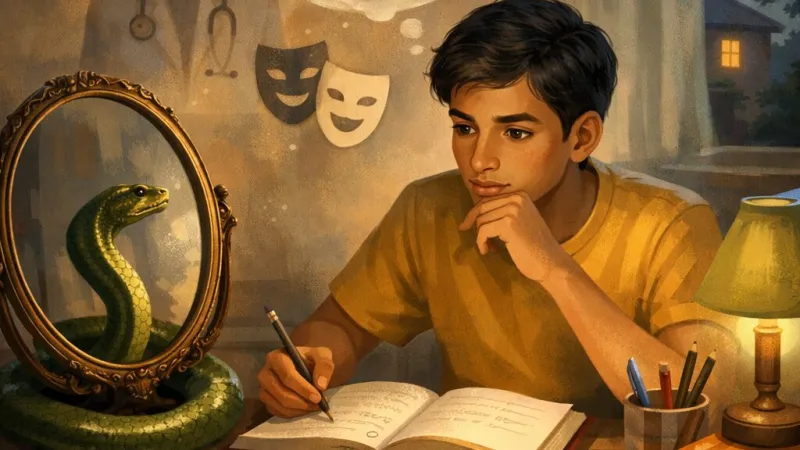
The mirror represents not just self-absorption, but self-realisation. The snake, unpredictable and dangerous, symbolises life’s sudden twists. Even the rats mirror the doctor's isolation and vulnerability. MCQs may draw on these motifs to gauge interpretative abilities.Narrative Style and Humour
Basheer’s use of irony—such as the doctor’s fanciful daydreams shattered by harsh reality—makes the story delightful. Many MCQs may ask about the effect of humour or the narrative’s first-person style for reader engagement.Creating Effective MCQs: Topics and Focus Areas
Literal Comprehension
- What was the condition of the doctor’s house? - Where did the snake coil itself? - Which sounds disturbed the doctor before the incident?Vocabulary-Based MCQs
- What does “meagre” describe in the story? - Find a synonym for “idleness” in the context used.Analytical and Inferential
- Why does the doctor feel both foolish and lucky after the incident? - What realisation does he arrive at in front of the mirror?Application and Moral Reasoning
- What lesson does the story teach about overconfidence or vanity? - How does the story reflect Indian middle-class values and anxieties?Visual and Audio Comprehension
- If students watch a video adaptation, they might be asked: What expressions does the actor show when the snake appears? - Identify background sound details that built suspense.Multiple Correct Answer Types
- Which of the following statements is/are true about the setting/unfolding of the main event? - Strategies include reading all options, eliminating the obviously wrong ones, and isolating subtle clues from the text.Sample MCQ Topics and Explanations
1. The Doctor’s Living Conditions: MCQ Example: Where did the doctor live? (a) In his own house (b) In a rented kachcha house (c) In his clinic (d) At a friend’s place. *Explanation:* The rented kachcha house is central to the story’s mood—one of insecurity and humility.2. Income and Routine: MCQ Example: Why is the doctor’s income described as “meagre”? *Explanation:* This underlines his status as a struggling, young professional, establishing empathy and realism.
3. Sensory Experiences: MCQ Example: What made the doctor aware of something unusual before the snake appeared? *Explanation:* The sudden silence after constant rat scuttling signals danger, invoking tense anticipation.
4. Character Decisions and Traits: MCQ Example: What plan did the doctor make looking at the mirror? *Explanation:* Thinking about growing a moustache and marrying a rich, fat, and qualified doctor—displaying youthful dreams and foolhardy confidence.
5. Symbolism: MCQ Example: Why does the snake turn towards the mirror? *Explanation:* Just as the doctor is caught up in self-admiration, so too is the snake, suggesting universal vanity.
Tips for Students Preparing for MCQs in “The Snake and the Mirror”
- Read the Text Thoroughly: Pay close attention to the details of the setting, character’s thoughts, and scene descriptions. - Build Vocabulary: Maintain a list of unfamiliar words; try to use them in sentences. - Practice Regularly: Attempt MCQ quizzes from guidebooks, online platforms like myCBSEguide, or classroom practice sheets. - Use Multimedia: Watch Hindi or Malayalam video lessons with subtitles for diverse perspectives. - Manage Time Effectively: During practice and exams, give yourself fixed limits for each MCQ item. - Eliminate Incorrect Options: Narrow down choices by linking options directly to paragraphs in the text. - Revise Frequently: Make summary tables and mind-maps of character traits and plot.Challenges Faced and Strategies to Overcome
- Confusing Options: Read every option carefully, underline keywords, and double-check the answer. - Interpreting Symbolic Language: Discuss metaphors and symbolism in peer groups or with teachers for clarity. - Vocabulary Difficulties: Maintain a glossary specifically for this chapter and revisit it daily. - Access to Past Papers: Solve MCQ questions from past years to understand frequently tested areas.Conclusion
Mastering MCQs based on “The Snake and the Mirror” is not just about scoring well, but also about grasping the richness of Indian short story tradition. Engaging with Basheer’s humorous yet insightful storytelling expands both our minds and our emotional intelligence. Regular reading, revision, and smart strategies will ensure you are well-equipped for exams and can truly enjoy literature’s subtle beauties. Ultimately, such stories subtly teach us life lessons—humility, courage, and the ability to laugh at ourselves while facing life’s unpredictable twists.Annexure
Sample MCQ Template for Practice
1. Where did the dangerous encounter occur? (a) At the clinic (b) In the doctor’s bedroom (c) On the verandah (d) At the neighbour’s house2. What does the mirror symbolise in the story? (a) Vanity (b) Wisdom (c) Fear (d) Skill
Glossary
- Meagre: Very little, insufficient - Kachcha: Temporary or unfinished (as in a house) - Idleness: State of doing nothing, inactivity - Introspection: Looking into one’s own mind and thoughtsRecommended Resources
- NCERT English Textbook (Beehive) - myCBSEguide App/Website - Diksha Platform Videos - School teacher explanations and YouTube revision clips---
By following this study guide and making MCQ practice a habit, students can excel in both exam performance and literary appreciation—an outcome that forms the true purpose of studying “The Snake and the Mirror.”
Rate:
Log in to rate the work.
Log in