In-Depth Analysis and Summary of The Snake and the Mirror for Class 9
This work has been verified by our teacher: 11.04.2026 at 11:40
Type of homework: Essay Writing
Added: 10.04.2026 at 11:01
Summary:
Explore an in-depth analysis and summary of The Snake and the Mirror for Class 9 students to understand themes, characters, and literary style clearly.
A Comprehensive Analysis of *The Snake and the Mirror* by Vaikom Muhammad Basheer: For Class 9 Students
*The Snake and the Mirror* is a short story that has found a beloved place in the Class 9 English curriculum of schools across India. This tale is a humorous yet profound narrative written by Vaikom Muhammad Basheer, one of the most renowned figures in Malayalam literature. The story, originally penned in Malayalam and later translated into English, weaves together wit, irony, and introspection, making it both entertaining and deeply meaningful.
Basheer’s tales often derive their charm from everyday life and simple characters, reflecting subtle wisdom hidden within mundane situations. In *The Snake and the Mirror*, he uses the device of a frame narrative, where the main character recounts his own experience to an eager audience of friends, creating both intimacy and suspense. The title itself is layered with symbolism: the snake signifies sudden, primal fear, while the mirror becomes a motif for vanity and self-realisation.
This essay aims to unravel the narrative, examine its themes, analyse Basheer’s unique literary style, and clarify key vocabulary from the story for better understanding, while also offering insights relevant to young readers in India.
---
Setting and Context
The story takes place in a modest, rather shabby rented room that belongs to the narrator—a homeopathic doctor who has just begun his medical practice and is yet to experience professional or financial stability.The room, described as an outhouse, is basic and uncomfortably warm. The absence of electricity forces the doctor to rely on a kerosene lamp for light, and the tiled roof, supported by gables, lets in the faintest reminders of rural Kerala’s rustic architecture. The constant scurrying of rats adds an element of unease and hints at the unhygienic and challenging living conditions faced by many young professionals in India’s smaller towns—a reality familiar to many readers, whether one lives in the Kerala backwaters or the outskirts of a growing city like Nashik or Bhubaneswar.
This setting, simple yet oppressive, creates a mood that is both mundane and tense. The doctor’s isolation becomes pronounced, magnifying the vulnerability that is later exploited when the snake appears. A plain table in the room holds a mirror, comb, and a few books—ordinary items, but in Basheer’s hands, these become symbols and plot devices that drive the narrative.
---
Plot Summary
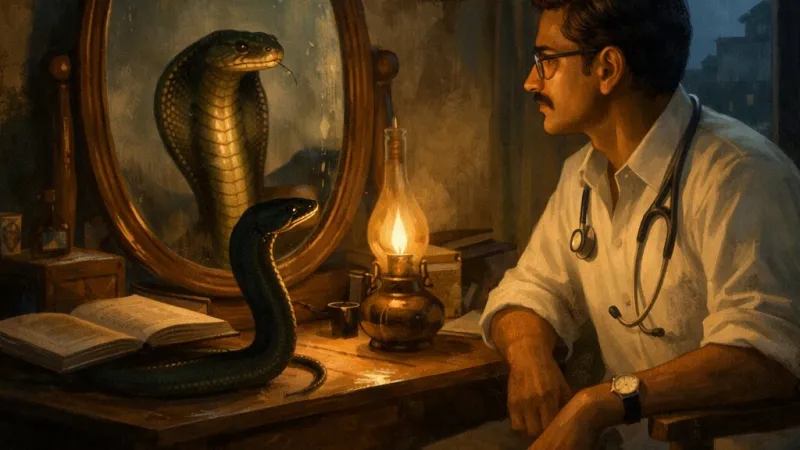
The story unfolds as the doctor narrates an unforgettable night from his youth. Having just finished his dinner at a nearby restaurant, he returns to his room after a long summer day. Tired and seeking comfort, he lights his kerosene lamp, undresses, and sits before the mirror.The doctor’s early interactions with the mirror are light-hearted and almost comical. He admires his youthful face, runs his fingers through his hair, and thinks about his prospects. He is unmarried and dreams of marrying a wealthy woman doctor, ideally someone who is not only rich but also overweight—so that, in his own words, she wouldn’t be able to run after him and catch him if he ever made a mistake. This dream sequence reflects his hidden insecurities, as well as an amusing arrogance.
Suddenly, the mood shifts. The familiar background noises—rustling rats—vanish, replaced by an uneasy silence. In that stillness, something soft and cold falls on his shoulder. Looking up through the mirror’s reflection, the doctor is horrified to see a large cobra slithering onto him, coiling itself around his arm, with its hood raised and tongue flicking—mere inches from his face.
The doctor is paralysed, frozen by fear. His mind races, pondering over the medicines on the shelf and praying for deliverance. He realises, in that instant, the fragility of human existence—his earlier vanity and pride mean nothing before death. He turns to God, reflecting on his arrogance and pleading for another chance.
Then, in an almost magical turn, the snake drops its gaze and becomes absorbed in its own reflection in the mirror. The deadly reptile flickers between threatening the doctor and being entranced by its twin in the glass. Seizing the opportunity, the doctor slips away without harm.
The story takes one final ironic twist—returning the next morning with his friends, the doctor finds his room ransacked by a thief. Everything of value is gone except for one dirty vest, which even the thief does not consider worthwhile. The loss of material possessions, juxtaposed with the blessing of survival, completes the story’s circle with both irony and wisdom.
---
Character Analysis
The Doctor
At the centre of the story is the homeopathic doctor—a figure who oscillates between pride and helplessness. In the opening, he relishes small pleasures, views himself with affection and a touch of narcissism, and weaves grand plans for his future. These traits make him relatable: many young people, especially those starting careers, dream of success and self-importance.Basheer skillfully exposes the doctor’s vulnerabilities, however, as fear strips away all illusions of control. When threatened by the snake, his knowledge and bravado collapse. He is simply a human being—alone, frightened, and humbled. This transformation from pride to humility is what gives the story its emotional depth.
As a narrator, the doctor is candid, humorous, and able to laugh at himself—turning a harrowing experience into a tale that is at once cautionary and entertaining.
The Snake
The cobra is both a symbol of fear and an unpredictable force of nature. Its entrance disrupts the doctor’s routine, introducing the possibility of instant death and underscoring human vulnerability. Interestingly, the snake’s fascination with the mirror—seemingly admiring its own image—serves to parallel the doctor’s earlier vanity. The snake, in its distraction, becomes the agent of the doctor’s escape, highlighting the unpredictable mercy of fate.Minor Characters
The thief, though unseen, is integral to the lesson at the end. The theft is the story’s final irony—a reminder that possessions are transient, and the true value lies in surviving life’s tests with newfound wisdom.---
Themes and Messages
Pride and Humility
At its heart, *The Snake and the Mirror* is about how vanity blinds us to real dangers. The doctor’s preoccupation with his image and daydreams soon crumbles, replaced by humility when faced with the snake. This mirrors the moral teachings often found in Indian culture and proverbs—for instance, Kabir’s couplet: “Bada hua to kya hua, jaise ped khajoor” ("What is the use of growing big like a palm tree?") reminding us of the futility of pride.Human Vulnerability and Mortality
The doctor’s helplessness, despite his medical training, underscores a universal truth: human beings are, after all, fragile and mortal. This reminder is relevant in India, where stories of saints and ordinary individuals alike caution against arrogance before the vastness of fate or the divine.The Illusion of Control
The story’s humour arises from the doctor’s conviction that he can plan his life. Yet, a single, unforeseen event changes everything—a lesson for students who often believe that grades, money, or status guarantee security. In real life, circumstances can transform in the blink of an eye.Perception and Reality
The mirror symbolises self-image, illusion, and sometimes, self-deception. Both the doctor and the snake are momentarily spellbound by their reflections, missing the dangers around them.Divine Intervention or Fate
The doctor’s realisation, his prayer to God, and his subsequent escape show the Indian belief in destiny and divine will—a theme that recurs in classical literature and spiritual teachings from the Gita to stories from Panchatantra.Material Possessions and True Worth
Finally, the story mocks materialism. The loss of all but the filthy vest, an item even the thief does not want, underscores the true value of life over possessions.---
Literary Devices and Style
Basheer’s style is conversational and engaging. The device of “a story within a story” draws the reader in, as if part of the circle listening to the narrator. Imagery—like the oppressive heat, the silence, the eerie sight of the snake—is vivid, putting the reader right in the scene.Symbols are used skilfully: the mirror for self-reflection and delusion, the snake for unexpected danger, the vest for poverty and resilience. Irony sparkles throughout; the doctor survives the snake only to fall victim to a petty thief. Internal monologues capture the doctor’s terror and self-derision, making him endearing and real.
Language is simple but carries deep meaning—perfectly suited for students building their reading skills.
---
Important Vocabulary and Word Meanings
- Homeopathic: Relating to homeopathy, a branch of alternative medicine. - Outhouse: A small, separate building—usually humble, meant for living or other practical purposes. - Gables: The triangular upper part of a wall, often seen in tiled Indian roofs. - Kerosene: A type of fuel used in lamps or stoves. - Wriggled: Twisted or turned with quick movements. - Coiled: Curled or wound into a series of loops. - Meditation/Reflection: Deep thought (not just a mirror image, but also introspection).Students should try to guess the meanings of words through the context first, then confirm with a dictionary, relating them back to the actions or objects in the story.
---
Moral Lessons and Practical Takeaways
The tale imparts several practical and moral lessons:- Humility matters more than arrogant pride. - All humans, regardless of education or skills, are vulnerable—accepting this reality leads to wisdom. - Being present and alert is more useful than being lost in dreams when danger strikes. - In moments of crisis, calm thinking and faith can offer hope. - Material possessions are fleeting; the true value lies in survival, humility, and what we learn from life’s surprises.
---
Conclusion
In sum, *The Snake and the Mirror* is much more than a simple story about a man and a snake; it is an insightful commentary on human nature, pride, fear, and the unexpected turns life can take. Basheer’s storytelling—rich in humour, irony, and meaning—reminds us to hold our achievements lightly, to not be deceived by appearances, and to find courage and clarity in life’s chaotic moments.For students, this narrative is not only entertaining but prompts self-reflection—on vanity, humility, and the real sources of safety and happiness. May readers carry these lessons into their own lives, learning to face unexpected challenges with both careful thought and humility.
---
Tips for Students: - Read the story slowly, noticing shifts in mood and the doctor’s changing emotions. - Visualise the setting to deepen understanding. - When answering questions, use examples from the story to support your ideas. - Practise using new vocabulary in sentences. - Discuss your interpretations with classmates to appreciate different perspectives.
Happy reading and reflecting!
Rate:
Log in to rate the work.
Log in