Understanding the Meaning and Impact of ‘Necessity is the Mother of Invention’
This work has been verified by our teacher: 15.04.2026 at 11:17
Type of homework: Essay Writing
Added: 14.04.2026 at 7:01
Summary:
Explore the meaning and impact of the proverb necessity is the mother of invention with examples and insights for your essay and homework.
Necessity is the Mother of Invention – Proverb Meaning and Expansion of Idea
Throughout history, people have faced countless hardships, unique problems, and urgent needs. Sometimes, it’s as simple as discovering a shortcut home to avoid getting soaked in the rain during monsoon; at other times, it involves finding ways to heal dangerous wounds when there is no doctor nearby. Every time we find ourselves in a difficult spot, something pushes us to imagine, to experiment, to create. As we say, “Necessity is the mother of invention.” The beauty of this proverb, found in the nooks and corners of everyday Indian life, is that it describes not only how big machines or great discoveries arise, but also the small solutions invented by ordinary people in their own lives. In this essay, I will explore the deeper meaning of this proverb, its roots in our history and society, and its continuing truth in modern India through stories, examples, and personal reflections.Decoding “Necessity is the Mother of Invention”
To understand this saying, let’s first break it down. ‘Necessity’ refers to a pressing need or challenge—something that demands an answer. It could be hunger, danger, discomfort, or just the desire for an easier life. ‘Invention’ means creating something new or novel that did not exist before. In combination, the proverb explains that: when people are confronted with a pressing need, they are nudged—or sometimes forced—to think creatively for solutions.Think about how Indian households cleverly cover food with mesh domes in summer to protect against flies or how a roadside chaiwala, not able to afford a traditional stall, designs his own mobile tea cart from a discarded wooden crate and cycles from place to place. These examples, though simple, reflect the same principle on which great technological advancements rest.
It is the pressure of needs—external ones like food, shelter, health, or internal ones like the search for comfort or purpose—that ignites this fire of innovation. Indian culture, with its diversity and shades of poverty and abundance, is rich in such everyday stories.
History and Culture: Indian Examples of Inventions Born from Need
Let us look deeper into our roots to understand how necessity has shaped invention over the ages. India, the land of jugaad (innovative fixes or simple workarounds), has countless examples.Water and Agriculture: Facing unpredictable rain and dry spells, ancient Indians built stepwells like those in Gujarat and Rajasthan, allowing water to be stored during lean months. Likewise, the invention of the Persian wheel (rehat) in Punjab or drip irrigation techniques by farmers in Maharashtra solved local problems of water scarcity.
Engineering Marvels: Consider the iron pillar of Delhi, which has stood unaffected by rust for over a thousand years. The real necessity behind such works was the search for durable structures, leading ancient metallurgists to invent new alloys and techniques.
Science and Mathematics: With urban planning needs in the Indus Valley, our ancestors invented advanced drainage systems and grid layouts. Aryabhata, on seeing the need for systematic calculation, contributed to the invention of zero. In the field of medicine, Charaka compiled Charaka Samhita out of the necessity to treat rising health issues and diseases.
Transport Evolution: When people found it hard to carry loads, the ideas of using animal-driven carts or the later development of the bullock cart took shape across rural India. Even today, we see modified versions of trucks (jugaad gaadis) with simple engines, built out of necessity by villagers where regular vehicles cannot be afforded.
Pandemics and Health Care: Necessity during health crises has always been a catalyst. During the tuberculosis epidemic, Indian scientists developed cost-effective drugs. More recently, the requirement for COVID-19 testing and vaccines gave birth to low-cost testing kits and the Covaxin vaccine, developed entirely in India.
The Psychological Spark: When Challenges Motivate Invention
Inventing is not just about skill or resources; at its root lies a psychological push. Scarcity or challenge forces people out of their comfort zone. Human beings, by nature, dislike suffering and are curious to find out ‘what if’. Sometimes, in the villages, where children do not have cricket bats or balls, they make their own from coconut shells and broomsticks. Such acts arise not from luxury, but sheer need.Education, too, is vital. Only when people have a foundation of knowledge can they use it to convert pressing needs into satisfying solutions. That is why social reformers like Savitribai Phule, realising the necessity of education for girls, worked to start schools for them despite all obstacles.
But invention is not just a solo act. Indian culture values community, collaboration, and co-creation. For instance, entire villages in Tamil Nadu build bunds and irrigation channels together. In times of floods, local communities pool their tools and know-how, inventing new ways to protect their crops and homes.
Resourcefulness abounds when materials are limited. From toys made of waste, to solar-powered lamps made out of plastic bottles in electricity-starved hamlets, the Indian way of life is a testament to this proverb.
Stories and Real-Life Examples from the Indian Landscape
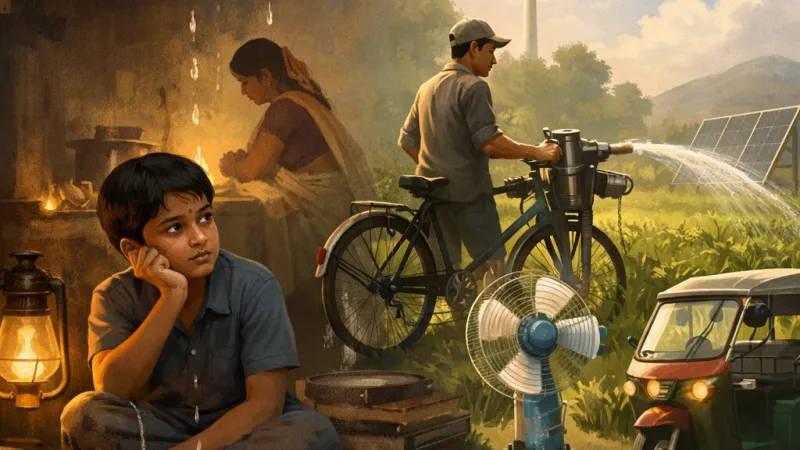
Let us bring this concept alive with specific stories from our Indian soil.Jugaad in Rural India: In Haryana, I once witnessed a farmer using an old bike engine to power a water pump. His family could not afford a new machine, but his necessity and mechanical instinct combined to invent a working solution from scrap parts. This is the true spirit behind necessity-driven invention.
The Animal World: Or consider the familiar Panchatantra story where a thirsty crow drops pebbles into a half-full pot to raise the water level—a parable taught to children across India. The crow’s necessity (thirst) leads to his invention (using stones to get water), mirroring human ingenuity.
Modern Technology Yielding Social Solutions: During the COVID-19 lockdown, the closure of schools revealed a new necessity: learning from home. Indian educators and tech enthusiasts rapidly developed low-data video classes, affordable e-learning apps like BYJU’S, and even “mohalla” classes with mobile blackboards in states like Chhattisgarh.
Startups Rising from Unique Needs: Companies such as Ather Energy, designing electric scooters for India’s urban chaos, or the affordable sanitary pad made from locally available materials in Arunachalam Muruganantham’s famous story, are modern reflections of how local needs drive business and technical invention.
Public Initiatives: The Swachh Bharat Abhiyan is another example: the necessity of improved sanitation in rural and urban spaces has led to a wide range of new toilet designs, waste management apps, and fecal sludge treatment innovations built by Indian engineers and social workers.
Beyond Necessity: Luxury, Curiosity and the Journey of Invention
While necessity is often the strongest driving force, it is not the only fuel for invention. Sometimes, curiosity and even comfort play a role. The ancient game of chess, invented as chaturanga in India, is said to have been developed for entertainment and learning, not mere survival.Interestingly, items that start as luxury—like mobile phones—quickly become a necessity when widespread. Who could have imagined twenty years ago that even vegetable sellers today would use smartphones to track orders and payments on UPI?
Moreover, not every attempt at solving a problem is successful immediately. The story of E Sreedharan, the “Metro Man” of India, is one of facing repeated setbacks while designing the Konkan Railway and the Delhi Metro, but persevering until a solution emerged.
Many pressing global issues—like climate change, clean water, and energy—are driving new inventions. Indian scientists have led the development of solar cookers, cheap water purifiers like Tata Swach, and electric rickshaws which aim to tackle both environmental and economic needs.
However, invention must walk hand-in-hand with ethics. Solutions must not harm nature or people. For example, plastic, once an invention out of necessity, now poses a huge challenge, reminding us that wise use of invention is as crucial as invention itself.
Conclusion: Embracing the Catalytic Power of Necessity
From humble homemade inventions to national feats such as the Mangalyan mission (Mars Orbiter Mission), Indian society proves that necessity is indeed a mighty mother of invention. Whether it was the challenge of famine that led to Green Revolution, or the need for affordable communication that led to mass mobile connectivity, every era and locale presents its own stories of creative responses to problems.The journey from necessity to invention is not always easy or quick. But, with resilience, curiosity, and community effort, ordinary people overcome impossible odds and move the wheel of progress forward. Like Dr. APJ Abdul Kalam once said, “Excellence happens not by accident. It is a process.” The process begins with necessity, and leads, through hard work and imagination, to invention.
I believe we all should develop a mindset of looking at problems as opportunities to bring about change—whether in our families, schools, or the country at large. As we face the challenges of tomorrow, especially as young Indians, let us remember that the power to invent, adapt, and improve lies within us. The motherly force of necessity will forever keep birthing new solutions, shaping our lives and the destiny of our nation.
Rate:
Log in to rate the work.
Log in