10 Short Lines About the Sun for Secondary School Students
This work has been verified by our teacher: 16.04.2026 at 13:29
Type of homework: Essay Writing
Added: 15.04.2026 at 13:27
Summary:
Explore 10 short lines about the Sun for secondary school students in India to learn key facts about its nature, size, and role in our solar system. 🌞
The Sun: The Heart of Our Solar System
The Sun, a blazing ball of fire in the sky, has always captured the imagination of humanity. For students in India, the Sun is not only an essential topic in science textbooks but is also deeply woven into our culture, festivals, and daily lives. As the centre of our solar system, the Sun is much more than just a source of daylight; it is the life source for every plant, animal, and human being on this planet. Through this essay, I aim to bring together the fascinating scientific facts and the cultural values associated with the Sun, so that we can appreciate its awe-inspiring influence in a truly holistic way.---
Physical Characteristics and Nature of the Sun
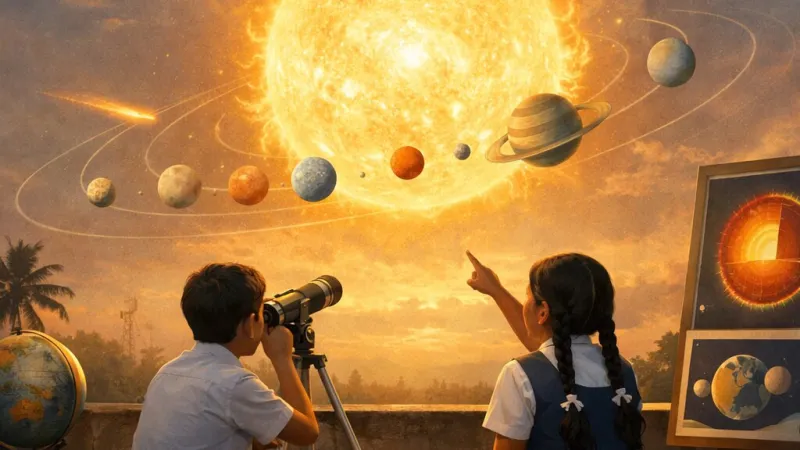
The Sun is, in essence, a star – though we only ever see one as bright as ours because it is so close to us. Classified as a “yellow dwarf” by astronomers, the Sun sits majestically at the centre of our solar system, holding the planets together in its fierce gravitational embrace. In the simplistic language of sky gazers, a star is essentially a massive ball of fiery gas, producing energy by fusing atoms at incredible temperatures.To understand the scale of the Sun, one must stretch one’s imagination. The Sun’s diameter is about 1,39,00,000 kilometres, making it roughly 109 times wider than our Earth. Picture filling the Sun with planets of Earth’s size – astonishingly, over 1.3 million Earths would fit inside it! Such enormity is hard to visualise, but it does convey just how grand our life-giver really is.
In terms of composition, the Sun is not solid – it is made of gases, mainly hydrogen (about 70 percent) and helium (around 28 percent). There are trace amounts of other elements too, but these two dominate. This mixture is crucial because hydrogen, under the extreme conditions in the Sun’s centre, fuses to form helium, releasing massive amounts of energy. It is, in a sense, a naturally occurring nuclear reactor, quietly fuelling itself for billions of years.
The Sun’s structure is layered like an onion, though each layer is invisible to our eyes. The layer we can see, the photosphere, glows with the brightness we observe as sunlight. Above this is the chromosphere, where solar flares and other fascinating phenomena occur. Outermost is the corona, which extends for millions of kilometres into space and becomes visible during a total solar eclipse as a shimmering white halo. As for temperature, the surface is blistering hot at about 5,800 Kelvin, but this is nothing compared to its core – a staggering 15 million Kelvin, where the real magic, nuclear fusion, happens.
---
The Sun’s Energy: Source, Types, and Impact
At the core of the Sun, an unending dance of elementary particles results in nuclear fusion, with hydrogen atoms merging to form helium and unleashing titanic amounts of energy in the process. This energy travels outwards, eventually escaping as various forms of radiation.Of these, visible light makes the world around us shine, while infrared rays warm us. However, the Sun doesn’t just send comforting light and heat; ultraviolet rays can cause harm, such as sunburns on our skin – a reality most of us learn the hard way during harsh Delhi summers or while holidaying in hill stations. Solar wind, a stream of charged particles released from the outer layers of the Sun, zips across the solar system, occasionally affecting satellites or creating breathtaking auroras near the polar regions (faintly visible even in high-altitude places like Ladakh).
The importance of solar energy in Gujarat’s bright fields or Tamil Nadu’s lush farms cannot be overstated. Sunlight powers photosynthesis, the process by which plants make food. Without sunlight, there would be no plants; without plants, there would be no animals or humans. Every grain of rice or bite of mango owes its existence to the endless generosity of the Sun. Moreover, solar energy helps regulate the Earth’s climate and weather. Monsoons, so vital to Indian agriculture, are also influenced by how the Sun’s energy heats land and sea differently.
---
Motion and Life Story of the Sun
While sitting unmoving to our eyes, the Sun actually spins on its axis, but not as a uniform whole, because it is made of gases. This phenomenon, called differential rotation, means the Sun takes around 25 days to rotate at the equator and about 35 days at the poles. Beyond this, the Sun is slowly but surely orbiting around the centre of our Milky Way galaxy, a journey lasting roughly 235 million years – a figure far beyond human lifespans yet remarkable in scale.The Sun is currently a middle-aged star, roughly 4.6 billion years old and expected to continue shining for another five billion years. When the hydrogen at its core is exhausted, it will expand into a red giant – perhaps engulfing some of the inner planets – and eventually shed its outer layers to leave a tiny, dense white dwarf. In the distant future, the demise of our Sun will change the face of the solar system, but for now, and for eons to come, we can rely on its warmth and light.
---
The Sun in Indian Culture and Symbolism
If the Sun is the heart of our solar system in science, it surely occupies the same position in our spiritual and cultural imagination. In Indian tradition, the Sun is worshipped as Surya, a major deity in Hinduism. Surya is described in many ancient texts as the mover of time, the witness to oaths, the granter of health and knowledge. The revered "Gayatri Mantra", recited by millions daily, seeks enlightenment from the divine light of the Sun, reflecting both the cosmic and personal significance it holds.Our festivals resonate with celebrations of the Sun’s cycles: Makar Sankranti marks the Sun’s northward journey and is celebrated by flying kites across Gujarat and Maharashtra, while Chhath Puja in Bihar venerates the setting and rising Sun with ancient rituals conducted beside rivers. Pongal in Tamil Nadu is another harvest festival to honour the Sun’s beneficial light. Through these, the Sun symbolises more than a source of heat; it represents energy, healing, enlightenment, and the rhythm of nature’s cycles.
---
Phenomena Associated with the Sun
The Sun’s interactions with the Earth create several phenomena that invite curiosity and wonder. A solar eclipse, for instance, occurs when the Moon comes exactly between the Earth and the Sun, temporarily blocking the Sun’s light. Eclipses have been both feared and revered in India’s history, with elaborate scriptures advising people on rituals and precautions during their occurrence.Then there are sunspots – relatively cooler, dark patches on the Sun’s photosphere, first observed by astronomers in India with humble telescopes. These sunspots, tied to intense magnetic activity, sometimes lead to spectacular solar flares – sudden explosions of energy that can disrupt radio and satellite communications. Such events remind us that the Sun is not idle but a dynamic, ever-changing celestial force.
---
Solar Energy in Modern India
In today’s quest for sustainable development, solar energy draws renewed attention. India, blessed with abundant sunshine, has taken ambitious strides in harvesting the Sun’s power. Across the deserts of Rajasthan and the rooftops of Kerala, solar panels convert sunlight directly into electricity, fueling everything from village streetlights to metro trains.Through government campaigns like the National Solar Mission, India aims to reduce pollution, curb climate change and decrease dependence on fossil fuels. Solar lamps have brightened rural homes and reduced kerosene use, while massive solar parks in places like Rewa and Charanka showcase the promise of clean, green energy. This embrace of solar power is not just practical but resonates with the ancient Indian respect for the Sun as the ultimate life-giver.
---
Conclusion
The Sun stands as a magnificent symbol of both scientific complexity and cultural harmony. It is a gigantic nuclear engine that sustains forests, fields, and cities, yet it also inspires poetry, prayer, and celebration from Kashmir to Kanyakumari. Every aspect of life on Earth depends, directly or indirectly, on the ceaseless generosity of this solitary star.In reflecting on the Sun, one understands why it commands reverence across science labs and temple courtyards alike. Studying the Sun, respecting its power, and using its energy wisely can help India – and the world – move towards a future that is both bright and sustainable. As we watch the sunrise each day, let us remember both its warmth and its wisdom, for in the Sun’s light lies not only the power to grow but also the promise to progress.
Rate:
Log in to rate the work.
Log in