Top 10 Key Facts About the Prestigious Jnanpith Literary Award
This work has been verified by our teacher: 22.04.2026 at 18:46
Type of homework: Essay Writing
Added: 20.04.2026 at 12:46
Summary:
Discover the top 10 key facts about the prestigious Jnanpith Literary Award and learn its origin, significance, and impact on Indian literature and culture. 📚
An In-Depth Exploration of the Jnanpith Award: India’s Pinnacle of Literary Excellence
Literary awards play a fundamental role in cherishing and immortalising the creative spirit of a society. In India, a civilisation of epic poets, saintly thinkers, and diverse artistic expressions, the tradition of honouring writers is integral to the national ethos. The legacy of Indian literature weaves through ancient Sanskrit shlokas, vibrant regional narratives, and powerful social commentaries, echoing the voices of centuries. Among the pantheon of accolades, the Jnanpith Award stands as a beacon, celebrating the profound intellect (‘Jnan’) and creative achievement of India’s finest literary minds. Established to recognise outstanding contributions in the domain of literature, the Jnanpith Award not only serves as India’s most prestigious literary prize but also as a custodian of linguistic and cultural plurality. In this essay, I will analyse the origin, criteria, symbolic significance, and impact of the Jnanpith Award, reflecting on its influence on modern Indian literature and society.
Historical Background and Origin
The inception of the Jnanpith Award in 1961 marked a turning point in post-independence India, when the urgency to reawaken cultural consciousness was palpable. After centuries of colonial dominance, there was a collective yearning to reclaim indigenous art forms and literary practices. At the heart of this renaissance was Sahu Shanti Prasad Jain, an illustrious industrialist with a profound interest in cultural enrichment. Inspired by the air of revival and coinciding with his fiftieth birthday, Jain chose to endow a recognition that would perpetuate the quest for knowledge and creative brilliance. From its initial emphasis on crowning a singular, exceptional literary work, the award matured over time to acknowledge a writer’s entire body of contributions, thereby embracing a more holistic appreciation of literary journeys.The purpose behind this evolution was clear: to spotlight lifetimes of thought and expression that shape the imaginative landscape of the nation. Changes in the material reward accompanied this transition. Starting from a cash prize of just one lakh rupees, the sum has expanded over decades, mirroring the rising stature and relevance of the award. The Jnanpith soon commanded global respect, setting a benchmark akin to the Nobel Prize for Indian literature.
Eligibility and Languages Recognised
India, more than any other country, is defined by her plurality of languages and scripts. The Jnanpith Award is distinctly rooted in this diversity. From the beginning, the award has been conferred in Indian languages recognised under the Eighth Schedule of the Constitution — a list that features Hindi, Bengali, Malayalam, Kannada, Assamese, Gujarati, and numerous others, now extending to 22 languages. English, as a living legacy of colonial times and modern discourse, was officially brought into the fold in recent years, marking a progressive approach to inclusion.This deliberate recognition of multiple languages enshrines the syncretic fabric of Indian society. A notable feature is that only living authors of Indian citizenship are eligible, and both poetry and prose are considered across genres — from novels and plays to essays and criticism. Posthumous conferral is not permitted, ensuring that living talent is acknowledged and celebrated.
Historically, languages such as Hindi and Kannada have received more Jnanpith laureates, which reflects the depth and scale of their literary traditions. Malayalam, Bengali, Marathi, Odia, and Urdu writers, too, have often been recognised, illustrating how the award serves as a mirror to India's linguistic ecology. While some languages have received less representation, the award continually raises awareness about the wealth found in regional and minority voices.
Selection Process and Criteria
Given India’s layered literary heritage, the selection process of the Jnanpith Award is rigorous, aiming to uphold the highest standards of fairness and scholarly judgment. The process begins with the formation of a Selection Board comprising seven to eleven distinguished individuals — scholars, critics, former laureates, and literary connoisseurs, each representing different Indian languages and regions. Their tenure is fixed at three years, with a possible extension for an additional term.Nominations are forwarded by literary academies, universities, and notable experts. Each entry undergoes a meticulous evaluation, where the candidate’s lifetime contribution, the depth of their themes, linguistic innovation, and the transformative power of their works are carefully weighed. The Board strives to remain impartial, navigating the challenges posed by disparities in literary traditions and critical standards among languages. While transparency is often called for and the task is not without debates or controversy, the overall process underlines the seriousness with which literary merit is assessed in the country.
Components and Rewards of the Jnanpith Award
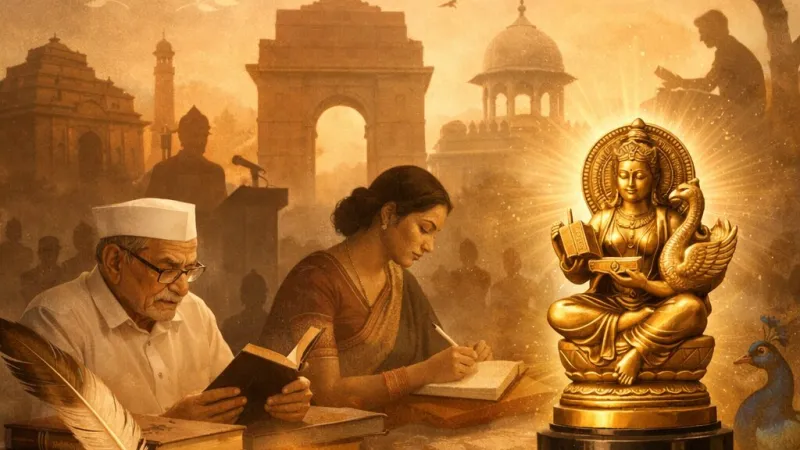
Apart from the glory and peer recognition, the Jnanpith Award confers tangible and symbolic rewards upon its recipients. The monetary component of the prize has kept pace with changing times—from the modest beginning of one lakh rupees, it currently stands at eleven lakhs (Rs. 11,00,000). For many writers, especially those working in lesser-known languages, this support is invaluable, enabling them to pursue greater intellectual freedom.Equally significant is the bronze plaque featuring Saraswati, the goddess of knowledge and the arts, which the awardees receive. The inspiration for the design draws from ancient Malwa temple sculptures, encapsulating the enduring reverence for wisdom in Indian tradition. This iconography serves as a reminder that literature is not just a matter of craft, but a sacred pursuit, tying the individual creator to centuries of cultural memory.
The annual award ceremony gathers together India’s literary luminaries, policymakers, and cultural enthusiasts, crafting a festival of intellect and creative celebration. The ritual itself becomes a focal point for debates, discussions, and the renewal of collective pride in Indian literature.
Notable Recipients and Their Contributions
Over the decades, the Jnanpith Award has created a constellation of exemplary names representing the zenith of Indian letters. G. Sankara Kurup, the very first laureate in 1965, was a trailblazer in Malayalam poetry. His evocative poems, particularly the famous “Odakkuzhal” (The Bamboo Flute), captured the philosophical and emotional nuances of Kerala’s changing times.In recent years, the awarding of Amitav Ghosh in 2018 marked a turning point. Recognised for his powerful narratives in English that traverse the Sunderbans, the colonial trade routes, and contemporary realities, Ghosh's works have taken Indian stories to global audiences. His honouring underlines the evolving nature of Indian literature as fundamentally multilingual and cosmopolitan.
Luminaries such as U.R. Ananthamurthy (Kannada), Mahasweta Devi (Bengali), Qurratulain Hyder (Urdu), and Vishnu Vaman Shirwadkar (Marathi) have collectively depicted the spectra of Indian social realities. Their works, ranging from gripping social novels to radical feminist critiques, from historical retellings to lyrical poetry, have enriched not only their native literatures but the collective imagination of the nation.
Themes addressed by awardees are as diverse as the country itself — delving into caste, migration, spirituality, independence, folklore, modernity, and the tumult of changing societies. By honouring not just novelists but poets, critics, and playwrights, the Jnanpith Award signals the multi-faceted brilliance of Indian writing.
Impact of the Jnanpith Award on Indian Literature and Society
The cultural value of the Jnanpith Award transcends its material and individual dimensions. At its core, the award enlivens a sense of national pride in India’s polyphonic literary traditions, prompting younger generations to embrace careers in writing and critiquing. It acts as a beacon for the preservation of threatened regional languages and dialects — as seen in cases where lesser-known languages gained national attention after their writers were recognised.Further, the global profile of Indian literature is uplifted by the award. Many Jnanpith laureates have seen their works translated into multiple languages, fostering international literary exchanges and cross-cultural understanding. Critically, the award establishes criteria for excellence, prompting deeper academics, and critical analyses, and enriching syllabi across the country.
Moreover, the award becomes a tool in nation-building, preserving the unity-in-diversity that is at the core of India's identity. By bringing together writers from various linguistic backgrounds, it builds bridges of understanding in an often-fragmented social landscape.
Contemporary Challenges and Future Prospects
The Jnanpith Award’s role continues to evolve. A key challenge is balancing the weight of classical traditions with the creative disruptions brought by digital and experimental literature. Expanding the recognition to newer or marginalized languages, especially those struggling for script or media representation, is an urgent priority.Another concern is making the laureates’ works accessible, especially in translation, to the broader public. Government efforts, publishing houses, and digital platforms must collaborate to ensure that award-winning literature does not remain the preserve of the elite but trickles down to enthusiastic readers across rural and urban India.
Financial sustainability and institutional support are essential; while the Bharatiya Jnanpith Trust remains at its heart, broader state and private participation can help elevate the award’s outreach and relevance.
Conclusion
The Jnanpith Award is not merely a hallmark of individual brilliance. It is a bulwark against cultural amnesia, a torchbearer of India’s vibrant literary past, and a catalyst for the intellectual futures yet to be written. In saluting its legacy, one realises that the true worth of the Jnanpith Award lies in the imagination it sparks and the dialogues it sustains among readers of all ages.As students and young citizens, we must engage with the works of Jnanpith laureates, opening ourselves to the vast, ever-evolving wisdom of Indian literature. By doing so, we not only preserve our literary heritage but also participate in the making of an India where every language, every story, and every voice is accorded its rightful place in history.
Rate:
Log in to rate the work.
Log in