Key Facts About National Deworming Day in India for Students
This work has been verified by our teacher: 27.04.2026 at 18:56
Type of homework: Essay Writing
Added: 24.04.2026 at 7:50
Summary:
Discover key facts about National Deworming Day in India and learn how it protects children’s health from intestinal worms to boost growth and wellbeing.
Essay: 10 Lines on National Deworming Day
India has always believed that the well-being of children lays the foundation for a strong nation. Our greatest poets and leaders, from Rabindranath Tagore to Dr. APJ Abdul Kalam, have often stressed the importance of nurturing healthy, curious young minds. One of the significant government initiatives that seeks to protect the health of millions of Indian children is National Deworming Day. Every year, on the 10th of February, schools, Anganwadi centres, teachers, and medical workers across the country unite for a common cause – to safeguard children from the silent danger of intestinal worms. In this essay, I will explain, in detail and with clear examples, what National Deworming Day is, why it matters, how it is observed, and the broad impact it has on our society.---
Understanding Deworming and the Need for a National Day
Deworming, in simple terms, means the process of giving medicine to people—mainly children—to rid their bodies of intestinal worms such as roundworms, hookworms, and whipworms. These worms, mostly invisible to the naked eye, thrive in unhygienic environments. Many people may wonder why there is a specific day set aside for deworming in India. The reason lies in the massive scale of the problem. Across the country, especially in rural and developing regions, large numbers of children suffer from worm infections due to contaminated soil, unsafe drinking water, and poor sanitation. Just as Gandhi ji emphasised the importance of cleanliness, National Deworming Day stresses the critical connection between hygiene and health.---
Historical Background and Significance
National Deworming Day (NDD) was first observed in India in the year 2015. The Ministry of Health and Family Welfare launched it after recognising alarming levels of worm-related illnesses in our children, which was hampering their growth and learning. This initiative is a key aspect of Swachh Bharat Abhiyan's vision, contributing to broader goals like reducing child malnutrition and anaemia, which is the shortage of healthy red blood cells due to low iron. The programme mainly targets children and adolescents aged 1 to 19 years—the most vulnerable age group as per health studies conducted in Indian schools and villages. The scope is enormous, making NDD one of the largest public health drives in the world. During its first phase itself, more than 9 crore children were given deworming tablets. The day has grown in reach and impact every year since.---
Causes and Impact of Worm Infections
In the Indian context, worm infections, or *soil-transmitted helminthiases*, often result from coming into contact with infected soil—common in places where open defecation happens. Children may get infected by walking barefoot, eating unwashed fruits, or drinking unsafe water. The problem is rampant in areas lacking toilets and proper drinking water facilities. Once inside the body, these worms steal nutrients from the host, leading to conditions like anaemia (low iron in blood), malnutrition, stunted physical growth, weakened immune systems, and tiredness. Many students, especially in rural schools, have complained of fatigue, stomach pains, or lack of attention—all symptoms that often go unnoticed as worm infections. Over time, this not only affects school performance but also leads to a vicious cycle where a sick child becomes an underperforming student and, ultimately, a less productive adult—a concern noted by social reformers like Ishwar Chandra Vidyasagar.Further, the economic burden created by the healthcare cost and lost working potential in the future cannot be ignored. Deworming, therefore, is not just a health intervention but an education and economic reform as well.
---
Objectives of National Deworming Day
The intent behind observing this day goes beyond simply distributing tablets. The government and its partners aspire to: 1. Educate: Spread awareness about the dangers of worms and the importance of handwashing, clean food, and sanitation. Posters, loudspeaker announcements, and local storytelling often play a key part. 2. Treat: Provide Albendazole 400mg tablets free of cost to all targeted children at schools and Anganwadi centres. This mass administration makes the programme affordable and accessible, especially for poor families. 3. Promote Hygiene: Encourage simple yet powerful habits like washing hands with soap, trimming nails, wearing slippers, and using toilets—echoing the lessons India learnt during the Swachh Bharat Abhiyan. 4. Leave No One Behind: Special "mop-up" days are held after NDD to reach those children who were absent the first time—no child is left out, be it in hill villages of Himachal or tribal hamlets in Odisha. 5. Continuous Engagement: National Deworming Day is linked with other health and nutrition drives, such as the Mid-Day Meal Scheme and Vitamin A supplementation.---
How National Deworming Day is Observed
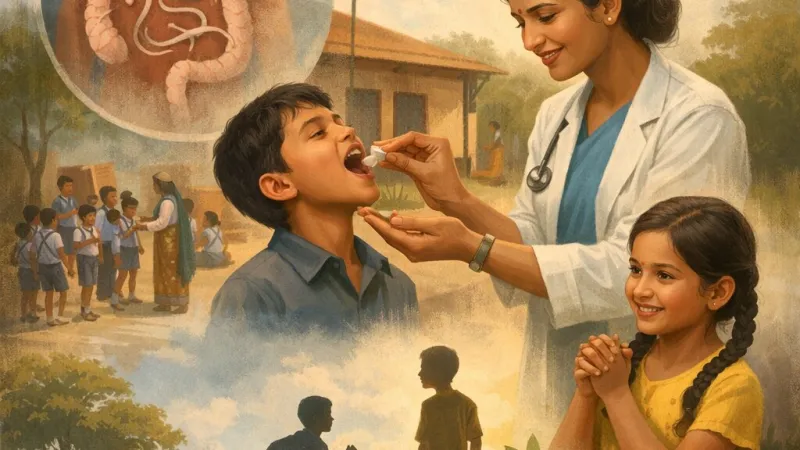
On the 10th of February, schools and early childhood care centres become the focal points of activity: - Medicine Distribution: Children are given the prescribed tablet, usually after eating. Teachers or Anganwadi workers carefully supervise the process to prevent mishaps. Since the medicine can feel slightly chalky, children are encouraged to drink water. - Awareness Activities: Teachers organise health talks, quiz competitions, and sometimes even street plays (nukkad nataks) to explain hygiene in an engaging manner. In states like Tamil Nadu and Kerala, educational puppet shows in local languages are used. - Training: Days before NDD, health workers and teachers attend workshops to learn about correct dosage, likely side effects (which are rare), and how to answer parents’ queries. - Parental Participation: Leaflets and WhatsApp messages are sent to parents, especially in urban areas, so that they understand why their children should participate. In some villages, Panchayats actively encourage and facilitate parent meetings. - Use of Media: NDD often features in All India Radio broadcasts, regional newspapers, and even popular TV serials through public health messages, ensuring everyone, from city schoolchildren to Himalayan villagers, gets the message.---
Importance of Hygiene and Prevention
Deworming Day is not a one-time cure. Along with taking medicine once or twice a year, adopting simple preventive measures is vital: - Handwashing with soap, especially before meals and after using the toilet, is constantly demonstrated and encouraged. - Using clean toilets instead of open spaces reduces reinfection risk. - Drinking boiled/filtered water becomes a lesson repeated by teachers and health workers. - Washing fruits and vegetables properly before eating, a simple but often neglected habit, is discussed. - Trimming nails becomes a shared routine in many government schools, just before lunch breaks.These behaviour changes, if continued, have immense potential to break the cycle of infection and ensure the effectiveness of the medicines.
---
Stakeholders and Their Roles
The success of NDD is due to the collective effort of several groups: - Government Ministries design policies, provide funds, and monitor outcomes. - State Health and Education Departments bridge policy with action by training teachers, ensuring medicine supplies, and maintaining records. - Schools and Anganwadi centres are the frontlines where the actual distribution and education happen. Here, children feel safe and are more likely to take medicine happily. - Teachers, Anganwadi workers, and ASHA workers are the unsung heroes. They explain the benefits, calm anxious parents, and make sure that no child is left out. - Parents and Guardians reinforce hygiene at home and encourage participation year after year. - Local leaders, NGOs, and community groups use street plays, folk songs, and community meetings to reach those beyond the school gates.---
Challenges and Way Forward
Despite these admirable efforts, several hurdles remain: - In remote or tribal regions, reaching every child can be a challenge due to poor road connectivity. - Myths, fears of side effects, and general distrust can lead some parents to refuse participation. Countering these requires sustained information campaigns in local dialects. - Hygiene practices often fade with time if not reinforced daily, reducing the long-term effect of deworming. - Finally, tracking every child, especially those out of school, demands innovative solutions, perhaps integrating NDD with schemes like Ayushman Bharat or local health drives.To overcome these obstacles, involving respected village elders, using local folk art like Bhavai or Chhau, expanding tracking systems, and regular monitoring are recommended. Collaboration with existing nutrition programmes (such as Poshan Abhiyan) can also multiply benefits.
---
Conclusion
National Deworming Day exemplifies how a seemingly small intervention, when scaled nationwide, can produce transformative results. It merges India’s traditional wisdom on food and cleanliness with modern medical science. As poet Subramania Bharati once wrote, “நலம் தரும் நிலவே…” ("may welfare shine bright"), so too does National Deworming Day bring the hope of a bright, healthy generation.To sum up its importance in clear points: 1. Celebrated every 10th February, National Deworming Day is a collective fight against harmful worms in children. 2. It directly supports child health, improves school performance, and ensures a brighter, more productive future. 3. Teachers, health workers, parents, and children play equally important roles. 4. Deworming must go hand in hand with hygiene and sanitation. 5. Active participation from all citizens is vital to eliminate worm-related health problems for good.
Let us remember, protecting every child's health today ensures a robust, prosperous India tomorrow. On every National Deworming Day, may we renew our commitment—to our children, our schools, our communities, and to the nation as a whole.
Rate:
Log in to rate the work.
Log in