Creative Diwali Drawing Ideas to Celebrate the Festival of Lights
This work has been verified by our teacher: 29.04.2026 at 11:06
Type of homework: Essay Writing
Added: 28.04.2026 at 15:09
Summary:
Explore creative Diwali drawing ideas to celebrate the Festival of Lights. Learn to depict diyas, rangoli, and festive symbols with artistic tips.
Diwali Drawing: Illuminating Traditions through Art
India is a land of festivals, each celebrated with unmatched fervour and joy, yet nowhere does the vibrancy shine brighter than during Diwali, the beloved festival of lights. This annual celebration, marking the victory of light over darkness and the return of Lord Rama to Ayodhya after fourteen years of exile, is deeply rooted in the collective consciousness of Indian society. Every lane and house sparkles with the glow of countless diyas, while laughter and anticipation fill the air.
But Diwali is not just about lights and fireworks; it is also an explosion of colour, design, and creativity. Art, especially drawing, assumes a special place in the hearts of children and students during this festival. Through sketches and colourful illustrations of diyas, rangolis, and deities, children not only add to the festive cheer, but also internalise the values and stories underlying Diwali. This essay attempts to guide students, both young and old, in exploring the festive spirit of Diwali through drawing, combining traditional inspiration with practical tips to create beautiful and meaningful art.
---
Understanding the Symbols and Themes of Diwali for Drawing Inspiration
The canvas of Diwali is rich with motifs and symbols that are deeply interwoven with India’s heritage. For a drawing to truly capture the essence of the festival, one must first understand these symbols and the stories behind them.The most iconic symbol of Diwali is undoubtedly the diya—the traditional oil lamp. Beyond its simple form lies profound symbolism: the diya represents the triumph of light (knowledge, goodness) over darkness (ignorance, evil). In the epic Ramayana, residents of Ayodhya decorated the city with rows of diyas to welcome Lord Rama, Sita, and Lakshman, a scene that has become the inspiration for countless artworks.
Rangoli, another vibrant feature, is an art form created at the thresholds of homes using coloured powders, flowers, and grains. Rangoli patterns often include geometric shapes, peacocks, lotus flowers, and traditional kolam designs, signifying auspiciousness and welcoming prosperity.
No Diwali evening is complete without the spectacular display of fireworks, which fill the night sky with cascading lights. These are often brought to life in drawings using striking lines, dots, and bursts of colour.
Finally, the festival pays homage to Lakshmi, the goddess of wealth, and Ganesha, the remover of obstacles. Their depictions are central to Diwali art, often surrounded by lotus flowers, coins, and other auspicious symbols.
Younger students might begin with simple sketches of diyas, while older students can attempt elaborate family celebrations, market scenes bustling with activity, or beautifully adorned homes. By drawing these motifs, students not only decorate their surroundings, but also immerse themselves more deeply in the cultural and spiritual values Diwali upholds.
---
Preparatory Steps Before Starting a Diwali Drawing
Before the pencil touches paper, a little organisation goes a long way in ensuring a joyful and rewarding drawing experience.Start with gathering your art materials: plain or coloured paper, a sketchbook for practice, pencils for sketching, a sharpener and eraser, and a selection of colouring tools—crayons for younger children, coloured pencils or watercolours for finer shading, and markers for bold outlines. For added festivity, keep glitter, sequins, decorative stickers, and even dried flower petals handy; these additions make the drawings more lively and tactile, much like the real decorations seen during Diwali.
Next, think about your drawing theme. Beginners might choose a single diya or a basic rangoli pattern, while advanced students may want to illustrate a Diwali puja scene, or a vibrant street lined with shops selling sweets and lamps. Decide if your drawing will show a daytime scene, with soft sunlight washing over colourful rangolis, or a night-time environment, with glowing diyas and fireworks lighting up the dark.
Sketch a rough outline first, placing the main elements—such as a diya, a goddess figurine, or the central pattern of a rangoli—strategically on the page. Around these, add background details like flower garlands, stars, or buildings, carefully planning their arrangement to create a balanced composition.
---
Step-by-Step Guide to Easy Diwali Drawings for Beginners
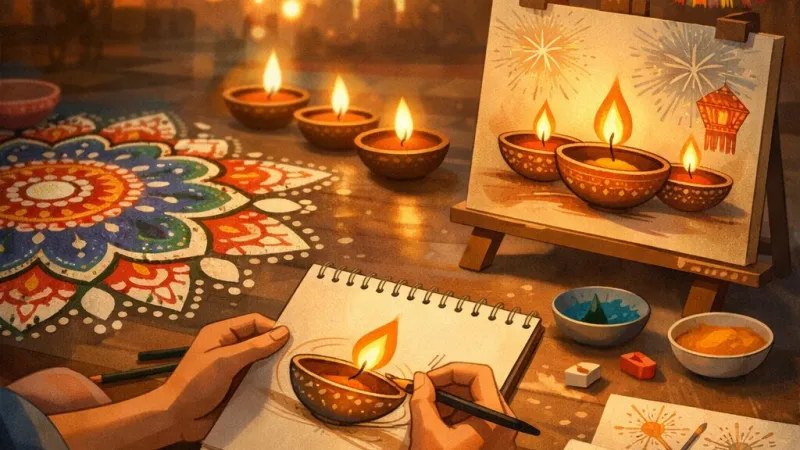
Even the most elaborate masterpiece begins with basic strokes. For those just starting out, here’s a simple approach:1. Drawing a Diya: Begin by sketching the base—a gently curving bowl shape. From its centre, draw a straight wick pointing up, and crown it with a teardrop-shaped flame. To make it realistic, lightly shade the bottom of the bowl and add glimmers of yellow and orange to the flame. For extra sparkle, a sprinkle of gold glitter can make the diya glow on paper as it does in reality.
2. Rangoli Designs: Start with a small circle in the middle of your page. Draw petals, triangles, or lines radiating out from the centre to mimic common rangoli patterns. Add dots and smaller shapes symmetrically for balance. Fill each section with bold, bright colours—pinks, greens, blues, and yellows—since rangolis are meant to attract and please goddess Lakshmi.
3. Fireworks: With a coloured pencil or crayon, make starbursts by drawing lines shooting out from a central dot, then add small dots along these lines to signify sparks. Try layering a few bursts in contrasting colours for dramatic effect.
To keep your artwork neat, always sketch with a light hand at first—mistakes are easier to erase this way. Colour layer by layer, taking care not to smudge, and always wash your hands before handling white or light-coloured paper.
---
Creating Advanced and Complex Diwali Scene Drawings
For those wishing to take their Diwali art a step further, try depicting festive scenes that tell a story.A household puja scene might show family members gathered around a thali, lighting diyas together, the room festooned with marigold garlands and mango leaf torans. Capture traditional attire—a mother’s sari pleats, a child’s kurta-pyjama—and don’t forget the thali with its arrangement of diyas, flowers, kumkum, and sweets.
A bazaar scene can be bustling and bright, with rows of sweet shops, lantern sellers, and people shopping in ethnic dresses. In the background, strings of fairy lights twinkle, and coloured paper lanterns hang above the crowd.
Lakshmi and Ganesha, if drawn, should reflect their iconic features: Lakshmi seated on a lotus, holding coins and lotuses, and Ganesha with his elephant trunk, modaks before him. Traditional colours—red, gold, and green—heighten the auspicious feel.
For a truly immersive scene, blend multiple elements: a family lighting diyas on a balcony, fireworks overhead, and a rangoli at their feet. Play with perspective—larger figures in the foreground, smaller details behind—to add depth.
---
Designing Original Diwali Greeting Cards Through Drawing
Gift-giving forms an essential part of Diwali, and handmade greeting cards are a thoughtful way to spread joy. These cards, adorned with personal drawings, carry emotional value that printed ones rarely match.On a folded sheet, sketch a diya or rangoli border at the front, alongside a heartfelt greeting—perhaps “शुभ दीपावली” or “Happy Diwali”. Open the card, and you can leave space for a personal message, or add a small drawing—an earthen lamp, a bowl of sweets, or a simple firework.
Decorate with touches of glitter or sequins for sparkle, and choose colours like orange, gold, yellow, and red for a festive look. Add final flourishes with neat handwritten calligraphy, using a sketch pen or glitter gel pen to write your greeting. The creative process lets each student infuse the card with their own spirit and style—making it a cherished keepsake for the recipient.
---
Practical Tips for Students and Children to Improve Their Diwali Drawings
Improvement comes with practice and observation. Here are some pointers:- Regularly practise basic shapes on rough paper—ovals for flames, lines for fireworks, zigzags for diyas. - Observe real-life objects during Diwali. Study how diyas cast shadows, or how the colour transitions in a marigold flower. Try to replicate these details in your artwork. - Make use of online tutorials in Indian languages, or drawing books from school libraries that provide stepwise instructions for rangoli or festival scenes. - Experiment with blending colours—layering shades lightly to create gradients. For example, blend yellow and orange for diya flames or multiple greens for rangoli leaves. - Seek feedback from trusted adults and friends—often, a fresh pair of eyes can offer helpful advice. - Most importantly, remember that art is about joy and self-expression; don’t rush to finish, and don’t be afraid of ‘mistakes’—each helps you learn and improve.
---
Conclusion
Diwali drawings are far more than just school assignments or holiday pastimes. They are a bridge connecting young minds with centuries of tradition and festivity. Through each sketch, stroke, and splash of colour, students contribute to keeping the vibrant legacy of India’s festivals alive. As you pick up your pencil this Diwali, remember that your artwork is not just decoration—it is a celebration of light, culture, and creativity.May every student feel the magic of Diwali in their art, and continue to explore new ideas and techniques year after year, making the festival ever more special for themselves and those around them.
---
Additional Resources
- “Rangoli: Folk Art of India” by Sudha G. Tilak – a colourful book on traditional and modern rangoli patterns. - YouTube channels like ‘Art with Deepali’ or ‘Crafts for Kids India’ for step-by-step Diwali drawing tutorials. - Educational websites such as ‘Bharatiya Vidya Bhavan’ often publish festival drawing templates and guides.With practice, patience, and a spirit of celebration, every child can light up their world—on paper and beyond—this Diwali.
Rate:
Log in to rate the work.
Log in