Key Facts About the Election Commission of India for Students
This work has been verified by our teacher: 1.05.2026 at 13:12
Type of homework: Essay Writing
Added: 29.04.2026 at 15:40
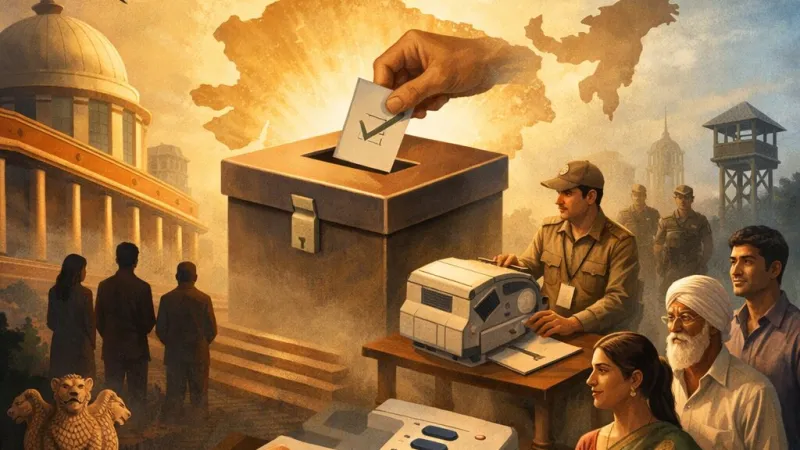
Summary:
Explore key facts about the Election Commission of India and learn its origin, structure, and vital role in ensuring free and fair elections nationwide.
Essay: 10 Lines on Election Commission
The Election Commission of India is often described as the silent sentry of our democratic fortress, embodying Dr. B.R. Ambedkar’s vision for an India where every vote possesses sanctity and every citizen enjoys the right to participate in governance. Though “10 lines” seems concise, the subject’s importance commands a thorough exploration, encompassing its origins, duties, and future.---
Introduction
India, with its vibrant diversity and population exceeding 140 crore, stands as the world’s largest democracy. At the heart of this democratic experiment sits the Election Commission, an institution charged with ensuring that the principles enshrined in the Constitution are transformed into action at every polling booth — from the remote Himalayan hamlet to the bustling streets of Mumbai. To comprehend the Election Commission’s significance, one must look beyond mere definition towards its historical context, elaborate functions, and the challenges it faces.---
1. Genesis and Constitutional Bedrock
The story of the Election Commission begins with the dawn of independent India. After the trauma of Partition and the subsequent birth of the Republic in 1950, our framers envisaged an impartial machinery to guarantee that elections — the very pulse of democracy — would be free from influence, intimidation, or fraud. Article 324 of the Constitution, drafted under the able stewardship of Dr. Ambedkar and other visionaries, established the Election Commission as an independent constitutional authority. The Commission first convened on 25 January 1950, a date still celebrated as National Voters’ Day, reflecting its pivotal place in our polity.---
2. Structure and Composition
Initially, the Election Commission was a single-member body with just the Chief Election Commissioner (CEC), a position of great dignity and responsibility. Over time, as elections grew more complex, two Election Commissioners were added, making it a multi-member Commission. The President appoints the CEC and Commissioners for six-year terms, ensuring continuity and autonomy. Supporting them is a vast, intricate network: State Chief Electoral Officers, local Returning Officers, and lakhs of staff mobilised during polls. The structure empowers the Commission to operate from the highest echelons in New Delhi to the remotest polling stations in Ladakh, Andaman, and beyond.---
3. Key Functions and Responsibilities
The Election Commission’s core mandate is to administer, supervise, and regulate elections to the Lok Sabha, Rajya Sabha, State Legislative Assemblies, and the offices of President and Vice President.a. Conduct of Elections: From announcing poll schedules to the day of counting, the Commission meticulously organises each step. For instance, in the 2019 General Elections — the largest in history — over 900 million voters and more than 10 lakh polling booths were managed without major incidents.
b. Updating Electoral Rolls: The Commission ensures regular revision and purification of voter lists. Adding new voters, especially among the youth, and removing duplicate or deceased names safeguards the process from manipulation.
c. Model Code of Conduct (MCC): To prevent the misuse of power, the MCC comes into force as soon as elections are announced. The Commission warns, penalises, or debars candidates flouting the Code, be it hate speech, excessive spending, or misuse of government machinery.
d. Party Recognition and Symbol Allocation: Recognising national and state parties, allocating election symbols (like the lotus, hand, broom), and registering new parties is crucial to fair competition. This is why, for example, symbols like the cycle or elephant evoke strong resonance during UP or Tamil Nadu polls.
---
4. Powers and Legal Stature
Enabling impartiality, the Election Commission enjoys safeguards protecting it from political pressures. Only Parliament can remove the CEC via impeachment — similar to a Supreme Court judge. During elections, the Commission can transfer officials, deploy paramilitary forces, order repolls, and in extreme cases, defer or countermand polls if rigging or violence is suspected (like in a few booths in 2014 and 2019).Any disagreements in its decisions may be challenged before the Supreme Court, but the Court usually respects the Commission’s autonomy, echoing Justice S.P. Bharucha’s assertion in the T.N. Seshan case: “The Election Commission is a mirror reflecting the will of the people.”
---
5. Innovations and Use of Technology
Indian elections are unique in their scale — they require constant innovation. The move from paper ballots to Electronic Voting Machines (EVMs) under T.N. Seshan and later S.Y. Quraishi marked a historic leap. The addition of the Voter Verifiable Paper Audit Trail (VVPAT) system increased transparency, reducing scepticism about EVMs. Even in the COVID-19 crisis, the Commission ensured social distancing, sanitizers, and gloved officials, proving its adaptability without halting democracy.Modern initiatives like online voter registration, the cVIGIL app for reporting violations, and awareness programmes targeting first-time voters testify to its commitment to inclusivity and transparency.
---
6. Voter Education and Inclusion
The Commission recognises that true democracy is not mere procedural rigour but also public participation. Through the Systematic Voters’ Education and Electoral Participation (SVEEP) programme, various states have witnessed street plays, painting contests, and campus drives to encourage youth and underrepresented communities, such as the third gender or Adivasi groups, to register and vote. Successes are visible: states like Punjab and Kerala have seen record high voter turnout due to these efforts.---
7. Challenges and Criticisms
However, the path is not without obstacles. Managing elections in a nation as diverse as India entails logistical nightmares. Allegations of EVM tampering, voter intimidation in sensitive districts, abuse of money (despite expenditure limits), and the role of “paid news” or fake news on social media platforms are pressing challenges. Maintaining neutrality in the face of political attacks, especially when results are close or disputes arise, tests the Commission’s resolve.For example, the 2021 West Bengal elections saw intense scrutiny of the Commission’s decisions, sparking nationwide debate on its impartiality. Critics stress the need for more public debates, transparency, and possibly even reforms in appointment procedures.
---
8. International Reputation and Cooperation
The Election Commission has earned international admiration. Delegations from emerging democracies like Nepal, Afghanistan, and Nigeria have visited India to learn its methods and best practices. The Institute of Democratic and Electoral Studies in New Delhi trains officials from across Asia and Africa, furthering India’s soft power.---
9. Recent Reforms and the Way Ahead
Recent steps such as introducing NOTA (“None of the Above”) on the ballot, digitising many voter services, and stricter spends monitoring have modernised Indian polls. Proposals for simultaneous Lok Sabha and Assembly elections, biometric authentication, and greater criminal background disclosure for candidates indicate the Commission’s willingness to further evolve.---
10. The Soul of Indian Democracy
Quoting former CEC Sukumar Sen, who oversaw the mammoth 1951-52 maiden elections: “A true election does not end on the day of voting; it ends when every Indian who wishes to vote, does so without fear and with confidence.” The Election Commission is not merely a bureaucratic body — it is a living institution, the very soul ensuring democracy does not become an unfulfilled promise. Its presence ensures that, as Rabindranath Tagore articulated, “the mind is without fear and the head is held high.”---
Conclusion
In India, democracy is a continuous festival — and the Election Commission is its most significant organiser. Its work makes it possible for a farmer in Bihar and a teacher in Kozhikode to have the same voting power as a CEO in Gurugram. Its guardianship over elections is, in essence, guardianship over the faith of a billion citizens in democracy itself. The future, rife with new challenges, will demand ever-greater vigilance, transparency, and innovation from this apex body. Yet, as long as the Election Commission upholds its impartial traditions, India’s democratic dream remains secure and alive for generations to come.Every Indian, especially the younger generation, must be aware of this institution’s vital role — and fulfil their own: to register, vote, and safeguard the precious legacy that is our democracy.
Rate:
Log in to rate the work.
Log in