Key Facts and Insights on Yogi Adityanath: A Secondary School Essay
This work has been verified by our teacher: 19.05.2026 at 9:24
Type of homework: Essay Writing
Added: 18.05.2026 at 10:58
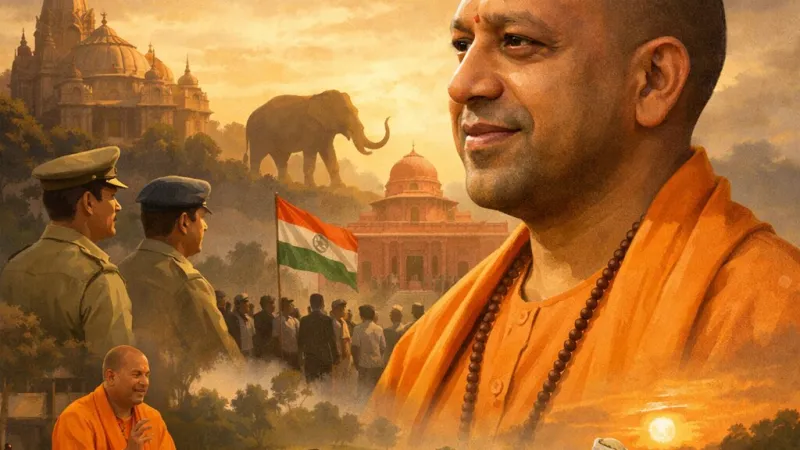
Summary:
Explore key facts and insights on Yogi Adityanath’s life, leadership, and impact in this detailed secondary school essay for effective homework and study.
10 Lines on Yogi Adityanath: A Comprehensive Essay
Yogi Adityanath, a name synonymous with dynamic leadership and unwavering commitment towards public life, stands as one of the most influential personalities in contemporary Indian politics. Serving as the Chief Minister of Uttar Pradesh, India's most populous state, since 2017, his tenure has brought both significant progress and heavy debate. Uttar Pradesh, often regarded as the political heartland of India, has a history of shaping national narratives and political fortunes. From his spiritual roots in the hills of Uttarakhand to his commanding presence in the legislative corridors of Lucknow, Yogi Adityanath's journey is an intriguing blend of ascetic discipline and assertive politics. This essay delves into his early years, religious evolution, political ascendancy, major administrative initiatives, controversies, and the larger impact of his leadership on the fabric of Uttar Pradesh and beyond.
---
I. Early Life and Background
Yogi Adityanath was born as Ajay Mohan Bisht on 5th June 1972 in the quaint Panchur village of Pauri Garhwal district, which is now part of Uttarakhand. Hailing from a Rajput family, his father Anand Singh Bisht was a forest ranger, and his upbringing involved a traditional Hindu joint family alongside brothers and sisters. From a young age, Ajay was recognised for his sharp intellect and spiritual curiosity. He completed his basic education in local schools and later pursued a Bachelor’s degree in Mathematics from Hemwati Nandan Bahuguna Garhwal University, Srinagar.During his school and college years, he exhibited a keen interest in social service and was known to participate in various cultural and religious gatherings. The pivotal phase in Ajay's life came when he decided to renounce his family at the age of 21, drawn by a spiritual calling. He arrived at Gorakhpur, where the revered Gorakhnath Math became his new abode. Under the mentorship of Mahant Avaidyanath, his spiritual guide and a prominent figure in the Nath sect, Ajay Bisht underwent rigorous training in yoga, spirituality, and public service. In 1994, as a testament to his spiritual transformation, he formally became 'Yogi Adityanath', a name deeply anchored in the ancient yogic tradition.
---
II. Spiritual Life and Role as a Monk
Ascending quickly in the spiritual hierarchy, Yogi Adityanath was designated as the Mahant (head priest) of the Gorakhnath Math after the passing of his guru in 1994. His authority extended beyond religious rituals—he became a moral compass and social reformer for countless devotees, especially in eastern Uttar Pradesh. The Gorakhnath temple itself has historically played not just a religious but also a socio-political role, often acting as a bridge between tradition and modernity in the region.Yogi’s ideological foundations are rooted in a blend of yogic principles and Hindu renaissance. Deeply influenced by the reformist Sant tradition, he stood for a life of discipline, service, and the propagation of Hindu cultural values. He advocated for Hindutva, asserting that it is more a cultural consciousness than a political dogma. The creation of the Hindu Yuva Vahini in 2002 proved pivotal; this youth organisation sought to inculcate discipline, patriotism, and social responsibility among the youth of Uttar Pradesh. Its activities included social service, cultural events, and at times contentious activism—highlighting the complex interface between religion and politics in North India.
---
III. Political Career and Rise to Prominence
Yogi Adityanath’s entry into the formal political landscape was inspired by his guru, Mahant Avaidyanath, who was himself a Lok Sabha member. He contested and won the Gorakhpur parliamentary seat in 1998 as a candidate of the Bharatiya Janata Party (BJP), becoming one of the youngest MPs in the 12th Lok Sabha at just 26. His strong grassroots connections in eastern UP, unmistakable oratory, and ability to mobilise large crowds made him a formidable force in regional politics. Over the next two decades, he secured five consecutive victories from Gorakhpur, steadily emerging as one of the most recognised faces of the BJP in Uttar Pradesh.While his critics often portrayed him as a hardliner, to his supporters, Yogi Adityanath represented discipline, resolve, and a willingness to take tough decisions. The political scenario ahead of the 2017 assembly elections saw the BJP searching for a leader who could translate the party’s national wave into a resounding victory in UP. Yogi's appointment as Chief Minister on 19th March 2017 marked a significant shift; he became not just the 21st CM but also the face of a new brand of assertive, culturally rooted leadership in the Gangetic plains.
---
IV. Governance and Policies as Chief Minister
As the head of the state, Yogi Adityanath embarked on a multi-pronged approach towards governance. His first emphasis was on restoring law and order—a persistent issue in Uttar Pradesh’s history. Within weeks, he cracked down on illegal slaughterhouses, enacted stricter measures against cow smuggling, and launched broad police reforms to improve the sense of security. Under his leadership, incidents of high-profile crime witnessed a dip, with his supporters citing improved law enforcement as a major achievement.The government also took decisive steps in infrastructure. The expressways connecting urban and rural regions, fast-tracked metro rail projects in Lucknow, Kanpur, and Ghaziabad, as well as the launch of the Defence Corridor for boosting local industry, signalled a focus on economic development. Through investor summits and reforms in land acquisition, Yogi’s administration aspired to attract both domestic and international capital, viewing industrialisation as key to generating employment.
Social welfare did not lag behind. Schemes for the upliftment of backward classes, scholarships for students from SC/ST communities, free electricity connections under the Saubhagya scheme, and women-centric programs such as Mission Shakti addressed some of the core social inequalities lingering in the state. Health sector reforms included the expansion of hospital infrastructure and wellness centres, especially highlighted during the COVID-19 pandemic when Uttar Pradesh, despite its huge population, managed a large-scale vaccination and relief operation.
However, Yogi’s proposal for the Population Control Draft Bill (2021-2030) stirred significant debate. Although intended to promote family planning, the scheme drew mixed reactions regarding its societal impact and practicality within the diverse Indian demographic context.
---
V. Controversies and Criticism
No account of Yogi Adityanath’s tenure is complete without mentioning the considerable controversies that trailed him. Known for his fiery speeches, his adversaries accused him of adopting a polarising rhetoric, often leading to heightened communal sensitivities. Incidents such as the anti-Romeo squads and the handling of law enforcement during communal tensions in parts of western UP received both commendation and censure. Critics argue that his leadership sometimes reflected majoritarian impulses, potentially undermining the delicate fabric of pluralism essential to Indian society.Yet, from another vantage, his supporters see in him a custodian of national culture and a restorer of law and order after years of perceived neglect. As with any public leader, the reality probably lies somewhere in between—balancing an assertive administrative style with the need for communal harmony and inclusive growth.
---
VI. Impact and Legacy
Yogi Adityanath’s rise transformed the political landscape of Uttar Pradesh, cementing the BJP’s dominance in both assembly and parliamentary elections. His ability to invoke a sense of pride, link the past with present aspirations, and directly engage with youth and grassroots workers has had a cascading effect, with similar models replicated in other north Indian states.Culturally, his tenure has seen an overt push for the revival of ancient traditions—be it the grand Deepotsav celebrations in Ayodhya, efforts to develop Kashi Vishwanath corridor, or state support for festivals like Holi and Diwali. Such initiatives have both strengthened cultural identity and drawn tourists in large numbers. However, challenges remain, especially in sustaining inclusive development and ensuring that economic progress does not bypass the state’s marginalised sections.
On the national canvas, Yogi Adityanath is often counted among the probable future leaders who could shape the country’s direction. His journey from a monk in a distant Himalayan village to the echelons of power represents the fluidity and diversity of Indian public life.
---
Rate:
Log in to rate the work.
Log in