Key Facts and Importance of the Chenab River in Northern India
This work has been verified by our teacher: 16.03.2026 at 17:57
Type of homework: Geography Essay
Added: 13.03.2026 at 6:46
Summary:
Explore key facts about the Chenab River in Northern India and understand its geographical, economic, and ecological importance in shaping the region’s landscape and culture.
Chenab River: A Lifeline of Northern India
Rivers have always been a vital part of the Indian landscape, shaping both the geography and the civilisation that thrived around them. From the ancient Indus and the sacred Ganga to the mighty Brahmaputra, rivers sculpt fields and forests, sustain millions, and feature richly in our history and culture. Among these, the Chenab river holds a special place, traversing rugged mountains and fertile plains, crossing borders, and nurturing countless communities. With its origins deep within the Indian Himalayas, the Chenab’s journey is one of natural grandeur, cultural unity, and cross-border cooperation. In this essay, I will explore the multifaceted importance of the Chenab river—geographical, historical, economic, ecological, and geopolitical—revealing how it truly connects people, land, and legacy across northern India and beyond.---
I. Geographical Origin and Course of the Chenab River
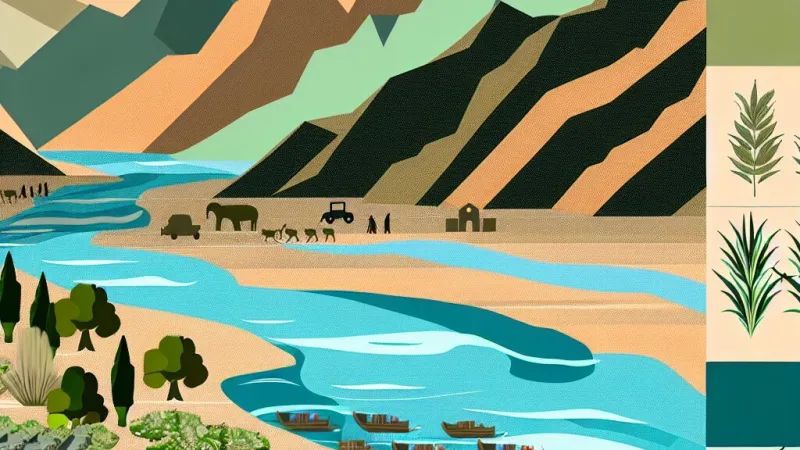
The story of the Chenab begins high up in the snow-draped mountains of Himachal Pradesh. Nestled among the peaks of the Lahaul and Spiti district, two pristine streams—the Chandra and the Bhaga—emerge separately from glaciers near the Baralacha La, a lofty mountain pass known both for its treacherous weather and breathtaking beauty. According to local legend, the Chandra is believed to represent the moon, while the Bhaga is likened to the sun, and their union near Tandi symbolises harmony and auspicious beginnings.As the united waters carve their way down, the Chenab enters Jammu and Kashmir, threading through districts like Lahaul, Pangi, Doda, Kishtwar, Ramban, and Reasi. Here, the river cascades through steep gorges and valleys, often changing mood with its surging rapids and swirling mists. The region stands as a living testament to the magnificent power of Himalayan hydrology, drawing both trekkers and pilgrims.
Once the river leaves the mountains, its flow slows and expands, spilling into the broad plains of Jammu before crossing the international boundary into Pakistan’s Punjab province. Along the way, tributaries such as the Tawi, Marusudar, and the streams of the Kishtwar region enrich its waters. The Chenab’s journey is a classic example of a transboundary river, serving as a crucial water resource for both India and Pakistan.
After meandering through the fertile alluvial fields of Punjab, the Chenab ultimately meets the Jhelum and the Ravi rivers. Near Uch Sharif in Pakistan, it merges with the mighty Sutlej, forming the Panjnad—literally, ‘five rivers’—before draining into the Indus, which finally empties itself into the Arabian Sea. This interconnected network of rivers, known as the Punjab (land of five rivers), underscores the region’s agricultural and cultural bounty.
---
II. Hydrological Features and Physical Characteristics
Stretching close to 974 kilometres, with a basin spanning over 29,000 square kilometres, the Chenab is among the largest tributaries of the Indus system. Its upper reaches rely heavily on the annual cycle of Himalayan snowmelt and glacial runoff, especially prominent after the harsh winter months. When the summer sun strikes the snows of Baralacha La and the adjoining peaks, the river surges, swelling with icy-cold waters.But it is the Indian monsoon, with its unpredictable yet rejuvenating torrents, that sends the Chenab roaring through valleys and inundating the plains. Seasonal differences are stark: summer and early autumn see the river brimming, while in the chilly winter months, its volume abates as snow accumulates upstream.
Physically, the Chenab exhibits two distinct avatars. In the hilly stretches, the river is a wild, fast-flowing stream, violently cutting through rocks, creating deep canyons and waterfalls. Sediments and boulders, carried along by the turbulent current, settle once the river slackens in the plains. Here, the Chenab reveals a meandering course, sometimes forming sandbanks, islands, and oxbow lakes. Its deltaic patterns have shaped the landscape of many villages and towns that hug its banks.
---
III. Historical and Cultural Importance
The Chenab is no stranger to history or the imagination of people. Ancient texts, like the Rigveda, refer to it as ‘Askini’ (meaning ‘dark’), possibly alluding to its muddy waters during floods. Later, in Greek accounts brought back by Alexander’s chroniclers, the river appears as the ‘Akesines’. Such references bear witness to its long-standing association with Indian culture and religion.In Jammu and Kashmir, age-old beliefs honour the Chenab’s life-giving fertility. The Dogra people, for instance, have legends about the river goddesses Chandra and Bhaga, whose union is celebrated even today. Fairs like the Minjar Mela in Chamba recall the river’s role in ensuring agricultural prosperity. Folktales, such as those of Sohni Mahiwal and Heer Ranjha, immortalise the river as a backdrop for forbidden love and sacrifice, with the Chenab often depicted as a witness or even a participant in the trials of lovers.
Historically, the Chenab has served as a corridor between the hills and the north-western plains. Merchants and travellers once relied on simple boats or ingenious swinging bridges (like the 19th-century timber bridge at Doda) to traverse its mighty current, linking the valleys with distant cities. The river thus functioned as both a physical pathway and a cultural bridge, fostering exchange among diverse communities.
---
IV. Economic and Developmental Aspects
The Chenab’s economic contribution is immense. The river, with its perennial flow, is a cornerstone of irrigation in the region. Both Indian and Pakistani farmers depend on its waters to nurture wheat, rice, maize, and cotton fields. In Punjab, the granary of the Indian subcontinent, elaborate canal systems spread out from the Chenab, nourishing countless green acres. Without the river’s bounty, food security in these areas would be severely compromised.Harnessing the Chenab for electricity is another mark of modern engineering. Several dams and hydroelectric projects, including the Salal, Baglihar, Dul Hasti, Ratle, and Pakal Dul, tap its rushing waters to generate power for Jammu and Kashmir. The Baglihar Dam, for example, has become almost symbolic of self-sufficiency and progress in a region often troubled by blackouts and shortages. These projects also provide jobs, spur local business, and foster development in remote corners of the state.
The Chenab is also known for the world’s highest railway bridge—the Chenab Bridge near Reasi—which connects the Kashmir valley to the rest of India. As an engineering marvel, this bridge stands as a metaphor for overcoming geographical isolation and national integration. Besides, the river is a vital source of fish, supporting various indigenous species like mahseer, snow trout, and catfish. Fisher folk along the river depend on its steady waters for subsistence and trade.
---
V. Environmental and Ecological Significance
Like all great rivers, the Chenab hosts a vibrant ecosystem. Its catchment supports a mosaic of Himalayan forests, subalpine meadows, and riverine wetlands. Unique flora such as Himalayan balsam, willow, and silver birch dot its banks, while its waters shelter fish like the snow trout and golden mahseer—both prized and endangered species.However, the river faces growing ecological threats. Agricultural runoff, effluents from urban settlements, and litter degrade water quality. The building of multiple dams has fragmented the habitat, impeding the migration of fish and altering natural flood cycles. Siltation, bank erosion, and shrinking wetlands are persistent concerns for both local communities and conservationists.
Climate change presents deeper, more insidious dangers. As Himalayan glaciers retreat, the river’s seasonal flow may become more erratic, raising fears of both droughts and sudden floods. This instability could spell trouble for millions dependent on the Chenab for water and food security. Efforts are underway by government and NGOs alike—such as wetland restoration in Jammu and awareness drives among villagers—to counter these challenges.
---
VI. Geopolitical and Legal Perspectives
The Chenab also occupies centre stage in the India-Pakistan relationship, due to its transboundary nature. Under the Indus Waters Treaty (IWT) of 1960, brokered with World Bank mediation, the Chenab’s waters are reserved mainly for Pakistan’s use, although India is allowed certain non-consumptive uses and limited storage for hydro projects.The river has occasionally been a flashpoint for diplomatic tensions, especially when new dams are planned. However, the robust conflict-resolution mechanisms built into the IWT have stood the test of time, making the treaty widely regarded as one of the world’s most successful examples of water sharing. Regular meetings of the Permanent Indus Commission, technical inspections, and data exchanges help manage misunderstandings and disputes.
Yet, as water scarcity looms due to rising populations and climate change, continued cooperation and dialogue remain vital. Many in both countries now see potential for joint watershed management, real-time flood warning systems, and even eco-tourism, rather than mere rivalry over a shared resource.
---
VII. Social Impact and Community Life
The Chenab’s banks are home to a tapestry of ethnicities—Dogras, Paharis, Gujjars, and Bakarwals—each with unique livelihoods and traditions. Rural towns like Kishtwar, Doda, and Akhnoor thrive on agriculture, dairy farming, and crafts, thanks largely to the fertile silt and abundant water provided by the river.With bounty comes risk, however. The Chenab is prone to flash floods, which sometimes sweep away fields, cattle, and even homes during the monsoon. In 2014, devastating floods left thousands homeless in Jammu and Kashmir. Recognising this, both state agencies and community groups have set up embankments, early warning systems, and evacuation protocols.
Culturally, the Chenab runs deep in local songs, poems, and oral traditions. Ballads of pain and longing often use the river as a metaphor for fate and separation. The annual Chaitra Navratri fair at the Ramban ghats and other riverside festivals are attended by thousands, reflecting the enduring sense of community the Chenab inspires.
---
Conclusion
From its icy source to its union with the Arabian Sea, the Chenab is far more than a mere river. It is a force of nature, an economic backbone, a crucible of culture, and a symbol of international cooperation. The river nurtures crops, lights homes, and binds together peoples as diverse as the mountains and plains it traverses. But it also demands respect—both as an ecological entity and as a shared heritage. In a time of climatic uncertainty and cross-border tensions, careful stewardship and mutual trust are more important than ever. As we look towards the future, the Chenab’s greatest lesson is this: rivers, like destinies, are best shaped by harmony, not strife.---
Literary touch: The legendary poet Waris Shah once wrote, “The river that flows between two hearts can unite them or keep them apart.” The Chenab, in its mighty journey, does a bit of both—reminding us of our shared roots, our intertwined futures, and the unending dance between land, water, and people.
Rate:
Log in to rate the work.
Log in