Battle of Chandawar: 10 Key Lines on the 1194 CE Conflict
This work has been verified by our teacher: 25.01.2026 at 11:11
Type of homework: History Essay
Added: 18.01.2026 at 18:50
Summary:
Explore the Battle of Chandawar, 1194 CE, to learn key facts, historic rivalries, and its impact on Northern India's political landscape and sovereignty.
10 Lines on Battle of Chandawar
Medieval Indian history is filled with turning points, but few are as significant as the Battle of Chandawar, fought in 1194 CE. Located near present-day Firozabad along the Yamuna, this clash between Jai Chand of Kannauj and Muhammad Ghori shaped the destiny of Northern India. The story of this battle is not only about swords and armies but also about shifting allegiances, dynastic rivalries, and the dawn of a new political order.1. Introduction: Chandawar and Its Setting
The Battle of Chandawar unfolded near the city that bears its name, on the banks of the river Yamuna, now part of Uttar Pradesh. The year was 1194 CE, an era when rulers across north India were competing for supremacy. At one end was Raja Jai Chand, the powerful king of Kannauj, head of the famed Gahadvala dynasty. Facing him was Muhammad Ghori, leader of the Ghurid Empire, whose ambitions to spread his rule into the Indian subcontinent had already altered the landscape of power.As Chandawar’s fields echoed with war cries, what was at stake was far more than a single kingdom: it was the very fate of north Indian sovereignty, culture, and the balance of power.
2. The Road to Chandawar: Political Rivalries and Unrest
The seeds of this conflict were sown in the complex web of north Indian politics. The era was marked by legendary Rajput rulers — such as Prithviraj Chauhan of Ajmer and Delhi, and Jai Chand of Kannauj. Unfortunately, rivalry among these homegrown powers weakened their combined capacity to withstand foreign invasions. Jai Chand and Prithviraj Chauhan never saw eye-to-eye. Their noted rivalry, immortalised in Chandbardai’s “Prithviraj Raso”, depicts pride and bitterness clouding larger strategic interests.The preceding Battles of Tarain (1191 and 1192 CE) saw Ghori defeat Prithviraj Chauhan; Jai Chand remained aloof, perhaps hoping to safeguard his own rule as his rival fell. This decision proved costly. With the Chauhans subdued, Ghori’s ambition turned next to Jai Chand and the prosperous city of Kannauj — a city whose glory had echoed since the classical ages, being coveted by emperors from Harshavardhana to the Rashtrakutas.
3. Temptation of Wealth and Control
Kannauj was not just a city; it was a symbol of richness and grandeur. Its location, controlling crucial river trade and fertile land, made it a prime target. Muhammad Ghori, like many before him, understood that to dominate northern India, Kannauj had to fall. The Ghurid emperor’s armies, used to relentless campaigns across rugged Afghanistan and Punjab, were now set on mastering the flat plains of the Gangetic heartland. For Jai Chand, this battle was not simply about territory — it was about honour, heritage, and the survival of his dynasty.4. The Mustering of Forces and the Stage of War
Contemporary chroniclers, both Indian and Persian, describe the spectacle of preparations. Jai Chand’s army was impressive: vast infantry, formidable cavalry, and the pride of Indian warfare — war elephants adorned in armour and bells. These creatures were symbols of majesty and strength, featured in old Sanskrit war treatises like “Shukraniti”.Ghori’s army, while perhaps smaller, had advantages of experience, discipline, and mobility. The Ghurids were practiced in swift cavalry manoeuvres and had fought tough campaigns across varied terrains. As both sides lined up near the Yamuna, the river itself would play a silent but pivotal role, serving as both strategic advantage and possible obstruction, depending on the tides of battle.
5. The Course of the Battle: Clash of Titans
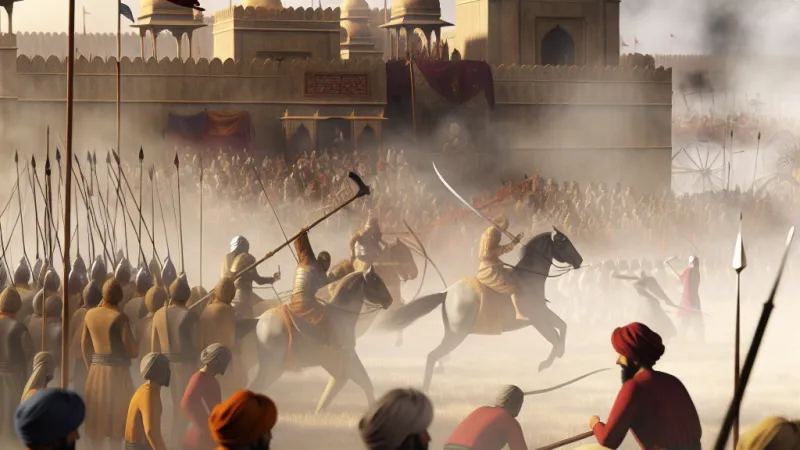
On the morning of the battle, the two armies arrayed themselves with all the pomp and fury of the times. The opening salvos were marked by archers and cavalry charges. Jai Chand’s elephants, rumbling forward, initially caused great disorder in Ghori’s ranks. By all accounts, the Gahadvala king held the upper hand in the first phase, with his soldiers inspired by their leader’s presence atop a grand elephant, his banners streaming in the wind.But ghastly fortune intervened. In the thick of combat, an arrow — some traditions say it was a stray, others insist it was a skilled marksman’s shot — struck Jai Chand in the eye. The mighty king tumbled from his elephant, mortally wounded. Turmoil spread through the Gahadvala ranks: seeing their king fall, soldiers lost their will and cohesion. In the confusion, Jai Chand, crushed by his own war beast or trampled amidst the melee, met his end.
6. Turning of the Tide: Collapse and Capture
With their king gone, the once-mighty Hindustani force broke ranks. Ghori’s disciplined soldiers pressed the advantage, swiftly capturing the Gahadvala treasury, war elephants, and a mountain of loot. In a matter of hours, the fate of Kannauj — and much of northern India — was rewritten. The Gahadvala court, steeped in Sanskritic traditions and the patronage of culture, was left leaderless.7. What Came After: Political and Cultural Upheaval
Muhammad Ghori did not linger to administer personally, instead placing loyal lieutenants to oversee territories. The Gahadvala dynasty all but crumbled; Jai Chand’s son Harishchandra tried to rally the remnants but lacked resources and popular support. The loss of Chandawar cleared the path for Muslim rule to expand unchecked, first under the Ghurids, and soon, with Qutb-ud-din Aibak, the construction of the Delhi Sultanate. The battle’s outcome also initiated a period where mosque-building and temple-transformations in conquered regions became potent symbols of new authority, as seen in the inscriptions of the Qutub Minar and narratives of the times.8. Chandawar's Shadow in Literature and Folklore
While battles like Tarain are much celebrated, Chandawar is sometimes overlooked in mainstream retellings, except in local ballads and folk memories across Uttar Pradesh. Some versions, passed down in villages, claim Jai Chand escaped, living anonymously before dying in exile, but these are mostly legend with little historical backing. Chroniclers like Hasan Nizami and Minhaj-i-Siraj reference the battle, sometimes with bias, reminding us how history is shaped by its tellers.The tale of Chandawar, however, is vital not only for the facts but for how it has entered our collective memory — as a warning against disunity and the tragic consequences of rivalry at the expense of the greater good.
9. The Legacy: From Rajputana to the Sultanate
The fall of Kannauj marked more than the end of a dynasty. It was a pivotal moment that saw centuries-old Rajput supremacy in northern India give way. The wave of conquests that started with Ghori and crystallised under Aibak cemented new socio-political structures, different administrative styles, and a gradual but undeniable cultural mingling — for instance, the adoption of Persian administrative terms into local courts, and the emergence of Indo-Islamic art and architecture.This event, more than being a mere battle, was a threshold: from the twilight of classical medieval India to the dawn of the Sultanate era, setting the stage for generations — from Iltutmish to Alauddin Khilji and beyond.
10. Reflection: Lessons from Chandawar
If history is our classroom, Chandawar is one of its most instructive lessons. The tragedy that befell Jai Chand and his dynasty was as much a result of external aggression as of fractured unity among Indian rulers. The battle also demonstrates how moments of crisis can reshape entire societies, languages, and ways of life. By studying events like Chandawar, students gain more than facts: they unearth the intertwined tales of ambition, loyalty, betrayal, resistance, and adaptation that define our past.Thus, the Battle of Chandawar is not just a paragraph in textbooks; it is a reminder that the stories of our land — echoing in riverside fields and remembered in secret ballads — are what make history come alive and urge us to reflect on the paths taken, and those not.
---
*In summary, the Battle of Chandawar symbolises a critical juncture in Indian history, when the fate of the land was shaped not only by armies and kings but by the very dynamics of political unity, the force of events, and the enduring lessons handed down through generations.*
Rate:
Log in to rate the work.
Log in