Annie Besant: Pioneer of Social Reform and Indian Nationalism
This work has been verified by our teacher: 5.03.2026 at 11:52
Type of homework: History Essay
Added: 2.03.2026 at 15:28
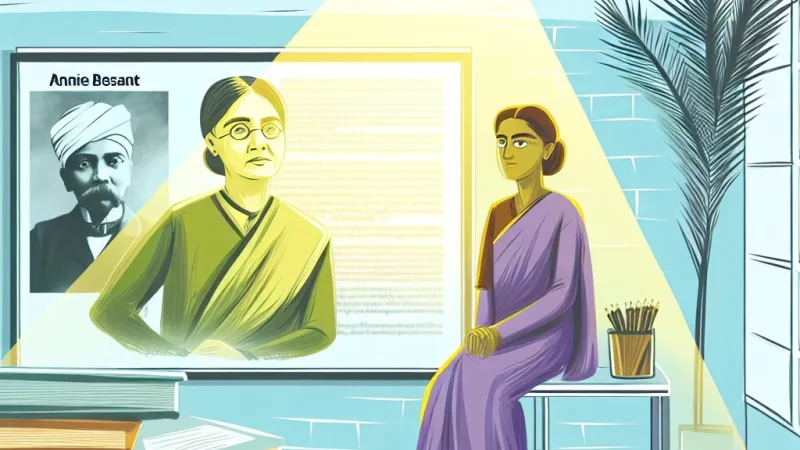
Summary:
Explore Annie Besant’s role as a pioneer of social reform and Indian nationalism to understand her impact on India's freedom and education movement. 📚
Annie Besant: The Torchbearer of Social Reform and Indian Nationalism
A name that resonates in Indian history with great pride, Annie Besant stands tall as a dynamic crusader for freedom, a visionary educationist, and an unparalleled advocate of social justice. While many remember the mainstream leaders of the Indian independence movement, Annie Besant’s contributions sometimes remain shaded, even though her impact was profound and far-reaching. She challenged the colonial establishment, redefined the idea of freedom fighting, and sowed seeds of progressive thought among generations of Indians. Her work encompassed not only the political arena but also the social and educational fabric of Indian society. In remembering Annie Besant, we not only honour her individual achievements but also acknowledge the power of ideas and leadership in nation-building.The Early Roots: A Life Shaped by Challenges
Born on 1st October 1847 in London, Annie Wood (as she was then known) came from a humble background, her father being a medical man and her mother running a girls’ school to support the family after his early demise. Growing up in such modest circumstances instilled in her a sense of independence, empathy, and responsibility from a young age. Her childhood was marked by limited resources but an abundance of books and moral conversations, which shaped her curiosity and critical thinking—a quality evident throughout her life.Annie’s higher education was sporadic but self-driven. Denied formal entry to universities (which at the time were not open to women), she learned voraciously from home, often surpassing her male counterparts in thought and ambition. At the age of 20, Annie married Frank Besant, a clergyman. However, differences in beliefs and values led to their separation. This phase of personal challenge did not dampen her spirit. Instead, it emboldened her resolve for self-realisation and societal service. Somewhat similar to the struggles that Savitribai Phule faced when advocating for women’s education in Maharashtra, Annie’s journey showcases perseverance in the face of conventions.
From British Reformer to Indian Ally
Back in Britain, Annie Besant immersed herself in the whirlwind of social changes defining the 19th century. She championed various causes: from trade unionism and women’s suffrage to birth control and secular education. Her association with the National Secular Society under Charles Bradlaugh marked Annie as a fearless rebel against dogma. She was a prolific writer, penning hundreds of essays and pamphlets, and a fiery orator whose lectures drew crowds across Europe.However, it was her involvement with the Theosophical Society, and later her encounter with Indian philosophies and Vedanta, that fundamentally transformed her path. Arriving in India in 1893, a time when the country was groaning under colonial weight, Annie Besant saw in India a land of immense spiritual depth yet stifled by both foreign rule and internal social ills. Her desire to learn from Indian wisdom and serve its people marked the real beginning of her Indian journey.
A Stalwart in India’s Freedom Struggle
To think of the Indian independence movement is to recall images of mass protests, Gandhi’s salt march, or Nehru’s stirring speeches. Annie Besant was a different but essential kind of freedom fighter. She believed that true ‘swaraj’—self-rule—could only blossom through mass enlightenment. In 1916, together with Lokmanya Tilak, she founded the All India Home Rule League, a momentous step that catalysed a new phase in India’s push for self-government. With headquarters in Madras (Chennai), the League strove for legislative reforms, greater Indian participation in governance, and social upliftment.In 1917, Annie Besant became the first woman President of the Indian National Congress—a remarkable achievement, considering the rigid gender and racial barriers of British India. She galvanised leaders like Motilal Nehru, C. Rajagopalachari, and even inspired the young Mohandas Gandhi, who acknowledged her importance in the movement. Her passionate speeches, petitions, and editorials (notably in her newspaper ‘New India’) were instrumental in broadening the nationalist platform to include students, workers, and marginalised communities, echoing Rabindranath Tagore’s call for an inclusive India.
Her activism was not without consequence—she was arrested by the British government in 1917. Her imprisonment sparked countrywide protests, entwining her fate definitively with India’s aspirations and cementing her as a people’s leader.
Reimagining Indian Society: Education and Social Equality
Annie Besant’s understanding of “freedom” went much beyond the British-imposed cages; it meant the freedom to think, question, and grow. A visionary educator at heart, she was instrumental in founding the Central Hindu College in Varanasi in 1898, which later became the nucleus of the Banaras Hindu University (BHU), one of India’s foremost educational institutions. Her belief was simple: education is the bedrock of personal and national progress.She defied caste barriers, promoted scientific and rational studies alongside traditional learning, and insisted on the education of girls—an act as revolutionary in her time as Pandita Ramabai’s crusade for women’s rights and literacy. Annie also led campaigns for birth control awareness, echoing concerns for women’s health that would only become mainstream in much later years.
Her leadership of the Theosophical Society—first in Adyar and later internationally—helped fuse Eastern spiritual insights with Western rationality. She popularised Indian scriptures such as the Bhagavad Gita worldwide and rekindled Indian pride in its philosophical legacy. Through her writings, she articulated a modern vision for India—one that respected its heritage while embracing progress.
A Legacy Carved in Indian Memory
Recognition for Annie Besant’s service came during her lifetime and continues even today. In independent India, her contribution was celebrated through institutions bearing her name and, in 1963, a commemorative postage stamp. Schools, colleges, and even public parks across cities like Chennai, Hyderabad, and Varanasi are named after her.Her life is immortalised not only in places but in the consciousness of reformers and youth who strive to blend social action with learning. Her ideas on secularism, as practiced by Jawaharlal Nehru in shaping modern India’s identity, and her advocacy for social equity, continue to be touchstones for activists pushing for change even today.
Annie Besant’s character was defined by courage, resilience, and an unshakeable intellectual integrity. She stood up unwaveringly to colonial authorities and cultural orthodoxies alike, reminding us of Indian leaders like Gopal Krishna Gokhale, who preferred persuasion and intellectual debate as their primary tools.
Remembering Annie Besant: Final Reflections
It is impossible to capture the essence of Annie Besant in just a few lines. Yet, if there is one lesson from her life for today’s youth, it is that one does not need to wield arms to fight for a nation. The power of speech, of the pen, of empathy, and of unrelenting will can move mountains. True, she came to India as a foreigner, but she became an Indian by heart; her life shows that love for a nation is defined not by birth but by service.Anna Hazare’s peaceful activism, Medha Patkar’s environmental campaigns, or Malala Yousafzai’s battle for girls’ education—all echo the spirit of Annie Besant. She bridged continents, beliefs, and classes, advocating an India that is self-reliant, aware, and just.
Tips for Students: Learning from Annie Besant
When studying the lives of historical figures like Annie Besant, look beyond the facts and timelines. Try to understand the world they lived in, their struggles, their choices, and the values they stood for. Read her collected speeches (available in the archives of the Theosophical Society or the National Library of India), or her biography by Arun Chandra Guha for a closer perspective.Her vision is still meaningful: the fight for gender equality, education reforms, religious harmony, and justice carries relevance in modern India. As young Indians, reflecting on her legacy encourages us to ask—how can we become channels for positive change in our own communities?
In sum, Annie Besant is more than just a name from the pages of history books. She is an enduring example of global citizenship, intellectual bravery, and transformative action. May her life inspire ever more generations to work for a free, fair, and enlightened India.
Rate:
Log in to rate the work.
Log in