Why Money Can't Buy Happiness: Meaning and Insights from India
This work has been verified by our teacher: 16.01.2026 at 16:30
Type of homework: Essay Writing
Added: 16.01.2026 at 15:56
Summary:
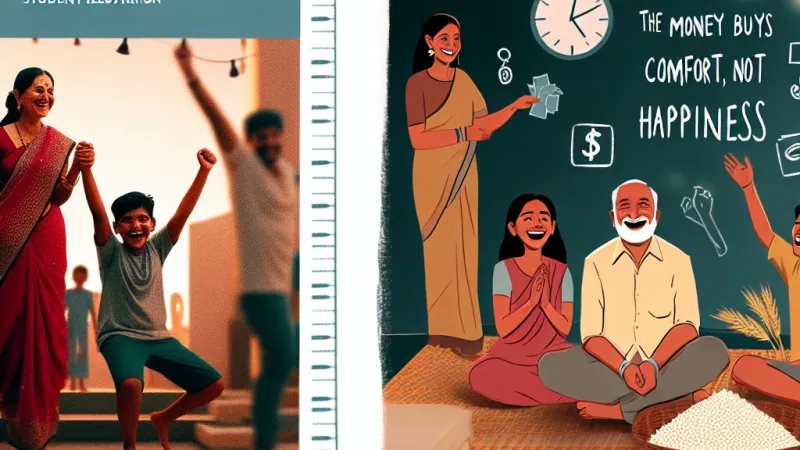
Pieniądze kupią wygodę, nie trwałe szczęście. W Indiach radość rodzi się z rodziny, wspólnoty i sensu; wydawaj mądrze na czas i doświadczenia.
Money Can’t Buy Happiness – Proverb Meaning and Expansion of Idea
If money truly bought happiness, then the busy city towers sparkling with possessions would be the happiest homes in India; yet, often, it is a crowded train ride home for Diwali that brings the real smiles. The ancient proverb “Money can’t buy happiness” is voiced by wise grandparents and philosophers alike, yet modern life constantly tempts us to measure our contentment by salary slips, smartphones, and status cars. At first glance, it seems obvious—one needs money for food and shelter—but the emptiness of a festival spent alone, despite an over-flowing wallet, tells a different story. Especially in India, where family bonds and traditions compete with pressures for material success, this proverb compels us to examine what truly matters. While money can secure comfort and expand opportunity, genuine happiness in the Indian context springs from relationships, meaningful pursuits, and a content mind—ingredients that no amount of wealth can guarantee.
---
Understanding the Proverb: Direct Meaning and Immediate Implications
At its simplest, “Money can’t buy happiness” means that while cash allows us to purchase goods and services, it cannot hand us the keys to satisfaction or contentment of the heart. Material comfort—a new car, designer sarees, or the latest phone—can certainly bring flashes of joy, but this is not the deep, lasting happiness that people long for. Take for example a family in Delhi who provides branded clothes and the best school for their daughter but rarely spend an hour genuinely talking with her; she is left feeling isolated despite the privileges. The proverb points out this gap between what wealth buys and the deeper, emotional nourishment that only care and connection can give. Still, it must be asked: Are all forms of happiness untouched by money’s reach, or does it sometimes help in more indirect ways?---
The Role of Money: Meeting Needs and Expanding Choices
To dismiss the value of money completely would be naive. Money is indispensable for meeting basic needs—nutrition, secure shelter, education, and healthcare—which are the foundations for any chance at happiness. In Indian households, rising income often means moving from a kutcha hut to a pucca house, or that a child can afford coaching classes for competitive exams. Here, a classic insight from economists like Richard Easterlin and researchers Kahneman & Deaton is apt: up to a certain threshold, increased income leads to better daily life and well-being, but beyond that, its power fades. In the rural Indian context, extra earnings may mean a bicycle to reach school or a water filter; in cities, perhaps the relief of paying rent on time. Money, then, is vital for dignity and safety, and it surely reduces distress. However, once the basic ladder of needs is climbed, adding more rungs does not correspond to greater emotional fulfilment. This is the limit the proverb highlights.---
Why Money Alone Cannot Produce Lasting Happiness
The limits of money’s magic are not only social but psychological. First, there is hedonic adaptation—the tendency for people to quickly get used to new comforts. The euphoria of buying a new bike in Bengaluru might thrill for a few days, but soon it becomes ordinary, and the mind yearns for the next big thing. Second, social comparison is forever at play. A middle-class student who tops in his hometown may feel inadequate in an urban coaching centre packed with wealthier peers, leading to unnecessary stress and envy despite “having enough”.Moreover, happiness driven by external purchases is fragile: it depends on fleeting circumstances rather than inner strength or values. Workaholic parents often claim to “earn for the family”, but their children may remember only the missing seat at Sunday lunch. Migrant workers from Bihar or Odisha may send money home, upgrading households, yet ache during Chhath Puja when distance robs them of celebration and belonging. Thus, while money can buy time, people frequently trade away precious time and presence, believing money will compensate—forfeiting the very moments that create true happiness.
---
Relationships, Purpose and Community: The Foundation of Happiness
If money is not the main ingredient, what then sustains happiness? Across India, whether in village or metropolis, the answer is surprisingly constant: deep relationships, a sense of belonging, and purposeful activity. Family and friendships provide love, trust, and support, especially during festivals like Holi or Eid, when communal meals and rituals knit people together. The sight of neighbours pooling food for Ganesh Chaturthi or lighting lamps together during Diwali often brings more joy than a solo shopping spree in a mall.Purpose, too, matters deeply. Whether it is a teacher shaping young minds in a small-town government school, or a volunteer organising winter blankets for the homeless, the satisfaction from meaning and service far outweighs material perks. Let me share a brief vignette: In my own colony, an elderly widower, living in modest means, beams every evening as children visit him for stories—his room is sparse, but his heart is full, proving that the richest joys are often “earned” through warmth and connection, rather than bought.
---
Nuance and Counterarguments: When Money Can Increase Happiness
It would be simplistic, however, to treat the proverb as an absolute. There are times when money does enable happiness—not by directly buying it, but by removing barriers. Access to reliable healthcare, quality education, and even leisure experiences like a family trip to a hill station can greatly enhance well-being. Research shows that strategic spending—using resources to buy time (such as hiring household help), creating shared memories, or providing security—can have real benefits.In the Indian context, consider a parent who invests in a child’s tuition classes, reducing exam stress, or a family using savings for a crucial surgery or sponsoring a modest community wedding. These uses of money build conditions in which happiness becomes possible. Similarly, gifts that create shared moments—a cricket bat for siblings, or funding arrangements for a neighbourhood Iftar—foster connection and joy. Thus, while money’s powers are limited, wise and thoughtful use can sustain the emotional health of individuals and families, especially during adversity.
---
Practical Ways to Use Money to Foster Genuine Happiness
If we accept that happiness is not simply available on the shelves of the local bazaar, the question becomes: how should we use what we have? The wisest choice is to spend on what strengthens relationships and nurtures personal growth. Weekend trips to a relative’s village, hosting family feasts, or enrolling in painting or yoga classes together often bring lasting pleasure. Investing in help that frees up time—like hiring a cook so parents can join children at the park—can be more rewarding than upgrading to a flashier device.Altruism is another source: contributing to charity, or even supporting a friend’s education, generates well-being, as countless studies (and our own experience) confirm. In the Indian web of rituals, investing in community events or joint festival arrangements can reinforce bonds that outlive any material purchase. Avoiding conspicuous consumption for status’s sake and focusing on self-improvement, whether through education or therapy, can make each rupee serve a higher purpose.
---
Stories from Indian Life: Illustrating the Idea
Let’s consider the story of Ramesh, a young engineer from Pune. Ambitious and talented, he quickly climbed the salary ranks in an IT company, always trading time for overtime, missing birthdays and anniversaries at home in Nashik. Year after year, he consoled himself with expensive gifts sent by courier to his parents. Yet, when his father fell ill and he finally managed a fortnight’s leave during Ganpati, it was the quiet chai on the veranda and simple home-cooked meals with his family that brought him a joy his bonuses had never matched. Ramesh realised that small moments, not big paycheques, stayed alive in memory and spirit. Such stories abound in every Indian town—a reminder that genuine happiness is built, not bought.---
Broader Social and Policy Implications
On a larger canvas, the proverb urges us to think about how societies and governments should prioritise well-being. A country’s wealth alone does not guarantee its citizens happiness. Smart Indian policy would combine economic growth with provision for mental health services, green spaces, community halls, and work-life balance initiatives. Programmes like midday meals and neighbourhood festivals may cost less than high-tech gadgets but deliver greater social contentment. Vast inequality, too, erodes trust and togetherness, emphasising the need for social safety nets. Education must build emotional resilience and value compassion, not just academic scores or financial ambition, for a truly satisfied society.---
Rate:
Log in to rate the work.
Log in