Maha Vir Chakra: 10 Simple Lines About India's Second Highest Gallantry Award
This work has been verified by our teacher: 23.01.2026 at 15:16
Type of homework: Essay Writing
Added: 21.01.2026 at 5:53
Summary:
Explore 10 simple lines on Maha Vir Chakra to learn about India’s second highest gallantry award and the bravery honored in its military history.
10 Lines on Maha Vir Chakra
India is a land that has produced countless brave hearts who guarded its borders and preserved its honour with immense courage. In any society, it is crucial to recognise those who risk or lay down their lives for others. Just as ancient texts like the *Mahabharata* celebrate the valour of warriors like Arjuna and Abhimanyu, modern India honours such bravery with prestigious military awards. Among these, the Maha Vir Chakra (MVC) holds a place of extraordinary significance. The MVC is the second highest gallantry award given for acts of conspicuous bravery in the presence of the enemy. Understanding the essence of the MVC helps Indian students appreciate the sacrifices made by soldiers and motivates them to uphold the spirit of selfless service for the nation.
Historical Background and Establishment
After India attained its independence from British rule in 1947, the need arose for indigenous awards to honour acts of civilian and military gallantry. The old British decorations like the Distinguished Service Order (DSO) no longer represented the new spirit of the nation. Thus, on 26th January 1950, the very day when India became a republic and adopted its Constitution, the Government of India instituted the Maha Vir Chakra. Interestingly, the effect of the award was made retrospective from 15th August 1947, ensuring that heroes who had already displayed exemplary courage during the tumultuous times of partition and subsequent wars would not go unrecognised. Through the decades, the MVC has served as a symbol of India’s gratitude to its brave defenders in all major wars — from the Kashmir conflict of 1947-48, the Indo-China war of 1962, the Indo-Pak wars of 1965 and 1971, to the Kargil conflict of 1999.Eligibility and Criteria
One of the salient features of the Maha Vir Chakra is that it may be awarded to all ranks of the Indian Army, Navy, and Air Force, without distinction based on grade, position, or gender. The award is conferred for acts displaying exceptional bravery or self-sacrifice on the battlefield, in the direct presence of the enemy. For example, during the Kargil conflict, MVC recipients included not only officers who led attacks but also junior soldiers who mounted daring rescues or defended their posts against overwhelming odds. The MVC can also be given posthumously, recognising the ultimate sacrifice of a soldier who did not survive their act of bravery. Families of such martyrs receive the medal and the gratitude of the whole nation. In rare instances, a person may be decorated with the MVC more than once for separate displays of gallantry, cementing their legacy as shining examples of heroism.Design and Symbolism
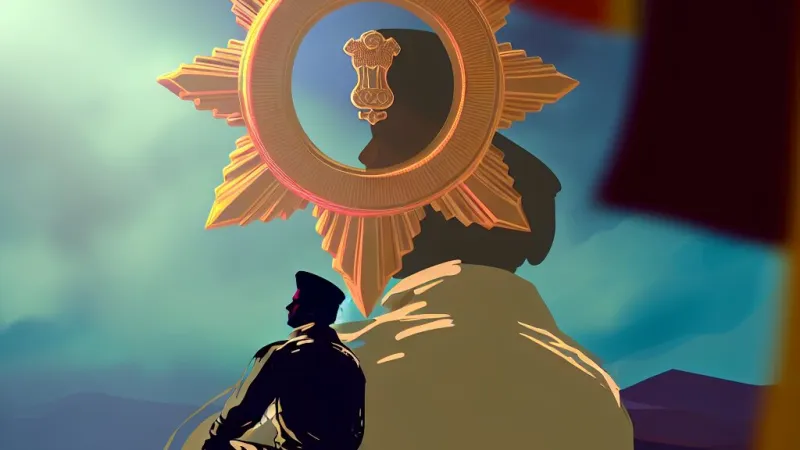
The Maha Vir Chakra medal is itself a piece of art reflecting India’s culture and values. Crafted from standard silver, the medal is circular, approximately 35 mm in diameter. Its face features a five-pointed star, in the centre of which is the Lion Capital of Ashoka, the national emblem of India, representing strength and pride. On the reverse, “Maha Vir Chakra” is engraved in both Hindi and English, with a lotus flower — a motif deeply connected with Indian art and spirituality — on either side. The ribbon from which the MVC is suspended is a rich orange colour with a white stripe in the middle, symbolising courage (orange) and purity (white). The regulations about wearing it are meticulous, reflecting the deep respect with which such honours are treated in the Indian armed forces.Presentation and Benefits
Being awarded the Maha Vir Chakra is not just a personal honour — it is a matter of immense pride for an individual’s family, regiment, and their entire community. The medal is traditionally presented by the President of India during grand ceremonies on Republic Day (26 January) or Independence Day (15 August) at the Rashtrapati Bhavan in New Delhi. Apart from the distinction of wearing the medal, recipients are also entitled to use “MVC” as a suffix to their name. Additionally, the central government provides a monthly allowance and, often, state governments grant extra benefits such as cash awards, land, or other incentives. The event is widely covered by Indian media, and awardees become household names, inspiring both present and future generations.Notable Recipients and Their Stories
Since its inception, more than 200 individuals have received the Maha Vir Chakra. The very first batch of MVCs was conferred in the aftermath of the 1947-48 conflict in Jammu & Kashmir, with Colonel Ranjit Rai being among the initial recipients for his gallantry. One story that stands out is that of Squadron Leader Jag Mohan Nath, who received the MVC not once, but twice, for his daring reconnaissance missions during the 1962 and 1965 wars. In the 1971 Indo-Pak war, Flight Lieutenant Nirmal Jit Singh Sekhon was posthumously awarded the MVC and remains a legend in the Indian Air Force as the only IAF officer to have received this honour. These stories find their place not just in military records but also in popular culture, history lessons, and motivational books that fill Indian library shelves.Cultural Relevance
The respect commanded by the Maha Vir Chakra extends far beyond the armed forces. Its recipients are celebrated in national textbooks, documentaries on Doordarshan and private channels, and even in films such as “LOC: Kargil” and “Border”, which depict the heroism of soldiers who either were awarded the MVC or were considered for it. School children recite poems about such bravery, and in many CBSE schools, short essays or “10 lines” compositions are assigned to instil a sense of patriotism. Moreover, the awareness about the MVC contributes to unity in a country as diverse as India. It reminds citizens that valour knows no barriers of language, region, or religion.Educational Importance
The “10 lines” format is especially popular among Indian students, making complex subjects accessible and memorable. By summarising the key facts about the MVC in ten specific points, students gain both information and an emotional connection to the topic. For example, when learning that the youngest recipient of the MVC was only in his early twenties, students feel a mix of pride and empathy for the youth who defend them. Teachers use these lines to start classroom discussions on duties, sacrifice, and the meaning of courage in daily life.My Own Reflection on Maha Vir Chakra
The Maha Vir Chakra is not just a medal but a living symbol of courage and selflessness. Every time I read about another young soldier awarded the MVC, I feel inspired to do my own duty honestly, whether it is studying for exams or helping someone in need. The stories of MVC recipients prove that greatness is achieved not by birth or wealth but by standing up bravely at the right time, when your people expect it. In many ways, the Maha Vir Chakra unites our past — the spirit of warriors like Chhatrapati Shivaji and Rani Lakshmi Bai — with our present and future defenders of the nation.10 Key Lines on Maha Vir Chakra
1. The Maha Vir Chakra (MVC) is India’s second highest military decoration for bravery. 2. It was established on 26th January 1950, effective from 15th August 1947. 3. MVC honours acts of great courage and self-sacrifice in the face of the enemy. 4. All ranks of the Indian Army, Navy, and Air Force are eligible for this award. 5. The medal is silver, circular, with a five-pointed star and the Lion Capital at its centre. 6. “Maha Vir Chakra” is inscribed in both Hindi and English, flanked by lotus symbols. 7. The ribbon is orange with a white stripe, representing courage and purity. 8. Awardees receive the MVC from the President of India in a special ceremony. 9. The MVC can be given posthumously, honouring fallen heroes and their families. 10. Recipients inspire the nation with their stories of selfless courage and patriotism.Conclusion
The Maha Vir Chakra is a testament to the spirit of sacrifice that lies at the heart of India’s armed forces. Its recipients, whether living or martyred, are the true heroes of our land. By learning about the MVC, students and citizens alike develop a deeper appreciation for the values that keep our country safe and united. As Rabindranath Tagore wrote in *Gitanjali*, “Let me not beg for the shelter in danger's hour but let me be fearless in facing them.” The MVC is, indeed, the highest embodiment of such fearlessness — a beacon that will continue to light the path for generations of Indians.---
Glossary - *Gallantry*: courage, especially in battle - *Posthumous*: awarded after the recipient has died - *Sovereignty*: supreme power or authority
---
By celebrating the Maha Vir Chakra and those who earn it, we pay homage to the best qualities of the Indian spirit and pass on a legacy of honour to the future.
Rate:
Log in to rate the work.
Log in