Swami Vivekananda: A Visionary Leader of Indian Spirituality and National Pride
This work has been verified by our teacher: 19.02.2026 at 16:45
Type of homework: History Essay
Added: 16.02.2026 at 11:53
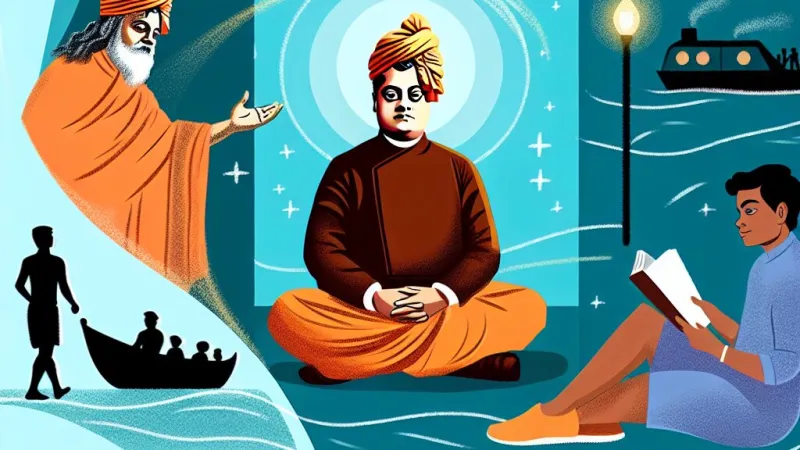
Summary:
Explore Swami Vivekananda’s visionary leadership in Indian spirituality and national pride, learning his inspiring journey and lasting impact on youth and society.
Swami Vivekananda: The Torchbearer of Modern Indian Spirituality and National Consciousness
Swami Vivekananda remains an eternal star in the constellation of India’s spiritual and intellectual heritage. Revered not just as a saint but also as a visionary thinker and social reformer, he profoundly reshaped the idea of Indian spirituality at a time when our country grappled with colonial subjugation and cultural self-doubt. He instilled newfound pride in our ancient wisdom, while simultaneously urging Indians to engage with the modern world with confidence and dignity. His powerful call to the youth—"Arise, awake, and stop not till the goal is reached"—continues to echo in the corridors of our schools and universities. This essay journeys through Swami Vivekananda’s inspirational life, exploring the confluence of spirituality, social commitment, and intellectual vigour that defined his legacy, and examining his relevance in contemporary India.Early Life and Foundations
Born as Narendranath Datta on 12 January 1863, in Kolkata, Vivekananda belonged to a distinguished Bengali Kayastha family. His father, Vishwanath Datta, was a modern thinker and a successful lawyer, whose legal practice brought both comfort and intellectual exposure to the household. More profoundly, Narendranath’s mother, Bhuvaneshwari Devi, with her deep religiosity and strong character, became his first spiritual teacher. In family traditions and stories, it is said that she would often narrate episodes from the Ramayana and Mahabharata to the young boy, sowing in him seeds of heroism and compassion.From an early age, Vivekananda exhibited an uncanny curiosity about the mysteries of life and existence. Meditation came naturally to him; often, he would sit motionless with eyes closed, lost in profound contemplation—even as a child. His schooling at Ishwar Chandra Vidyasagar’s Metropolitan Institution introduced him to an atmosphere that upheld rational thought and social reform. Later, at Presidency College, he mingled with the brightest minds of Bengal Renaissance—a period marked by intellectual and cultural efflorescence, producing legendary figures like Bankim Chandra Chatterjee and Rabindranath Tagore.
Narendranath was not merely a scholar. He was an accomplished athlete, practiced yoga and wrestling, and had a melodious voice that enchanted listeners in music soirees. This holistic development—encompassing body, intellect, and spirit—was to become a hallmark of his later teachings. His memory was phenomenal; anecdotes from his friends mention how he could recall whole passages from philosophical texts after a single reading.
The Search for Spiritual Truth
Despite his academic prowess, Narendranath’s youth was haunted by profound existential doubts. He questioned dogmas and rituals, refusing to accept mere tradition without personal verification. The central question that disturbed him was—"Has anyone seen God?" He approached many religious scholars with this query but found no satisfactory answer until destiny led him to Sri Ramakrishna Paramhansa at Dakshineswar.Ramakrishna, a simple priest deeply steeped in spiritual experience, profoundly influenced the restless young man. Unlike the pedantic scholars of his time, Ramakrishna spoke from the depth of his own realisations, teaching that religion was not blind faith but direct experience—"Yato mat, tato path" (As many faiths, so many paths). Under Ramakrishna’s guidance, Vivekananda experienced glimpses of divine bliss and realised the core tenet of Vedanta—that the soul is inherently divine and unity is the fundamental truth. The earnest disciple soon adopted monastic life, giving up worldly attachments. He received the name ‘Vivekananda’—a combination of ‘Viveka’ (discrimination between the real and the unreal) and ‘Ananda’ (bliss), symbolising his spiritual insight.
Swami Vivekananda: Social Reformer and Voice of India
Swami Vivekananda’s mission transcended personal enlightenment. He affirmed that "service to man is service to God," often referencing the Upanishadic dictum "Atithi Devo Bhava" (The guest is God). He travelled extensively across India, witnessing first-hand the abject poverty, superstitions, and caste discrimination that plagued Indian society. Deeply moved, he resolved that spiritual awakening must go hand in hand with social upliftment.His founding of the Ramakrishna Mission stands as a testament to his vision: an institution dedicated to educating the masses, caring for the sick, and fostering interfaith harmony. Long before the word ‘secular’ became popular in Indian polity, Vivekananda lived and preached it.
His moment of global recognition came in 1893, in Chicago, at the World Parliament of Religions. Addressing the gathering as "Sisters and Brothers of America," his words drew thunderous applause and placed Indian spirituality on the world stage. He spoke not only of Hinduism, but eloquently advocated for religious tolerance and universal brotherhood. This was a time when India was often regarded patronisingly by the West; Vivekananda’s proud assertion of India’s spiritual heritage countered stereotypes and won profound respect for the country.
Back home, Indian freedom fighters including Subhash Chandra Bose and Sri Aurobindo drew inspiration from him. Bose famously remarked that Vivekananda was "the maker of modern India." His vision of nationalism was unique—infused with pride in India’s spiritual roots, but also with a pragmatic willingness to reform and modernise.
Philosophical Teachings and Spiritual Practice
At the heart of Vivekananda’s philosophy lay four yogas—Karma Yoga (the path of selfless action), Bhakti Yoga (devotion), Jnana Yoga (knowledge), and Raja Yoga (meditation). He urged people, especially youth, to cultivate strength—physical, intellectual, and moral. Unlike escapist asceticism, his ‘Practical Vedanta’ stressed bringing spirituality into daily actions, transforming both the individual and society.He popularised Yoga in the West long before it became a global craze, linking it not just to physical health but to mental discipline and self-mastery. His seminal book ‘Raja Yoga’ made Indian meditative traditions accessible to seekers outside India. He insisted—“You cannot believe in God until you believe in yourself.” For him, faith in one’s own potential was as important as faith in divinity.
Always optimistic, Vivekananda believed that every individual possessed infinite energy and possibility. Courage, he often said, was the highest virtue. Instead of lamenting fate, "take up one idea… make that one idea your life," he implored. The well-being of the poor, women’s education, and unity across caste and religion were central to his reforms.
His Daily Discipline and Endearing Personality
Swami Vivekananda’s discipline is almost legendary. Even in monastic life, he maintained a strict regimen of exercise—wrestling, rowing, swimming, and walking. His mornings began with prayer and meditation, which he believed were as vital as food and sleep. Despite being a monk, he enjoyed playing the pakhawaj (an Indian drum) and singing devotional songs, often bringing deep warmth to his congregation.Intellectually, he was unmatched. He could quote from the Vedas, Upanishads, and Gita, as easily as he could discuss Shakespeare or explain Newton’s theories. His speeches were marked by lucidity, wit, and profound empathy—a rare blend that charmed both scholars and commoners.
Yet, it was perhaps his compassion that won people most. He mingled with everyone, regardless of caste or creed, often visiting the poor and the ailing. Numerous anecdotes describe his humility—sharing his meal with orphans, consoling widows, or encouraging students to be bold and self-reliant.
Legacy: Radiance Across Generations
Swami Vivekananda’s impact didn't end with his short span of 39 years. To this day, his birthday is celebrated as National Youth Day, reminding every Indian adolescent of the potential within. The Ramakrishna Mission and global Vedanta societies continue his work, blending spirituality with social service.He inspired countless leaders—Jawaharlal Nehru acknowledged him as "one of the great founders of the nationalist movement," while Mahatma Gandhi said that reading Vivekananda made him love his country a hundredfold. His writings have been translated into almost every major Indian language—reaching young minds from Nagaland to Kerala.
His thoughts resonate powerfully in contemporary India, dealing with issues like communalism, youth unemployment, and a crisis of values. His message is clear—India’s regeneration depends not on political power alone, but on “muscles of iron, nerves of steel, [and] mind made of thunderbolt.” His call for spiritual democracy—where every human’s divinity is respected—remains as vital in our fractured times as it was during the struggle for independence.
Conclusion: The Path Forward
To encapsulate Swami Vivekananda’s legacy is to chart the evolution of modern Indian identity—from the ashes of colonial defeat, he inspired pride, confidence, and compassion. He seamlessly fused the loftiness of Upanishadic thought with the urgency of social reform, urging every Indian to believe in oneself and serve humanity. As we face new challenges—technological change, social inequality, and a globalised world—his ideals provide both anchor and direction.Vivekananda once said, “They alone live, who live for others.” On that foundation, he built more than an ashram—he ignited a movement. For every Indian student, his life is a luminous example: to cultivate both intellect and empathy, to be as rooted as a banyan and as aspiring as the Himalayas. In striving for personal excellence and national good, may we find inspiration, as countless Indians before us have, in the undying light of Swami Vivekananda.
Rate:
Log in to rate the work.
Log in