Rathyatra: Odisha's Grand Chariot Festival and Its Significance
This work has been verified by our teacher: 25.01.2026 at 14:25
Type of homework: Essay Writing
Added: 24.01.2026 at 9:51
Summary:
Explore Odisha’s grand Rathyatra festival, its history, sacred chariots, and cultural significance, helping students craft insightful essays with ease.
Rathyatra: The Grand Chariot Festival of Odisha
Few festivals in India carry the scale, splendour, and sanctity of Rathyatra, an event so deeply enshrined in our nation’s consciousness that it transcends religious ritual to become a living symbol of spiritual unity, artistic heritage, and communal harmony. Celebrated annually in Puri, Odisha, Rathyatra is not only one of the oldest and most iconic festivals in India but also one which brings together people from all hues of society, drawing millions of devotees and travellers to witness a truly grand procession. This essay delves into the story of Rathyatra, exploring its historical roots, religious significance, the grandeur of its chariots, the rituals and processions that define it, and its enduring role in shaping the cultural and social fabrics of India.Historical and Religious Foundations
The story of Rathyatra flows from the very core of Odia culture, interwoven with the legend of Lord Jagannath—an incarnation of Lord Vishnu—and his siblings, Balabhadra and Subhadra. The word ‘Rathyatra’ is a marriage of two Sanskrit words: ‘Ratha’ meaning chariot, and ‘Yatra’ meaning journey. Its origins are deeply entrenched in the ancient Puranic texts such as the Skanda Purana and the Brahma Purana, which recount Lord Jagannath’s grand annual journey from his majestic abode in the Jagannath Temple to the nearby Gundicha Temple, believed to be his aunt’s residence.This ritualistic visit is popularly interpreted as a divine family reunion, where Lord Jagannath, along with his elder brother Balabhadra and younger sister Subhadra, embarks on an elaborate procession to the Gundicha Temple, symbolising the bonds of kinship as well as the Supreme Being’s accessibility to all. Notably, the very act of moving the deities outside the sanctum sanctorum and among the people signifies the immense grace of the Lord, erasing any barriers between deity and devotee.
Vaishnavism, a major strand of Hindu belief, venerates Jagannath as a form of Lord Krishna, and so the Rathyatra also celebrates the playful and compassionate persona of Krishna. What makes this festival particularly noteworthy is its overarching theme of inclusiveness—devotees from every walk of life, irrespective of caste, creed, or status, come together to pull the colossal chariots, signifying the essential equality of all before the divine.
The Chariots: Artistry, Symbolism, and Preparation
No description of Rathyatra is complete without marvelling at the chariots themselves, which stand as masterpieces of craftsmanship and religious symbolism. Each year, three gigantic wooden chariots are painstakingly constructed anew by hereditary master carpenters from the Maharana and Bhoi communities of Odisha—an act reminiscent of the joust between tradition and creative renewal.Lord Jagannath’s chariot, named Nandighosh, towers above the others, painted with thirteen peaks and adorned with a kaleidoscope of colours, symbolising the Lord’s supreme status. Its sixteen wheels suggest a completeness, echoing ancient cosmological symbolism. Balabhadra’s chariot, Taladhwaja, painted in deep green and blue, features fourteen wheels, while Subhadra’s chariot, Darpadalan, is distinguished by its canary-yellow hues and twelve wheels. Each chariot is drawn by four elaborately painted wooden horses and festooned with sacred motifs, appliqué canopies, and fresh floral garlands.
The preparation for Rathyatra begins many weeks in advance. A traditional ceremony known as ‘Akhaya Tritiya’ marks the beginning of chariot construction, accompanied by Vedic chants and purification rituals to invoke divine blessings. The work itself is a harmonious blend of religious discipline and shilpakala (sculptural art), with intricate carvings and vibrant paintings that reflect centuries of Odia woodcraft tradition.
Once every twelve or nineteen years, a rare and mystical event called Nabakalebara is held, wherein new idols are carved from sacred Neem wood and installed to replace the old. This ritual not only rejuvenates the festival but also sanctifies the link between mortals and the divine, as priests conduct secretive and age-old ceremonies to infuse the idols with life-force, known as ‘Brahmapadartha’.
The Rathyatra Procession: Rituals, Reverberations, and Revelry
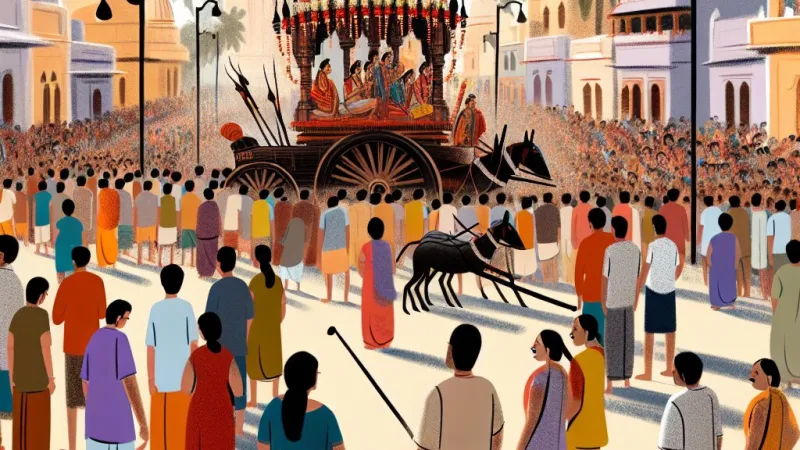
Rathyatra is celebrated on the second day of the bright fortnight (Shukla Paksha) in the month of Ashadha (June-July), as per the Hindu calendar. At dawn, Puri’s Grand Road (Bada Danda) readies itself for an unparalleled spectacle. A palpable sense of anticipation hangs in the air as lakhs of devotees, dressed in bright sarees and dhotis, gather outside the Jagannath Temple, their voices rising in devotion. The swirling fragrance of marigolds, the rhythmic beat of mridangams and cymbals, and the blowing of conch shells combine to create a mesmerising atmosphere.As the temple gates open, the deities are brought forth in a ceremonial procession called ‘Pahandi Bije’, swaying rhythmically as priests chant mantras and play sacred music. The ritual ‘Chhera Pahanra’ marks a moving moment when the Gajapati King of Puri sweeps the chariot platforms with a golden broom, demonstrating that before Lord Jagannath, all are humble servants—be they monarch or citizen.
The highlight is the actual pulling of the chariots. Thousands of devotees surge forward to grasp the thick ropes, their hands sticky with turmeric and vermilion, eyes glistening with tears of faith. The act of pulling the chariot is believed to earn great spiritual merit, washing away sins and bringing good fortune. As the chariots roll towards the Gundicha Temple, folk artists break into Odissi dance, kirtans, and bhajans, celebrating the Lord’s journey with infectious enthusiasm. The entire 2.5 km route becomes a river of chanting, music, and colour.
Once the chariots reach Gundicha Temple, the deities remain there for a week—a period filled with rituals, cultural fairs, and offerings. The city bustles with energy as locals and pilgrims mingle, and the air is thick with devotion and festivity. The return journey, known as ‘Bahuda Yatra’, sees the gods escorted back in similar grandeur, closing the sacred cycle.
Rathyatra’s Impact on Society and Culture
More than a religious event, Rathyatra epitomises India’s ethos of social inclusiveness. On this day, the distinctions that usually stratify society—caste, class, and background—dissolve in the sea of devotion. Whether it is a fisherman from Chilika or a software engineer from Bengaluru, all strive to lend a hand to the chariots, inspired by the faith that Lord Jagannath is everyone’s god.From a socio-economic perspective, Rathyatra provides a vital boost to Odisha’s economy. Every year, lakhs of pilgrims flock to Puri, fuelling a cycle of prosperity for hoteliers, local artisans, street vendors, and transport operators. Odia handicrafts, particularly Pattachitra paintings and appliqué textiles from Pipli, see robust trade during this period.
Rathyatra has also journeyed far beyond Odisha. Iconic temples in cities like Kolkata, Ahmedabad, and Mumbai now host their own chariot processions. Internationally, ISKCON has propagated Rathyatra to places as distant as London, Moscow, and Sydney—affirming its role as a powerful ambassador of Indian culture. For the Indian diaspora, these processions bridge the gap between the homeland and adopted countries, offering a slice of Indian spirituality amid foreign shores.
Personal Reflections: Devotees and the Transformative Power of Faith
For those who experience Rathyatra, either as a devotee or a wide-eyed observer, the memory lingers long after the chariots have returned to the temple. Many recount that the act of pulling the ropes, even for a moment, fills one with a profound sense of surrender—a reminder of our collective bond with the divine. An elderly pilgrim I met once described it thus: “To touch the rope is to touch God Himself. No temple wall, no ritual can come between us in that moment.”The festival is also a showcase of resilience and hope—through heat, crowds, and fatigue, people sing, dance, and open their hearts to one another. For countless believers, Rathyatra becomes a moment of self-discovery, humility, and joy, nurturing both personal faith and communal well-being.
Conclusion
To sum up, Rathyatra stands as a resplendent celebration of devotion, craftsmanship, and social unity. The festival’s origins stretch deep into Hindu mythology, yet its heartbeat remains powerfully contemporary—blending ritual and revelry, faith and fraternity. The artful construction of the chariots, the grandeur of the procession, the equality of all before the Lord, and the coming together of communities echo through the generations, upholding India’s unmatched cultural heritage.Even today, as modernity sweeps through our cities and aspirations, Rathyatra continues to draw people in, offering an anchor to tradition and a vision of universal brotherhood. It reminds us that festivals are not just about rituals but about reclaiming the best in ourselves—compassion, humility, and unity. In the rolling wheels of the chariots and the singing crowds on Puri’s Grand Road, one hears the timeless song of India itself: perpetually ancient, ceaselessly new, and forever united in the journey towards the divine.
Rate:
Log in to rate the work.
Log in