Women Empowerment: Key to India’s Progress and Equality
This work has been verified by our teacher: 28.02.2026 at 14:07
Type of homework: Essay Writing
Added: 26.02.2026 at 11:23
Summary:
Discover how women empowerment drives India’s progress and equality by enabling education, rights, and equal participation for a stronger nation.
Women Empowerment: The Foundation of Progress and Nation-Building
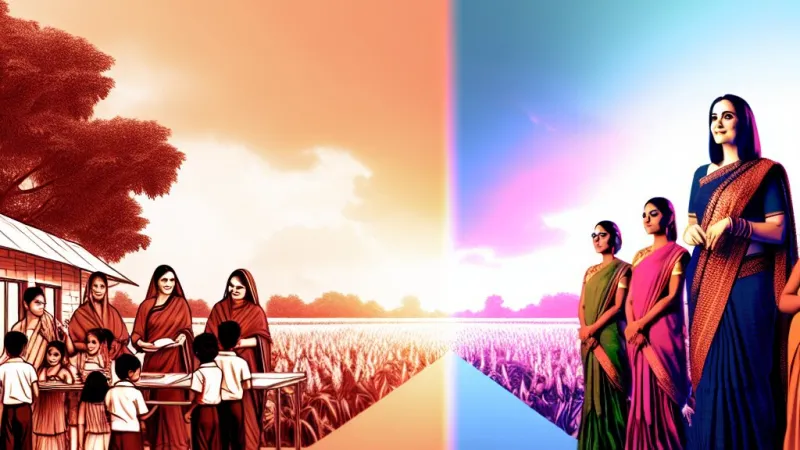
Women empowerment is a transformative process which equips women with rights, self-confidence, and the freedom to make their own choices in all spheres of life. It means giving women the ability to participate equally in education, economy, decision making, and social life – not just as dependents or supporters, but as independent contributors. In a country like India, where women account for nearly half the population, their empowerment is crucial for the country’s balanced development. As we move deeper into the 21st century, the need for empowering women is more urgent than ever, because the true progress of our society and nation is incomplete without active, dignified participation of women.
Historical and Socio-Cultural Context
The history of women’s status in India presents a complex picture. Ancient India saw women as respected and learned figures — Gargi and Maitreyi’s names are still mentioned with reverence in Vedic literature. However, over the centuries, the status of women diminished with the rise of patriarchal norms, restrictions on mobility, and customs like dowry, child marriage, and the practice of “purdah.” Literary classics like Munshi Premchand’s “Nirmala” depict the suffering of girls in arranged child marriages. Stereotypes about women being only suitable for household work became entrenched, often discouraging families from investing in girl child’s education, especially in rural settings.The tide slowly began to turn with the efforts of social reformers like Raja Ram Mohan Roy who opposed Sati, Ishwar Chandra Vidyasagar who campaigned for widow remarriage, and Savitribai Phule, the first female teacher of India, who fought for girls’ education. The Indian freedom struggle saw women like Sarojini Naidu and Kasturba Gandhi emerge as prominent leaders, and post-Independence, our Constitution guaranteed equality before law to women. Still, centuries of social conditioning and discrimination have left deep imprints, and the struggle for equality continues in the modern era.
Key Dimensions of Women Empowerment
1. Education: The First Step Towards Freedom
Education is the primary tool for breaking cycles of ignorance and subjugation. When a girl is educated, she not only gains knowledge, but also the self-assurance to question injustice, stand up for her rights, and contribute to society. Progressive thinkers like Swami Vivekananda declared that no progress was possible without women’s education. Our country has seen encouraging changes: According to the 2011 Census, the female literacy rate in India was 65.46%, up from earlier decades, signalling an upward trend. However, the gap with male literacy (82.14%) remains, and dropouts in rural schools are still a cause for worry.Besides books, skill development and vocational training are essential, especially in a rapidly changing job market. Programmes like “Skill India” focus on skilling women for employment, enabling them to support their families and pursue self-reliance.
2. Economic Empowerment: Building Financial Independence
A woman with her own income has a stronger say in her household and in larger community matters. Today, from women drivers like Shila Dawre in Pune to astronauts like Ritu Karidhal of ISRO (the ‘Rocket Woman’ behind Chandrayaan-2), Indian women have excelled in diverse professions. Self-help groups (SHGs), microfinance, and entrepreneurship training have played a vital role, especially in empowering rural women. The Lijjat Papad cooperative, started by a group of Mumbai women, is a powerful example – it now employs thousands of women across the country.Still, women’s representation in the workforce remains lower than expected. According to World Bank data (2021), female labour participation in India is around 19.2%, much lower than the global average. Achieving economic empowerment needs not just employment but also equal pay, maternity benefits, and opportunities for rising to leadership roles.
3. Legal Rights and Protection
While laws have been made to promote equality (like Article 14: Right to Equality), and protect women (like the Protection of Women from Domestic Violence Act, 2005 and the Sexual Harassment of Women at Workplace Act, 2013), their effectiveness depends on enforcement and awareness. Many women, especially in villages, remain unaware of their rights or how to access justice. The Nirbhaya case (2012) brought national attention to the urgent need for stricter laws and better policing. Legal sensitization programmes, helplines, and legal aid campuses run by NGOs have helped somewhat, but continued effort is crucial.4. Social and Political Participation
Political participation gives women control over decision-making and a voice in governance. The reservation of seats for women in Panchayati Raj institutions (33% mandated) has led to lakhs of women joining local politics. Figures like Smt. Pratibha Patil (former President) and Smt. Nirmala Sitharaman (Finance Minister) prove that women can – and must – be leaders at the highest level. In social life, women’s groups have spearheaded changes, whether it's fighting alcoholism as seen in some villages of Andhra Pradesh, or forming collectives against domestic violence.5. Health and Safety
Health is foundational for empowerment. Issues such as anaemia, maternal health, access to menstrual hygiene products, and malnutrition afflict millions. Schemes like Janani Suraksha Yojana promote institutional deliveries and maternal care. However, safety remains a concern: crimes like dowry harassment, female foeticide, trafficking, molestation, and rape still occur. Declining child sex ratios in some states reflect deeply-rooted problems. Creating safe public spaces, improving reporting mechanisms, and teaching self-defence must be part of the empowerment agenda.Barriers to Women Empowerment in India
Empowerment faces multiple, overlapping obstacles. Patriarchal attitudes confine many girls to homes, denying them freedom to study, work, or even go out independently. Poverty further limits access to opportunities — when a poor family must choose who to send to school, often it's the boy. Violence, both visible and invisible (like controlling behaviour, or insistence on certain dress), curtails women’s growth. In tribal and backward areas, child marriages are still practiced, and girls are married off before 18, disrupting their education.Another challenge is the digital divide: internet access is much lower for women than for men, limiting access to online education and career opportunities. A 2022 survey found that only about a third of internet users in rural India were women.
The Role of Government and Policy Initiatives
The Indian government has launched several schemes to address these gaps. ‘Beti Bachao Beti Padhao’ has campaigned extensively to improve child sex ratio and promote girl’s education, particularly in states like Haryana where gender imbalance was acute. Schemes like ‘Ujjawala’ work towards prevention and rehabilitation of trafficking victims. ‘Mahila Shakti Kendra’ and ‘National Mission for Empowerment of Women’ provide support at block and district levels. Policies like maternity benefits, increased for working women, and reservations in local governance have led to concrete, observable benefits.Yet, challenges persist, especially in uniform outreach and effective implementation in remote areas. Monitoring, accountability, and the proactive involvement of panchayats and community leaders need to be strengthened for real impact.
The Role of Education Institutions, NGOs, and Media
Schools and colleges play a decisive role in shaping attitudes. By including lessons on gender equality in textbooks and enabling girls to participate in sports, debates, and leadership roles, educational institutions can actively fight discrimination. Many NGOs, such as SEWA (Self Employed Women’s Association) in Gujarat or Pratham, work on the ground connecting women to skills, finance, health education, and legal help.Media has the immense power to shape social narratives – TV serials like ‘Balika Vadhu’ have sparked conversations around early marriage, and movies like ‘Dangal’ and ‘Pink’ challenge traditional roles and highlight women’s potential as well as everyday struggles. At the same time, the media must be responsible in not perpetuating stereotypes and instead, amplifying stories of positive change.
Importance of Empowering Women for India's Growth
The participation of women translates directly to family and national prosperity. Where women work, household incomes increase, children are better educated, and the next generation can break out of poverty cycles. Socially, empowered women are more likely to reject regressive customs – for instance, educated mothers rarely practice or approve child marriage or female foeticide.Furthermore, diverse leadership brings balanced decision-making, helps address community needs more holistically, and advances democracy. Internationally, India improves its global rank and competiveness when it reduces the gender gap and offers all citizens equal opportunity – this is critical for a fast-growing economy aspiring for “Viksit Bharat” in coming decades.
Strategies for Strengthening Women Empowerment
First, sensitisation on gender equality must begin early – in families, schools, and among boys as much as girls. Textbooks, counselling, and orientation sessions can change mindsets over time. Second, skill-building and higher education, tailored for local needs (like tailoring, computer literacy, financial management, or even non-traditional skills like solar installation), are needed to create jobs for women.Engaging men as partners – sons, fathers, brothers, husbands – in these efforts will accelerate change: societies advance when all members are invested in collective progress. Third, existing laws must be explained to women through workshops and local leaders; fast-track courts and helpdesks should become more accessible.
The use of technology — online classes, mobile banking, health apps, and digital communities — can help bridge gaps, especially for rural women. Government and private sector collaborations are key to scaling up such interventions.
Conclusion
To sum up, women empowerment cannot be restricted to one area; it is a holistic process involving education, economic independence, legal assistance, social freedom, and health. It requires coordinated efforts across family, society, government, and a change in long-standing attitudes. Recent visible progress gives hope, but equality must become the norm rather than exception—whether in classrooms, boardrooms, or homes.The vision for India must be one where each girl and woman enjoys the right to dream, choose, and achieve. When women rise, the whole nation rises with them — and thus, women empowerment is not merely an issue for women; it is a crucial step towards true national prosperity, justice, and harmony.
Rate:
Log in to rate the work.
Log in