Santa Claus: History, Traditions, and His Role in Indian Festivities
This work has been verified by our teacher: 31.03.2026 at 12:48
Type of homework: Essay Writing
Added: 30.03.2026 at 15:04
Summary:
Explore the history and traditions of Santa Claus and discover his unique role in Indian festivities, blending cultural tales with festive joy and generosity. 🎅
Santa Claus — The Legendary Gift-Bringer: Origins, Evolution, and Cultural Significance
Every year as December approaches, a peculiar excitement washes over children and adults alike. Shops put up twinkling lights, colourful decorations begin to appear, and in the midst of these celebrations, the image of a cheerful, red-suited old man emerges everywhere — Santa Claus. His jolly presence is not only central to Western Christmas traditions, but has also found an enthusiastic place in Indian urban life, especially among children who look forward to the possibility of mysterious gifts under their pillows or by the bedside. This essay explores the fascinating journey of Santa Claus, tracing his historical roots, evolution into a symbol of joy and generosity, and his cultural importance, especially reflecting on how he is celebrated within the unique context of the Indian festive landscape.
I. Historical Origins of Santa Claus
The legend of Santa Claus did not begin as the story of a merry, bearded man distributing presents in the cold of winter. Instead, his story has its origins in a real person: Saint Nicholas, an early Christian bishop who lived during the 4th century in the region now known as Turkey. Saint Nicholas was renowned throughout his life for his compassion, kindness, and acts of generosity, often directed towards children and the less fortunate. One of the most famous stories tells of how he discreetly provided dowries for three impoverished sisters, saving them from a life of hardship. This compassionate heart earned him great devotion, and his deeds began to turn into folk tales after his passing.Over time, Saint Nicholas’s fame grew, spreading across Europe. The remains of Saint Nicholas in Bari, Italy—in the Basilica di San Nicola—became a pilgrimage site, and devotion to his memory inspired various traditions of anonymous gift-giving, especially on his feast day, 6th December. In many European countries, this custom of sharing gifts in secret, especially with children, started gaining popularity. Gradually, the image of Saint Nicholas as a stern but loving bishop transformed through centuries of oral storytelling and local customs.
The most significant shift in the legend’s journey came when the Dutch, who called him “Sinterklaas,” settled in different parts of the world, including America. The name “Santa Claus” is believed to have developed from “Sinterklaas.” Thus, from his starting point as a religious figure, Saint Nicholas evolved into an almost magical character, forming the foundation of the modern Santa Claus.
II. Cultural and Symbolic Evolution
From Ancient Saint to Modern Santa
Santa’s appearance did not always match the fluffy-bearded, rotund gentleman we see today in shopping malls and greeting cards. In older illustrations, Saint Nicholas appeared in bishop’s robes. It was through the steady influence of literature and art, particularly in Victorian England and 19th-century America, that his look transformed. Stories like “A Visit from St. Nicholas” (commonly known as “The Night Before Christmas”) described him in a fur-trimmed red coat, with twinkling eyes and a joyful laugh. The famous “ho ho ho” and the habit of climbing down chimneys gained popularity through such retellings.By the 20th century, advertising companies contributed significantly in fixing Santa’s image as we know him today. It is often said that Coca-Cola advertisements in the 1930s popularised the cheerful, red-suited Santa who looks gentle and approachable, perfect for charming children’s hearts across the globe. From then onwards, this image became nearly universal, transcending boundaries and cultures.
Symbolism and Cultural Context
Santa Claus stands for much more than just a distributor of toys and sweets. He embodies the spirit of giving, the magic of hope, and the joy of community celebration. In every aspect, he represents generosity — a reflection of the values of sharing and caring that are echoed in numerous Indian festivals as well. One can even observe how the concept of anonymous giving, or “daan,” in Indian religious traditions, finds resonance in the story of Saint Nicholas.Across the globe, gift-bringers similar to Santa Claus can be seen. For example, in parts of Europe, he is known as Father Christmas, and in parts of the world like France, he is known as Père Noël. Folklore across Germany speaks of the Christkind, a gentle angelic figure bestowing gifts, while in some Asian cultures, new adaptations have taken place, integrating the gift-giving custom into their own festive routines.
III. Santa Claus in Tradition and Popular Practices
The Magical World of Santa’s Travels
The imagination of children has crafted a wonderful world where Santa Claus travels across the entire globe in a single night, delivering gifts to millions. Legends speak of his magical sleigh, pulled by eight reindeer with charming names like Dasher, Dancer, Prancer, Vixen, Comet, Cupid, Donner, and Blitzen. Eventually, the story introduced Rudolph, the red-nosed reindeer, who led Santa’s sleigh through foggy weather, teaching children about how uniqueness can be a gift.Children are often told that Santa manages to slip down chimneys to deliver presents, or in homes without chimneys (as in much of India), they invent other magical ways for his entry — some say through the window, others imagine he finds hidden doorways. The tradition of leaving out goodies for Santa — cookies and milk in some countries, or carrots for his reindeer — although not native to India, is sometimes adopted in urban, English-medium schools which host Christmas parties.
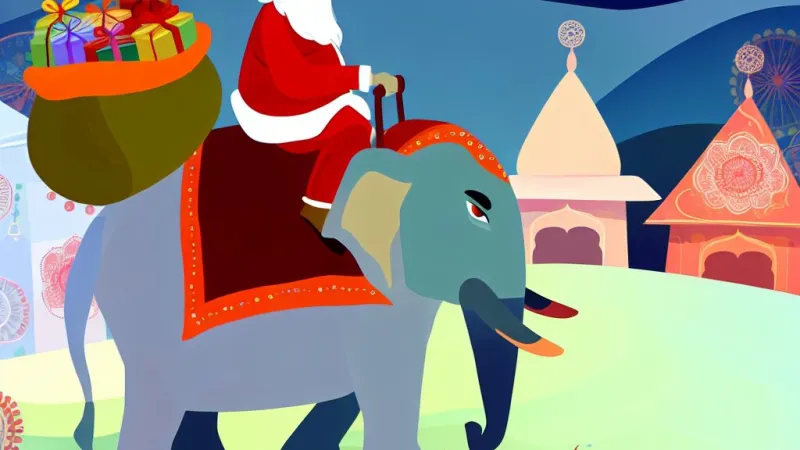
In India, especially in cities like Mumbai, Chennai, and Bengaluru where Christian communities thrive alongside others, Christmas celebrations have evolved to include the figure of Santa Claus. Schools organise Christmas functions where a teacher or student dresses up as Santa, distributing toffees or small presents. Shopping malls and department stores hire performers in Santa costumes to interact with children, keeping the magic alive.
The Art of Gift-Giving
One charming tradition is the act of writing letters to Santa Claus, telling him one’s wishes or sharing stories of good deeds. This ritual is not only about seeking gifts, but also an exercise in imagination and creative writing. In certain Indian schools, Secret Santa games are played where students or teachers anonymously exchange small gifts, inspired by Santa’s spirit of giving.The presence of Santa also strengthens the economy as businesses create elaborate displays and special products around Christmas, while various groups organise charity drives and community meals, inviting people from different backgrounds to partake in the festive spirit.
IV. Educational and Social Impact
Santa Claus, through his legend and practices, introduces children to the ideals of selfless giving and joy in bringing happiness to others. Indian parents and teachers often use his story to nurture these values. For example, children are encouraged to share their old toys or books with those less privileged during Christmas time, reliving the generosity that Saint Nicholas once showed.The fantasy surrounding Santa Claus also stimulates imagination and belief in magic — essential ingredients for the healthy emotional development of young minds. It is not uncommon for parents in Indian cities to hide gifts and create scavenger hunts, building an atmosphere of joyful anticipation.
However, there are thoughtful discussions about how long to maintain the legend, and at what age to gently reveal the truth, ensuring that the sense of wonder stays but the values attached to Santa’s story become rooted in reality.
Some critics argue that the modern Santa Claus, especially as seen through glossy advertising, represents commercialisation and excess, sometimes overshadowing the deeper meaning of Christmas, which for many is still a religious and deeply spiritual festival. Progressive voices also discuss how Santa can be made more inclusive, transcending the image of an elderly white man to reflect the diversity of communities celebrating him, including in India, where Santas of all hues don the red cap.
Conclusion
From a humble bishop embodying compassion in ancient Turkey, to a mythical figure delighting children from Kerala to Kashmir, Santa Claus has traversed an extraordinary journey through history, culture, and imagination. His transition from Saint Nicholas to the Santa celebrated in Indian malls and schools mirrors the evolving nature of traditions themselves — blending old and new, local and global.Santa’s enduring charm lies not in magic alone, but in the values of kindness, selflessness, and hope that he represents. Whether it is the joy of waking up to a surprise under the pillow, writing a letter to an unseen friend, or donning a Santa cap to spread laughter at a school gathering, the legend continues to brighten hearts.
In a country as vast and varied as India, where festivals are woven with stories that teach empathy and community spirit, Santa Claus is more than just a Christmas import; he is a figure who inspires us to keep the light of humanity burning bright, reminding us that in giving, we truly receive the greatest gift of all.
Rate:
Log in to rate the work.
Log in