Top 10 Sentences Explaining the Significance of Brahmotsavam Festival
This work has been verified by our teacher: 7.03.2026 at 18:45
Type of homework: Essay Writing
Added: 4.03.2026 at 14:38
Summary:
Discover the significance of Brahmotsavam festival with 10 clear sentences explaining its history, rituals, and cultural importance in Indian tradition.
Brahmotsavam: Celebrating Divinity and Community in Indian Culture
Festivals are the soul of Indian life, weaving together threads of faith, tradition, and collective joy. In every state of India, festivals mark the calendar not just as holidays, but as moments of spiritual renewal and communal togetherness. Among these vibrant festivals, Brahmotsavam stands out for its grandeur and heartfelt devotion, especially in Andhra Pradesh and Telangana. It is not merely a religious event; it is a spectacular fusion of mythology, art, tradition, and social harmony that continues to thrive from ancient times to the present day.Historical and Mythological Origins of Brahmotsavam
The term ‘Brahmotsavam’ itself reveals much—‘Brahma’ refers to the creator god in Hindu belief, and ‘utsavam’ means festival. According to age-old legends found in temple chronicles, the genesis of Brahmotsavam lies in a divine act. It is believed that Lord Brahma, wishing to seek forgiveness for Lord Indra’s excesses, was the first to perform this festival as an act of purification and penance. This act was dedicated to Lord Vishnu, who, in his incarnation as Venkateswara, became the recipient of immense devotion during these ceremonies.While much of the story is mythological, there are historical records found in stone inscriptions and palm-leaf manuscripts at the Tirumala Venkateswara Temple, the heart of Brahmotsavam festivities. These inscriptions point to royal patronage by the mighty Pallava and Vijayanagara dynasties. Notably, Queen Samavai, also remembered as Queen Samavai Perundevi, is recorded to have donated precious ornaments and lands for the uninterrupted conduct of Brahmotsavam in the ninth century. Over hundreds of years, what possibly began as a temple-centred ritual grew into a massive, public celebration that draws lakhs of devotees today, keeping the original spirit of atonement and gratitude alive.
Timing and Duration of the Festival
The timing of Brahmotsavam is deeply rooted in the Hindu lunar calendar. It is most commonly celebrated during the auspicious month of Ashwin, which falls between September and October. This period often coincides with the popular festivals of Navratri and Dussehra, adding to the magnificent festive mood throughout South India.A typical Brahmotsavam lasts nine days, mirroring the Navratri celebrations devoted to goddess Durga. Each day is assigned special significance, manifesting in unique rituals, processions, and offerings. In years when the lunar calendar includes an additional month (Adhika Masa), some temples conduct Brahmotsavam twice, with the ‘Salakatla Brahmotsavam’ and ‘Navratri Brahmotsavam’ celebrated in close sequence. This rare occurrence further amplifies the festival’s religious fervour.
Interestingly, the festival’s timing traditionally aligns with the harvesting season in south India. It is a period when granaries are full, and communities are naturally inclined towards gratitude and celebration, recognising both nature’s bounty and divine blessings.
The Temple and the Supreme Deity
No discussion of Brahmotsavam is complete without mentioning the majestic Tirumala Venkateswara Temple. Nestled atop the Seshachalam Hills in Tirupati, Andhra Pradesh, it is among the most visited pilgrimage sites in the world. The temple’s Dravidian architecture, with its towering gopurams and intricate carvings, is a testimony to centuries of devotion and artistry.At the centre of Brahmotsavam lies the worship of Lord Venkateswara, an incarnation of Vishnu. During the festival, it is not the main deity (Moolavar) who is brought out, but the Utsava Murti—a specially crafted idol designed for ease of procession. This idol, clad in dazzling ornaments and flower garlands, is carried across the temple streets, allowing devotees from all walks of life to witness and worship the deity in close proximity. This practice symbolically takes divinity beyond the sanctum sanctorum, into the midst of the people, reinforcing the notion that the divine pervades all spaces.
Rituals and Ceremonies: The Heartbeat of Brahmotsavam
Each day of Brahmotsavam is a spectacle of age-old rituals, with every detail meticulously followed as per Agama Shastras (temple scriptures).The festival begins with ‘Ankurarpana’, a seed-sowing ritual symbolising growth and prosperity. It is succeeded by the raising of the ‘Garuda Dhwaja’—the flag bearing the image of Lord Garuda—on the temple’s golden flagstaff. This act is believed to invite all celestial beings to participate in the earthly festivities.
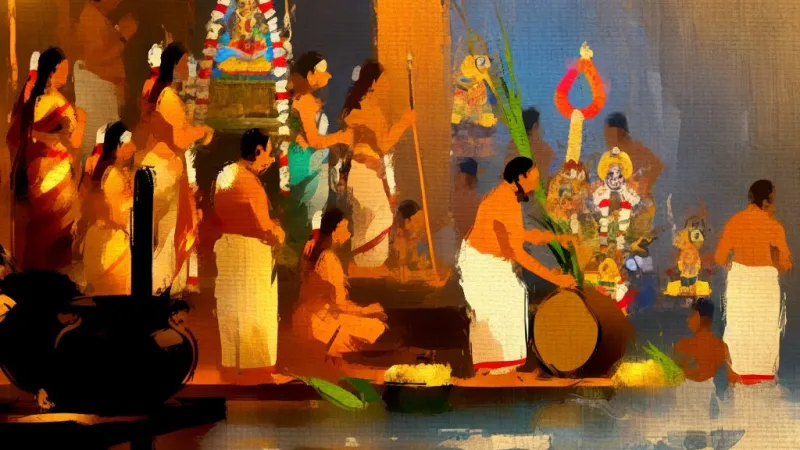
The most awaited events are the daily vahanam (vehicle) processions. Over nine days, the Utsava Murti is paraded atop different vahanams, each carrying symbolic significance. For example, the Garuda Vahanam, featuring Lord Vishnu’s eagle mount, represents omnipotence and protection; the Hanumantha Vahanam signifies loyalty and strength; while the Simha (lion) and Gaja (elephant) vahanams depict courage and royal dignity, respectively. The golden chariot procession (Tiruchi) and the palanquin (Palki) are grand highlights, often accompanied by festive music, the rhythmic beats of traditional drums, and the chanting of Vedic hymns.
On the concluding day, ‘Chakrasnanam’ or holy bath of the Sudarshana Chakra (Vishnu’s disc) is performed in the temple tank, underscoring themes of purification and renewal. Incense, sandal paste, and garlands of fresh flowers suffuse the air with fragrance, creating a deeply spiritual atmosphere.
Social, Cultural, and Economic Significance
Brahmotsavam is much more than a set of religious ceremonies; it is a powerful social event that draws millions, fostering a sense of belonging and unity. The whole community comes alive with activity—priests, staff, local families, volunteers, and visiting devotees—creating an ecosystem of vibrant participation and mutual support.The festival is a living exhibition of Indian performing arts. Classical music and dance recitals—such as Kuchipudi and Carnatic vocal performances—enrich the proceedings. Folk stories and legends surrounding Lord Venkateswara are retold, ensuring their preservation as part of the region’s intangible heritage. Artisans set up stalls selling traditional crafts and delicacies, benefiting from the influx of pilgrims.
From an economic standpoint, Brahmotsavam has a tremendous impact. The hospitality, transport, and food sectors flourish during this period as lakhs of visitors throng the temple town. Small traders and craftsmen find new markets for their wares, and the overall vibrance adds to the local economy.
The festival, however, is not without contemporary challenges. Managing huge crowds, ensuring the safety and comfort of pilgrims, and preserving the sanctity of rituals in the face of commercialisation are ongoing concerns. Modern technology—digital ticketing, live streaming for remote devotees, and enhanced crowd management systems—has been integrated to address these issues, ensuring that traditional values and present-day needs go hand in hand.
Deeper Symbolism and Spiritual Meaning
At its heart, Brahmotsavam is a reminder of life’s cyclical nature and the unbroken connection between humanity and the divine. The festival signifies cleansing—not only of the physical realm but of the soul. By participating in these sacred rituals, devotees believe their prayers are magnified, and their karmic burdens lightened.The daily processions are more than a visual treat; they symbolise the journey of the soul through different stages of life, guided and protected by the divine. The entire event, with its splendid celebrations and serious devotion, captures the essence of Indian spirituality: joy and discipline, tradition and innovation, the individual and the collective.
Conclusion
In summary, Brahmotsavam is a festival that embodies the multi-layered fabric of Indian tradition. Rooted in ancient legend and nourished by historical patronage, it stands today as a remarkable blend of spirituality, art, and social unity. The nine-day spectacle at Tirumala is echoed by similar celebrations in temples across Andhra Pradesh and Telangana, keeping alive the cosmic dance of ritual and meaning.Brahmotsavam is a reaffirmation of India’s enduring capacity to blend devotion with community, faith with festivity, and the past with the present. For every devotee, organiser, and visitor, the festival is a journey—one that inspires reverence, fosters connections, and ignites the soul with the spirit of divine grace. Even in the modern era, its echoes shape the cultural memory, economic well-being, and social life of generations, proving that tradition, when celebrated with sincerity and innovation, never truly grows old.
Rate:
Log in to rate the work.
Log in