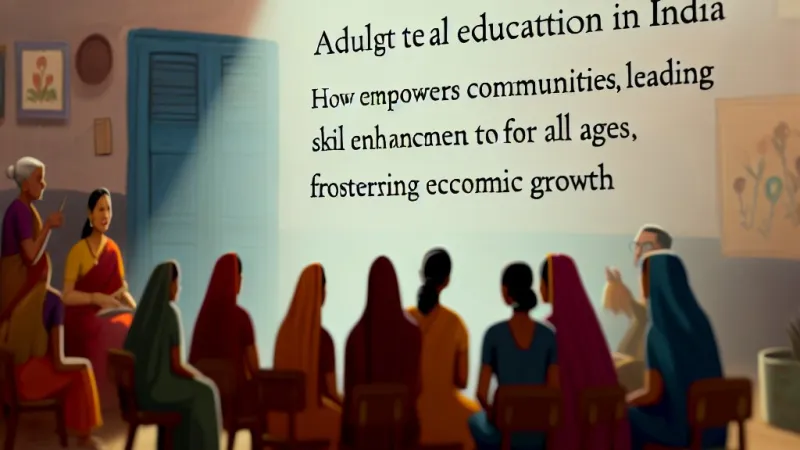
In India, education is often associated with school uniforms, morning assemblies, and the chatter of children in classrooms. Yet, learning is far from limited to one’s youth. Our ancient texts like the Upanishads and Bhagavad Gita remind us that the quest for knowledge is a lifelong journey, not a destination marked by age. Amidst a country as diverse and populous as ours, many adults missed timely access to formal education, whether due to poverty, social constraints, or personal circumstances. Adult education refers to initiatives aimed at equipping grown-ups—especially those who had little or no schooling—with essential skills, literacy, and knowledge. The significance lies not just in academic development; adult education is key to personal and social progress, economic upliftment, and national advancement. Nowhere is this truer than for women, rural citizens, and marginal communities. Thus, fostering adult education is vital for holistic growth, bridging gaps, and building a more equitable society.
The Significance of Adult Education
Breaking the Age Barrier in Learning
"Vidya dadati vinayam," our elders say—knowledge brings humility. In India, the notion that learning stops at a certain age is being challenged. Whether it is the 60-year-old grandmother proudly writing her name for the first time or a middle-aged farmer learning digital payments, adults are proving that curiosity and growth know no bounds. Education is continuously evolving, and every individual has the right and the ability to learn irrespective of age.
Bridging the Literacy Gap
According to the 2011 Census, India's adult literacy rate stood at 74%. However, this statistic hides staggering regional and gender inequalities: certain states and rural localities fare much worse, and women lag behind men. Adult education works actively to close this gap. A literate adult can participate more fully in societal activities, stay informed about rights, and break cycles of disadvantage that have persisted for generations.
Social and Economic Upliftment
Education is a ladder out of poverty. When adults learn to read, write, and acquire new skills, they access better jobs, make wiser financial decisions, and improve their standard of living. Adult education also encourages entrepreneurship—with training in skill development, many start small businesses, from tailoring to food stalls to computer centres. This domino effect greatly aids India’s mission to reduce poverty and bridge the urban-rural divide.
Empowerment of Marginalised Groups
For countless Indian women and marginalised communities, adult education is more than learning; it is liberation. It is the difference between dependency and autonomy. Women who become literate are likelier to ensure their children—especially daughters—receive an education, challenging outdated norms like child marriage or dowry. When people are empowered to participate in the democratic process, question injustices, and claim their rightful agency, true progress takes root.
Challenges Faced by Adult Learners
Balancing Responsibilities
A common sight in India is a mother attending evening classes after a day’s labour or household chores. Adult learners juggle multiple roles—as parents, workers, caregivers—which limits their availability for regular classes or lengthy courses. This calls for learning environments that are flexible, accessible, and sensitive to their constraints.
Limited Access to Resources
While urban areas enjoy digital infrastructure and libraries, rural India often battles shortages of trained teachers, study materials, and internet access. Power cuts, lack of classrooms, and minimal exposure to computers further hinder adult education efforts. Traditional blackboard learning may not suit elderly learners unfamiliar with classroom routines.
Social Stigma and Psychological Barriers
There remains a stigma around adults going "back to school." Many fear ridicule by peers or embarrassment at their learning pace. Those who have previously dropped out may lack confidence or motivation. Changing these perceptions requires compassion, role models, and empathetic community support.
Financial Constraints
Though schemes exist, adults often cannot afford to forego daily wages to attend classes. Even modest fees for registration, travel, or study materials can be prohibitive. Without proper incentives or stipends, participants may drop out, leading to incomplete or unsuccessful outcomes.
Types of Adult Education Programmes
Basic Literacy and Numeracy
Many initiatives focus on foundational reading, writing, and arithmetic. Programmes like the National Literacy Mission offer simple, context-based lessons tailored for adults, often delivered in local languages.
Vocational and Skill Development
From mobile repair to embroidery, cookery, or basic accounting, vocational courses are crucial. Government-run Industrial Training Institutes (ITIs), Jan Shikshan Sansthans, and NGOs provide hands-on training, linking education to practical, income-generating skills.
Awareness Programmes and Continuing Education
Some courses go beyond textbooks, offering guidance on health, sanitation, women’s rights, digital banking, and environmental sustainability. For instance, awareness about panchayati raj elections or legal rights can transform communities.
Formal and Informal Opportunities
Adult education centres may resemble traditional schools, but distance learning, weekend workshops, radio courses, or community study groups offer alternatives suited for busy adults. The growing popularity of online platforms—like SWAYAM or DIKSHA—makes learning accessible to those with internet or smartphones.
Government Initiatives
India has pioneered several schemes: Saakshar Bharat targets women’s literacy and community learning, while the Directorate of Adult Education designs material and training for educators. Adult education is also a focus area in the National Education Policy 2020.
Role of Government and NGOs
Policy Framework
Government policies have set ambitious goals for improving adult literacy and lifelong education. The National Literacy Mission, for instance, aimed to educate 80 million adults, and the more recent New India Literacy Programme (2022-27) seeks to make India fully literate.
NGOs Enhancing Outreach
Thousands of NGOs like Pratham, Ekal Vidyalaya, and Room To Read operate in difficult terrains and underserved areas, mobilising volunteer teachers, conducting literacy camps, and providing learning materials. Their participatory methods, like story-telling circles or interactive games, make learning enjoyable and relevant.
Community Involvement
Local leaders, Gram Panchayat heads, and former learners act as motivators and monitors. When education is rooted in community effort, the transformation is faster and more sustainable. Success is seen not just in exams, but in cleaner streets, healthier children, or a drop in social evils.
Benefits of Adult Education
Personal Growth
Acquiring the ability to read, write, and understand the world boosts self-esteem, broadens perspectives, and encourages better decision-making. Adults become more independent, articulate, and confident, benefiting their families and society at large.
Economic Development
With new skills, adults pursue better livelihoods, increase family income, and contribute to national productivity. Financial independence leads to improved health, housing, and access to services, uplifting entire communities.
Social Change
Adult education directly addresses issues like gender bias, superstitions, and discrimination. Literacy campaigns in states like Kerala have been instrumental in reducing child marriage, dowry cases, and even domestic violence.
Intergenerational Impact
Literate parents, especially mothers, inspire their children to study, ensuring that the legacy of learning continues for the next generation. It seeds lifelong curiosity, making education a family value, not just a personal pursuit.
Technology and Innovations
Digital Learning
Mobile apps in vernacular languages, video tutorials, WhatsApp study circles, and online classrooms connect even remote learners. Digital literacy campaigns teach adults how to access government schemes, e-health, and online markets.
Radio and TV Programmes
Channels such as Gyan Vani broadcast adult learning content, delivering lessons on everything from maths to health in regional languages, reaching places where internet is patchy.
Community Resource Centres
Libraries, panchayat bhawans, and community halls double as learning spaces. Here, adults can gather, exchange ideas, and learn together, fostering a sense of belonging and mutual support.
Bridging the Digital Divide
Though technology promises much, gaps still exist; initiatives like National Digital Literacy Mission aim to ensure all Indians, including adults, can use basic digital tools confidently.
Success Stories from Across India
Stories like that of Gulab Chand, a farmer in Rajasthan who learned to manage his accounts after attending night classes, or Saraswati Devi of Bihar, who after joining a literacy class now runs her own tailoring business, inspire many. In Kerala’s Kottayam, entire villages have achieved 100% literacy with adult education drives. Women’s self-help groups, once dependent, now run microenterprises, challenging stereotypes and raising living standards.
How Students and Society Can Contribute
Spreading Awareness
Awareness drives through rallies, street plays (nukkad nataks), or posters can motivate more adults to join classes and break the silence around illiteracy.
Volunteering
School and college students can tutor adults, tech-savvy youth can conduct digital literacy camps, and retired teachers can volunteer time and expertise.
Advocacy
Calling for more funding, infrastructure, and flexible courses is crucial. Society must lobby for accessible, affordable education for all, regardless of age.
Fostering a Culture of Learning
If families and communities celebrate every learner, no matter the age, adult education becomes a badge of honour, not shame.
Conclusion
Adult education is not just a second chance; it is a new beginning. It brings hope, dignity, and opportunity to millions who were once left behind. From raising living standards to enriching democracy and reducing harmful practices, its ripple effects touch every corner of our nation. In the words of Dr. B.R. Ambedkar, “Cultivation of mind should be the ultimate aim of human existence.” Let us stand together as students, citizens, and policymakers to ensure education is truly lifelong in India. For when adults learn, families thrive, and the whole nation marches ahead.
Frequently Asked Questions about AI Learning
Answers curated by our academic expert team
What are the key points on adult education and its role in empowering communities?
Adult education improves literacy, bridges social gaps, promotes economic growth, and empowers marginalized groups, fostering community advancement.
How does adult education empower communities in India?
It enables adults to acquire essential skills, access better jobs, and actively participate in society, thus uplifting entire communities.
What challenges are faced in adult education for empowering communities?
Challenges include balancing responsibilities, limited resources, social stigma, and psychological barriers that hinder adult learners' progress.
Why is adult education important for women and marginalized groups?
Adult education gives women and marginalized communities autonomy, helping break dependency and enabling them to advocate for their rights.
How does adult education contribute to bridging the literacy gap in India?
Adult education targets those who missed formal schooling, helping increase literacy rates and reduce regional and gender disparities.
Rate:
Log in to rate the work.
Log in