Ensuring Environmental Justice through Equitable Responsibility Sharing
This work has been verified by our teacher: 24.03.2026 at 18:45
Type of homework: Essay Writing
Added: 23.03.2026 at 11:42
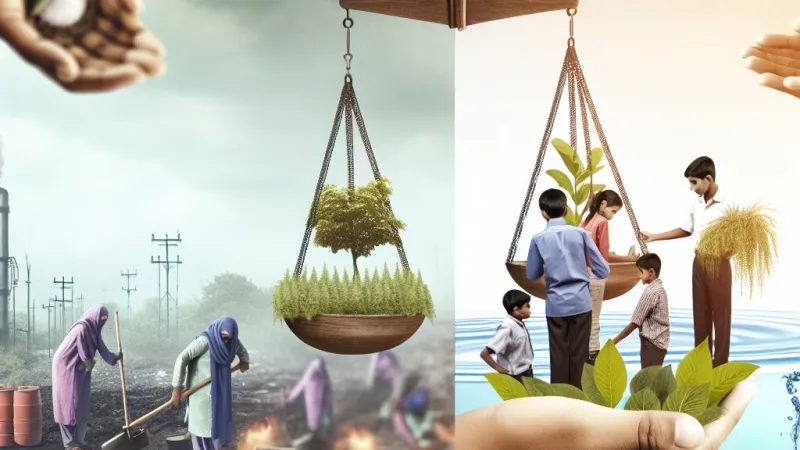
Summary:
Explore how ensuring environmental justice through equitable responsibility sharing helps students understand fairness in protecting India’s environment and resources.
Achieving Environmental Justice Requires a Fair Distribution of Responsibilities
Environmental justice, at its core, concerns itself with the fair treatment and meaningful involvement of all individuals in the protection and enjoyment of our shared environment. It transcends the simple act of planting trees or cleaning rivers; it is about ensuring that no group, community, or nation is burdened disproportionately by environmental hazards while others benefit from unrestrained resource use. In the context of India—a country wrestling with both chronic poverty and rapid industrialisation—the idea of “fairness” in environmental responsibilities strikes at the heart of present-day policymaking and moral ethics. The journey towards environmental justice, then, is not about shifting burdens but about finding equitable ways to share them—considering who caused what, who has the means to act, and who suffers most if we fail.
Philosophical and Ethical Foundations of Environmental Justice
The Indian worldview offers a rich tapestry of thought on our relationship with nature and one another. The ancient concept of ‘Vasudhaiva Kutumbakam’—the whole world as one family—reminds us that the earth’s resources are a shared inheritance, not a personal fiefdom. This spirit is echoed in the Rig Veda’s hymns, which speak of the interconnectedness of all life forms.Moreover, Mahatma Gandhi’s mantra, “The world has enough for everyone’s need, but not for everyone’s greed,” provides an ethical lens that is uniquely relevant to the environmental crisis of our times. Gandhi’s insistence on moderation and stewardship springs from a belief that human desires must be tempered by responsibility. Neglecting this, as often happens when the powerful shirk their share and “pass the buck,” creates a moral vacuum—and worsens inequity.
Emerging from this context is the principle of intergenerational equity: we hold the earth in trust for those yet unborn. Every tonne of coal burnt, every lake polluted, is a subtraction from the inheritance we will leave for those who come after us. This philosophical underpinning compels us to ask: who is responsible for preserving this trust, and how should these responsibilities be apportioned?
Historical and Global Responsibilities in Environmental Degradation
The demand for fair responsibility cannot be separated from history. Much of today’s climate crisis is rooted in the industrial revolutions of the West, where relentless burning of fossil fuels and exploitation of colonies—including British India—built economies but ravaged environments. For decades, the atmosphere has quietly accumulated the gases belched out by Western factories, while the poor countries—the least responsible—now face floods, heatwaves, and droughts with limited means to adapt.Acknowledging these injustices, climate treaties like the United Nations Framework Convention on Climate Change (UNFCCC) introduced the principle of “Common but Differentiated Responsibilities” (CBDR). This recognises that the burden of cleaning up the planet cannot be spread evenly: the wealthy, having reaped the benefits of early industrialisation, must bear a greater load.
For India, this presents a perennial dilemma. On one hand, as a developing nation with centuries of colonisation and millions still below the poverty line, it needs space to grow. On the other, it is now the world’s third-largest emitter, although its per-capita emissions remain low. The Maldives and other small island nations, meanwhile, contribute almost nothing to climate change but stand to lose everything as sea levels rise. In this global landscape, a fair distribution must include climate finance, technology transfer, and sincere cooperation. India’s role in the International Solar Alliance is a meaningful example—offering clean energy experience to those who need it most.
Economic Dimensions of Shared Environmental Responsibility
Any discussion about fairness must grapple with economics. For governments, the dance between growth and sustainability is tightrope walking. While advanced economies like Sweden have experimented with carbon taxes, India’s context is less straightforward: coal remains the mainstay of electricity for millions, and sweeping punitive measures could trigger social unrest.Corporations, especially those in extractive industries, shoulder a massive portion of blame. Be it mining in Chhattisgarh or chemical factories in Tamil Nadu, their environmental legacies persist long after profits have been banked. The emergent ESG (Environmental, Social, and Governance) frameworks are attempts at making corporate entities answerable to both shareholders and the environment. In India, mandates for Corporate Social Responsibility (CSR) are nudging firms in the right direction, but compliance and genuine commitment are still patchy.
That said, placing all responsibility on governments and companies is also unjust. Civil society and individuals—through everyday choices about water usage, electricity, waste disposal, and plastic consumption—hold significant power. India’s centuries-old culture of frugality, visible in village reuse and recycling practices, reminds us that habits matter. Yet, without systemic change and policy push, the cumulative impact of individual actions can only go so far.
Social and Human Rights Perspectives on Environmental Justice
Environmental injustice frequently mirrors social hierarchies. In India, the dirtiest air and water are often found where the most vulnerable live—in urban slums by railway lines, in the shadow of polluting industries, or in villages downstream from tanneries. The 1984 Bhopal Gas Tragedy, still fresh in collective memory, exemplifies this: the poor were exposed to toxic gas, medical help was slow, and remediation has been inadequate even decades later.Marginalised communities—Adivasis, Dalits, women, and children—routinely pay the highest price. Forest-dwelling tribes in central India, for instance, have been guardians of biodiversity for millennia, but their land rights are often ignored in the name of “development.” Women, particularly in rural areas, face disproportionate hardship when water sources dry up or forests are destroyed, as the daily chores of fetching fuel and water become ever more arduous.
Nevertheless, these same communities are frequently at the forefront of environmental stewardship. The Chipko movement, led famously by women in Uttarakhand, is a famous case where villagers hugged trees to halt deforestation. Such examples hint at answers: justice is not simply about protecting the vulnerable, but also about recognising and empowering them as custodians and leaders.
Scientific, Technological and Institutional Strategies for Fair Responsibility
Solving environmental challenges also means leveraging knowledge and innovation. India’s commitment to renewable energy is noteworthy. Through the International Solar Alliance, it is helping dozens of sun-rich but resource-poor countries leapfrog into clean technologies, showing that climate action can be collaborative and just.Urban planning holds key answers, too. With cities like Pune introducing bus rapid transit for public transport and Gurugram experimenting with clean mobility, the blueprint for sustainable urban India is being drawn, slowly but surely. Data and modern technology, like satellite monitoring of forest cover or air quality indices in major cities, are making environmental performance more transparent a critical step towards accountability.
Yet, laws and policies can only succeed with proper enforcement and democratic participation. India’s environmental laws—the Air Act, Water Act, and Forest Rights Act among others—are progressive on paper, but often falter in implementation. Including local communities and youth, through mechanisms like public hearings and tracking platforms, is essential for pushing institutions to act responsibly.
Challenges and Critiques in Distributing Environmental Responsibility
The quest for fairness is not without hurdles. Powerful interest groups, particularly those invested in coal and other fossil fuel industries, lobby hard to delay change. Nations, too, often prioritise immediate, domestic economic fears over long-term, global necessity—leading to deadlocks at climate summits. Deciding who owes what to whom is a messy affair, with historic emissions data contested and ‘development rights’ wielded like weapons.There is, too, the risk of ‘responsibility paralysis’: endless arguments about who should do more can sap momentum, letting the crisis worsen. What is needed is not perfection, but goodwill and compromise: a recognition that justice is best served not by apportioning blame, but by moving forward together, with each doing what they can, and more.
Conclusion
In sum, environmental justice is neither a Western luxury nor a burden to be shrugged off. It is an imperative—a moral, economic, and ecological necessity. For India, as for every nation, achieving justice means looking honestly at our past, equitably dividing duties in the present, and preparing to pass on a healthy planet to our children. This cannot happen unless responsibilities are shared in a way that reflects both historical wrongs and future hopes, economic capabilities and social vulnerabilities.A just world is not born overnight, but it begins with a commitment: that the burdens of environmental protection and the privileges of a clean environment shall be shared fairly. As the poet Rabindranath Tagore wrote, “The earth is not a gift from our parents, but a loan from our children.” In returning this loan, let us act with fairness, humility, and resolve. Only then will environmental justice be more than a slogan; it will be a reality.
Rate:
Log in to rate the work.
Log in