Comprehensive Overview of India's Mid Day Meal Scheme for Students
This work has been verified by our teacher: 8.04.2026 at 16:16
Type of homework: Essay Writing
Added: 6.04.2026 at 15:42
Summary:
Explore India's Mid Day Meal Scheme to understand its history, objectives, implementation, and impact on student nutrition and education improvement.
An In-Depth Analysis of the Mid Day Meal Scheme in India
Introduction
Education and nutrition are twin pillars upon which the future of any nation, especially one as diverse and populous as India, firmly rests. Our children represent not just the inheritors of tradition, but also the architects of progress. However, for millions of Indian children, accessing good education has been an uphill task, often interrupted by poverty, hunger and malnutrition. Recognising this bitter reality, the Government of India has steadily introduced welfare initiatives marrying the goals of health and education—chief among them being the Mid Day Meal Scheme.The purpose of this essay is to thoughtfully examine the Mid Day Meal Scheme’s journey in India: its origins and objectives, method of implementation, beneficial impacts, challenges faced, and the scope for future advancement. The scheme, a symbol of hope in many classrooms, is not just about food—it is about dignity, opportunity, and justice.
Historical Background and Evolution of the Scheme
The concept of providing food to children at schools as an incentive to attend is not entirely new to the Indian subcontinent. Historical records indicate that the first structured attempt dates back to the Madras Corporation in 1925, which initiated meal provision to primary school children. The rationale was simple: hungry children cannot learn. As India progressed through independence, these ideals were given national importance.The decisive turning point came in 1995 when the Government of India officially launched the National Programme of Nutritional Support to Primary Education, commonly known as the Mid Day Meal Scheme, on the country’s Independence Day. Initially covering children up to the fifth standard in government and government-aided schools, the scheme gradually expanded to upper primary and special category schools.
The Supreme Court’s directive in 2001 made the scheme not merely a policy but a fundamental right, compelling all state governments to provide free cooked meals to children in government and aided schools. Later, the National Food Security Act, 2013 cemented this obligation, granting legal enforceability and protecting the right to food for children.
Interestingly, Tamil Nadu had already led the way, giving practical shape to the idea much earlier and inspiring many states—Karnataka, Gujarat and Rajasthan among them—to develop their own adaptations. Thus, India’s Mid Day Meal Scheme is rooted both in long-standing social concern and evolving law.
Objectives and Rationale of the Mid Day Meal Scheme
The principal aim of the Mid Day Meal Scheme is twofold: firstly, to nourish school-going children aged 6 to 14 years with balanced, wholesome meals and secondly, to improve attendance and reduce drop-outs from formal education, especially in rural and marginalized communities. By addressing “classroom hunger”, the scheme hopes to make the classroom a truly equal space for learning.Underlying these basic aims are a range of social and policy objectives. The scheme acts as a bulwark against malnutrition, which has historically afflicted large swathes of India’s child population, reflected in alarming rates of stunting and anaemia. Simultaneously, it offers a platform for fostering social integration. When all children, irrespective of caste, creed, or socio-economic background, eat together, the shackles of untouchability and discrimination begin to melt.
The Mid Day Meal Scheme dovetails with landmark government missions like the Sarva Shiksha Abhiyan (Education for All) and is in line with the Right to Education Act, which envisions every child in the country having access to quality education. In sum, mid-day meals are not a mere charity—they are a tool for social change.
Implementation Mechanism and Structure
At present, the Mid Day Meal Scheme covers more than 12 crore (120 million) children across nearly 11 lakh schools in India, forming arguably the world’s largest school feeding programme. The scheme primarily targets children in primary (classes 1-5) and upper primary (classes 6-8) sections of government, government-aided, and select special schools.To meet nutritional standards, the government has prescribed that each primary student should receive at least 450 calories and 12 grams of protein per meal, and upper primary students 700 calories and 20 grams protein. Typical meals consist of staples—rice or wheat, with dal, fresh vegetables, sometimes an egg or a portion of milk, and seasonal fruits. Such menus are chosen keeping in mind both nutritional balance and regional food habits.
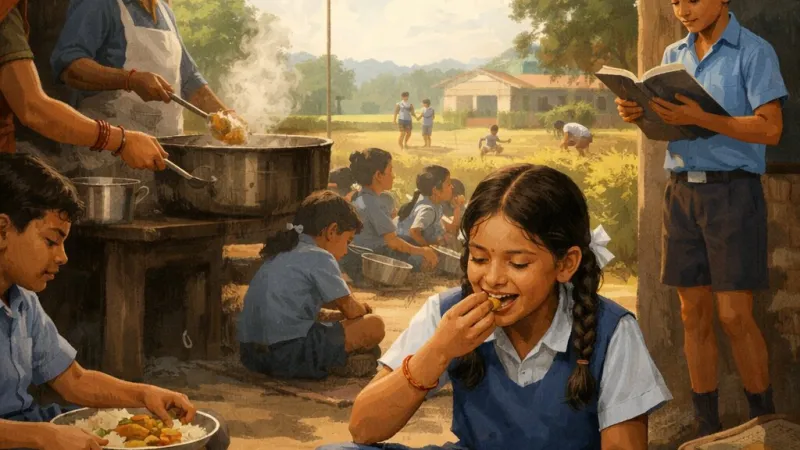
Meals are generally cooked on-site within schools, often managed by local self-help groups, especially women’s collectives. Strict hygiene protocols are mandated—proper washing of utensils, cleanliness of the kitchen area, and use of safe drinking water. Food safety officials, district authorities, and school management committees regularly inspect operations. Complaint mechanisms and transparency measures, such as menu displays and daily updates, are encouraged.
Delivery methods can vary by state. Some, like Gujarat and Odisha, supplement cooked meals with fortified foods or conduct pilot projects with new recipes. During crisis periods, as witnessed in the COVID-19 pandemic, dry rations have been provided in lieu of hot meals, though this is not considered ideal.
Positive Impacts and Benefits
The effects of the Mid Day Meal Scheme have been profound and wide-ranging. First and foremost, it has succeeded in boosting school enrolment rates, particularly in backward districts and among girls. For families grappling with grinding poverty, the promise of a nutritious meal is incentive enough to send their wards to school. This is supported by NSSO data and studies by the Ministry of Education, which have tracked consistent improvement in attendance and decrease in drop-out rates.Nutritionally, the scheme has made a substantial dent in hunger and malnutrition. Incidences of anaemia, stunting, and related illnesses among school-age children have dropped in many regions. For a country battling with the paradox of food surplus and chronic undernourishment, this is a significant achievement.
Socially, the impact is equally vital. The simple act of children—Dalit, Muslim, tribal, upper caste—sitting together to share a meal breaks down centuries of prejudice. The invisible barriers in the school yard, if not always in society, are weakened.
From an economic angle, the scheme eases the financial burden on poor households, freeing up income that would otherwise be spent on food. It also creates local employment, as lakhs of women have found gainful work cooking and distributing meals, strengthening community bonds.
Challenges and Limitations in the Scheme’s Execution
Despite its successes, the scheme is not without problems. Most glaring are periodic reports of food poisoning or substandard meals due to lapse in quality control or lack of hygiene. There have been tragedies—like the Saran incident in Bihar (2013)—which have shocked the nation and raised difficult questions about oversight.Fund leakages, pilferage, and corruption, though less reported now, still persist in some districts. Inadequate kitchen infrastructure, lack of gas connections, or improper storage of grains make consistent quality difficult, especially in remote or tribal belts. Regional disparities in allocation and execution are visible—some states prioritise the scheme, others lag behind, giving only dry rations in adverse circumstances, which dilutes its benefits.
Catering to religious preferences, allergies, or unique local diets is another issue, as a single national menu may not suit all regions. Many schools depend on overworked and undertrained cooks without sufficient knowledge of nutrition or hygiene, making regular capacity building essential.
Case Studies and Success Stories
Tamil Nadu stands out as a beacon, with decades-long commitment to school meals. The state’s early adoption, political will (initiated by K. Kamaraj), and focus on infrastructure ensured high rates of participation and minimal controversies. Innovations such as appointing dedicated nutrition officers and utilising government-supplied eggs weekly became models for others.Some cities, like Bengaluru, have experimented with digitised meal tracking and SMS-based reporting systems. NGOs such as Akshaya Patra have partnered with several state governments, bringing centralised kitchens, ISO-certified processes, and better logistics, ensuring taste and safety.
Particularly worth noting is the rise in girl child attendance in rural Rajasthan and Uttar Pradesh post-implementation, a transformative change in societies where girls were often pulled out of school to help at home.
Recommendations for Improvement
Moving forward, several steps can strengthen the scheme. Firstly, monitoring and evaluation must be sharpened—timely third-party inspections, digital feedback via simple mobile applications, and the use of public report cards will help track progress.Menus should be diversified, with greater emphasis on proteins (pulses, milk, eggs), micronutrients (iron, vitamin A) and foods that are locally accepted. Investing in better training for cooks and more engagement from school management committees will elevate hygiene and quality.
Funds must be released on time, and schools equipped with proper infrastructure—ventilated kitchens, gas stoves, storage facilities—especially in interior districts. Parent and teacher involvement should be strengthened so the community treats the scheme as their own, not merely a government handout.
Finally, local adaptability is crucial—what works in Kerala or Mizoram may not suit Bundelkhand or Jammu. Adapting menus and methods to local contexts while upholding national nutritional standards must be the guiding principle.
The Future of the Mid Day Meal Scheme
As India moves ahead, the scheme’s integration with broader health and education policies holds even greater promise. Linking periodic health check-ups, deworming, and nutrition counselling with mid-day meal distribution will ensure multi-layered impact.There is scope for extending the scheme to private aided and low-cost schools in urban slums or remote settlements, thereby achieving near-universal coverage. Embracing new food technologies like fortified rice, use of solar-powered kitchens, and bio-degradable plates can model sustainability.
Wider, tech-enabled public involvement—a grievance platform, community kitchen partnerships, and transparent dashboards—can rebuild trust and accountability. Ultimately, with sustained effort and innovation, the Mid Day Meal Scheme can remain a pillar of India’s fight against malnutrition and school exclusion.
Conclusion
It is undeniable—the Mid Day Meal Scheme represents one of independent India’s most effective and compassionate inventions. While challenges remain, its profound effect on children’s health, educational prospects, and social fabric cannot be overstated. As Rabindranath Tagore wrote in “Where the mind is without fear…,” true freedom comes when children are allowed to grow in body, mind, and spirit.Going forward, let us pledge to not only preserve the scheme, but also refine and empower it. For in feeding our children, we nourish not just their bodies, but our nation’s very soul and future. Continuous vigilance, creative adaptation, and heartfelt community engagement are the need of the hour. Only then can we ensure that every Indian child receives both their rightful meal and the wings to soar on the strength of education.
Rate:
Log in to rate the work.
Log in