Understanding the Gap Between Education and Wisdom in Today’s World
This work has been verified by our teacher: 16.04.2026 at 12:03
Type of homework: Essay Writing
Added: 13.04.2026 at 11:01
Summary:
Explore the gap between education and wisdom in India, learning why true success lies in applying knowledge with ethics, empathy, and social responsibility.
The World Is Full of Educated Derelicts: Bridging the Gap Between Knowledge and Wisdom
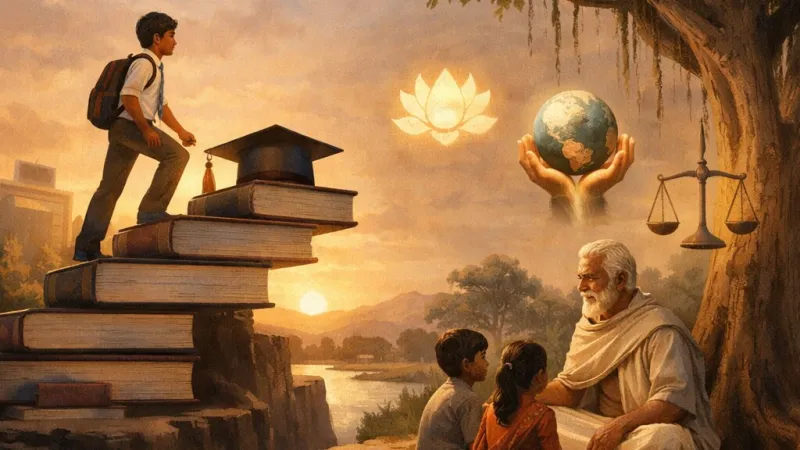
Ours is an age when education is widely pursued and degrees are considered the surest passport to success. Yet, every so often, society is jarred by the spectacle of well-qualified individuals acting without conscience or empathy, exemplifying the paradox: the world is indeed full of educated derelicts. This unsettling reality prompts us to question: is formal education alone enough, or must we seek something deeper? Can education devoid of values and social commitment ever fulfil its true purpose?
In the Indian context, the term ‘educated derelicts’ refers to those who, despite academic laurels, lack basic ethical grounding, emotional intelligence, or social responsibility. They embody a distinction: while *education* bestows knowledge and skills, *wisdom* lies in the meaningful and responsible application of those faculties. This essay explores why the proliferation of educational opportunities has not eliminated social ills, analyses how our current systems may unwittingly churn out educated but directionless individuals, and proposes a way forward towards holistic learning. Despite the expansion of educational infrastructure from rural schools to premier IITs, without integrating character development and critical thinking, we risk producing generations skilled in facts but benighted in spirit. This essay critically examines the root causes behind the rise of educated derelicts and suggests a comprehensive reform of Indian education to cultivate enlightened and responsible citizens.
---
Theoretical Foundations: Understanding the Concept of Educated Derelicts
Philosophical Dimensions
The tension between knowledge and wisdom is as old as civilisation itself. Indian thought has always recognised the difference between jnāna (bookish knowledge) and viveka (the discernment born of experience and introspection). The Upanishads, foundational to Indian philosophy, declare that “Education is that which liberates” (Sa Vidya Ya Vimuktaye). Here, liberation is not merely economic, but social, moral, and spiritual.Socrates, though a Greek philosopher, found consonance in Indian thinking when he insisted on the necessity of virtue and self-knowledge alongside intellectual accomplishment. In the Indian context, the Bhagavad Gita sets forth that one’s learning is incomplete unless one’s actions are guided by dharma (righteousness). This dual emphasis on head and heart was echoed centuries later by thinkers such as Mahatma Gandhi and Swami Vivekananda. Vivekananda, for instance, famously said, “Education is the manifestation of the perfection already in man,” highlighting the inner transformation education must seek.
John Dewey, though writing in a Western milieu, shared this universal concern. He advocated for experiential learning that develops both the intellect and moral conscience. Such perspectives remind us that any educational endeavour divorced from values and meaningful application is, at best, half-baked.
The Role of Character and Critical Thinking
While the power of intelligence is undisputed, lack of character can turn knowledge into a double-edged sword. History is replete with scientists, bureaucrats, and leaders who, despite sterling qualifications, caused widespread harm due to deficits in morality and empathy. As writer C.S. Lewis warns, “Education without values, as useful as it is, seems rather to make man a more clever devil.” Without the critical faculty to question and the moral compass to restrain, education can produce derelicts—technically sound but utterly adrift in moral terms.Limitations of Human Capital Approach
Prevailing policy often treats education as a mere economic investment, a way to produce efficient workers and fuel GDP growth. The “human capital” mindset can overlook that the purpose of learning is not only to create employees, but to form human beings capable of judgement, self-mastery, and civic engagement. Prioritising employability and examination results over character and wisdom limits education’s true scope, an imbalance especially pronounced in the Indian education system today.---
Causes and Contributing Factors to Educated Dereliction
Commercialisation and Rote Learning
Indian society has, in the rush to democratise education, allowed the mushrooming of coaching institutes, private universities, and tuition centres where “marks matter more than meaning.” Degrees have become status symbols or business investments, with many students and families pursuing them as credentials to secure jobs, marriages, or social standing, rather than for personal growth or civic usefulness.Rote learning remains prevalent, with Board examinations, NEET, and JEE fostering a culture of memorisation over comprehension. The result: students often top exams but falter in applying knowledge to real-world problems—a phenomenon satirised in films like *3 Idiots*, which highlight the pitfalls of our system.
Deficit of Moral and Civic Education
Syllabi seldom dwell on ethics, emotional intelligence, or civic duty. Social studies and moral science, if present at all, are marginalised. Teachers, struggling with overcrowded classrooms and an overloaded curriculum, rarely have time to encourage reflection on social responsibility and empathy.Disconnection from Social Realities
The academic focus is overwhelmingly theoretical, with practical skills, fieldwork, and experiential learning taking a back seat. Few students from privileged, urban backgrounds understand the challenges faced by rural migrants or the implications of environmental degradation. The disconnect perpetuates a generation schooled in formulas but uninitiated in compassion or problem-solving.Legacy and Policy Issues
The colonial education system, introduced by Macaulay’s Minute (1835), was designed to produce “a class of persons, Indian in blood and colour, but English in tastes, in opinions, in morals, and in intellect”—essentially, clerical workers, not critical thinkers or nation-builders. This legacy, with its emphasis on rote and obedience, still affects us. Despite massive reforms and the adoption of the National Education Policy 2020, pedagogical innovations remain slow.Technology and Critical Thinking Gaps
The rise of the Internet and social media provides access to vast information, yet many, even those highly ‘educated,’ fall prey to misinformation. The absence of training in critical analysis has enabled the spread of fake news and divisive rhetoric—witness the virality of WhatsApp forwards during elections and public crises.---
Consequences of Educated Dereliction on Society
Broken Governance and Ethical Decline
India’s long list of scams, ranging from banking frauds perpetrated by MBA graduates to scientific misconduct by professionals, stands as a cautionary tale. Advanced degrees do not inoculate against unethical behaviour; evidence of incompetence or corruption among regulatory officials, scientists, or corporate executives is, regrettably, widespread. When knowledge is not balanced by integrity, the very fabric of democratic institutions is strained.Economic and Social Inefficiency
Graduates devoid of problem-solving and social sensitivity often struggle to create new jobs, generate innovation, or contribute to inclusive growth. Paradoxically, employers in sectors such as IT, healthcare, and education note that even job-ready candidates need retraining in soft skills, creativity, or ethics.Civic Apathy and Cultural Alienation
Worryingly, educational attainment does not always translate to public service or social engagement. Voter turnout is lower among the urban, educated class in many cities; community involvement declines as individual competition increases. With progress comes alienation from the wisdom of ancient traditions—empathy, humility, and stewardship—core to Indian philosophy and neglected amidst the scramble for grades.---
Solutions: Towards Holistic and Value-Based Education
Formalising Value Education
India must integrate the teaching of ethics, philosophy, and citizenship from early primary grades. Initiatives such as the Central Board of Secondary Education’s Life Skills curriculum are steps in the right direction, but must be implemented with commitment and seriousness. Stories from the Panchatantra, Jataka tales, and lives of Indian saints and reformers can animate value education in a culturally resonant way.Experiential and Interdisciplinary Learning
Beyond textbooks, exposure to community-driven projects, rural internships, and social innovation labs—like those run by Azim Premji University or TISS—can bridge the gap between knowledge and action. Interdisciplinary learning combining science, humanities, and arts should be encouraged, fostering flexible thinking and a sense of shared humanity.Teacher Training and Institutional Example
No reform succeeds without competent, inspired teachers. Our teacher training colleges must impart not just pedagogy but also nurture in educators a sense of public duty and role modelling. The ancient Indian *gurukul* system stands testimony to the moral authority a good teacher exerts.Policy and Accountability
Policymakers should ensure that evaluation and accreditation mechanisms reward innovation, inclusivity, and ethical conduct, not mere rote performance. The National Education Policy 2020’s call for holistic report cards—incorporating self-assessment, peer feedback, and social service—should be rolled out sincerely.Technology as a Tool for Critical Thinking
Digital literacy programmes must transcend coding and IT skills to include training in discerning credible sources, questioning biases, and online etiquette. Initiatives like Diksha and SWAYAM have potential if used to democratise quality content, encourage dialogue, and foster critical faculties.---
Case Studies and Examples
The enduring influence of Macaulay's educational legacy is evident in the examinations-oriented mindset prevalent in India, but some institutions are pioneering new paths. For instance, Rishi Valley School in Andhra Pradesh emphasises multi-grade teaching, environmental stewardship, and service learning, producing socially conscious graduates. In Delhi, initiatives like Teach For India and government schools’ Happiness Curriculum nurture values alongside academics.Conversely, India’s financial sector scandals, from the Harshad Mehta scam to recent banking failures, involved highly credentialed individuals, proving that degrees alone cannot safeguard against disaster. Internationally, countries such as Japan and Finland, whose education systems stress ethics and collective well-being, often report higher measures of social trust and innovation.
---
Conclusion
In conclusion, education, stripped of wisdom, compassion, and integrity, is at best a glittering shell—producing derelicts rather than contributors. The Indian experience demonstrates how easily the quest for academic success can supplant the deeper mission of nurturing humane, thoughtful, and engaged individuals. Only when our curricula, institutions, and policies wholeheartedly embrace holistic and value-centred learning can we hope to transform our "educated derelicts" into responsible nation-builders.As we move forward, the challenge for Indian education is not merely to spread literacy or produce high aggregate scores, but to cultivate minds and hearts attuned to the demands of an ethical, equitable, and plural society. The true measure of educational success is seen not in examination results, but in the wisdom, courage, and public spirit our citizens manifest. To each educator, policymaker, and student, the call is clear: let us strive not only to be educated but to be wise, compassionate, and worthy of the legacy our heritage bestows.
Rate:
Log in to rate the work.
Log in