Mastering Fire and Ice MCQs for NCERT Class 10 English Poem
This work has been verified by our teacher: 20.04.2026 at 11:21
Type of homework: Essay Writing
Added: 17.04.2026 at 10:21
Summary:
Explore and master Fire and Ice MCQs for NCERT Class 10 English poem with clear explanations of themes, metaphors, and exam-ready practice questions.
A Comprehensive Study Guide for ‘Fire and Ice’ MCQs — NCERT Class 10 English Poem 2
Poetry has long held a cherished place in Indian education. Among the selections prescribed for CBSE’s Class 10 English, Robert Frost’s “Fire and Ice” stands out for its brevity and depth. Though Frost was an American poet, his universal themes and accessible metaphors have found resonance in Indian textbooks for generations. “Fire and Ice,” despite being just nine lines, asks some of the biggest questions confronting humankind: how will the world end, and what does that say about human nature? Every year, thousands of Indian students grapple with this poem, not just as literature, but through the multiple choice questions (MCQs) that test their reading, analysis, and literary acumen during board exams.
This essay seeks to equip students with a holistic approach to cracking “Fire and Ice” MCQs. We’ll delve into its themes, unravel its metaphors, and decode its poetic devices. The essay will then present practical techniques to approach MCQs, supported by sample questions and answers. In doing so, we not only prepare for the exams but also cultivate an appreciation for interpreting poetry thoughtfully—a crucial skill not just for marks, but for life.
---
Thematic Exploration of ‘Fire and Ice’
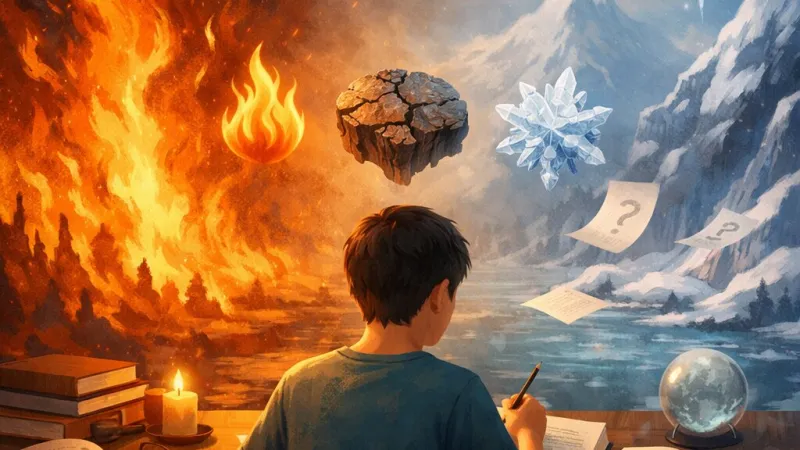
“Fire and Ice” disarms with its simplicity. The very first line poses a direct question: how will the world end—by fire or by ice? Yet, in these elemental opposites, Frost weaves an entire philosophy.The End of the World: An Eternal Curiosity The idea of the world’s destruction has preoccupied thinkers from ancient Indian texts like the Rig Veda all the way through to modern writers. In Frost’s poem, “fire” and “ice” personify ways the world might end and, by extension, represent extremes of human behaviour.
Fire as Desire Throughout Indian mythology, fire (agni) often denotes creation and destruction. Similarly, Frost’s fire represents intense human desires, longings, and passions. Think of stories from Indian epics—like Draupadi’s burning quest for justice in the Mahabharata or the raging ambition of Ravana in the Ramayana. When desires and cravings run unchecked—greed for power, uncontrolled anger—they set the world ablaze, both metaphorically and literally. Frost’s suggestion that he favours fire echoes the idea that desire is often acknowledged as the root cause of suffering, as found in Buddhist philosophy—‘trishna’ or craving.
Ice as Hatred and Indifference Ice is quieter but equally dangerous. Where fire burns with passion, ice chills with apathy. In our social contexts, indifference can take shape as communal disharmony, caste-based discrimination, or the subtle but corrosive neglect of the needy. The Mahabharata’s silence of elders during Draupadi’s humiliation is a stark parallel—coldness and calculated hatred can slowly destroy, just as surely as fire.
Comparing Both Forces Frost maintains a striking balance, admitting “But if it had to perish twice, I think I know enough of hate...” He refuses to privilege one over the other. In Indian traditions, such dichotomies are often reconciled. Our Upanishads teach that both wrath and apathy are ultimately undesirable for creating a sustainable world.
Lesson for Humanity The final lines carry a warning relevant for all societies: unchecked passion or hate will both bring destruction. In our context, whether through riots ignited by anger or relationships frayed by cold indifference, the metaphor remains ever fresh. Frost leaves the choice—and responsibility—with us.
---
Literary Devices and Poetic Techniques
The beauty of “Fire and Ice” lies not only in its message but how it is told.Metaphor as the Heartbeat of the Poem Fire and ice are more than elements here; they are extended metaphors for destructive human emotions. The poem compresses the vast spectrum of emotion into these two images, reminiscent of how Kabir’s dohas often use simple symbols to express profound truths.
Imagery and Symbolism “Some say the world will end in fire, / Some say in ice.” These opening lines paint immediate sensory contrasts—heat and cold. The word choice invokes imagery of burning cities or barren, frozen lands, echoing scenes etched in Indian collective memory—like the fiery Latur earthquake or the chilly fogs of Delhi winters, both unsettling in their ways.
Literary Devices - Alliteration: “Some say” repeats the ‘s’ sound, creating a soft, whisper-like effect. "World will" repeats ‘w’, adding weight. - Assonance: The long ‘i’ in “I think I know” draws attention to the poet’s introspection. - Antithesis: The entire poem is built on antithesis—opposing ideas placed in proximity: fire/desire versus ice/hate. - Irony and Ambiguity: While the poet seems to ‘favour fire’, he quickly admits the sufficiency of ice too—an ironic, slightly playful nod to life’s unpredictability.
Structure and Form Nine lines, three sentences, no wasted words. The rhyme scheme (aba abc bcb) threads the poem tightly, making each idea flow logically. It echoes the compactness favoured in Indian poetry—like Rabindranath Tagore’s “Stray Birds,” where brevity sharpens the impact.
Tone and Mood Despite the dire subject, the tone is contemplative, almost philosophical. Frost offers no easy answers, inviting the reader’s reflection—a style reminiscent of Indian bhakti poets who pose riddles more than sermons.
---
Approaching MCQs on ‘Fire and Ice’
CBSE board questions assess not just recall, but interpretation. Here’s a strategy built for Indian exam conditions:Familiarise with Question Patterns MCQs generally fall into: - Factual: Who wrote the poem? What do fire and ice symbolise? - Inferential: Which emotion is more dangerous? What tone does the poet adopt? - Literary: Identify a poetic device, rhyme scheme, or mood.
Sample previous years’ papers (available through CBSE or popular guidebooks like Together With or Xam Idea) to recognise these patterns.
Close Reading is Crucial Don’t skim—read every word. Mark phrases indicating metaphor, tone, and theme. Annotate your textbook—underline "desire", circle "hate", and notate literary devices. Create charts: | Fire | Ice | |------|-----| | Desire, passion, anger | Hatred, coldness, apathy |
Mastering Elimination Many MCQs give two close options. Remove obviously incorrect answers first. For example, if one option says, “Fire symbolises water,” that’s irrelevant.
Types of MCQs and Tackling Them - Thematic MCQs: Focus on central messages—look for options mentioning self-destruction, human emotions, or consequences. - Metaphor & Symbol MCQs: Commit to memory the associations—fire is never compassion; ice is never excitement. - Literary Device MCQs: Prepare a list of devices with examples. For “Some say the world”—spot the alliteration. - Tone/Mood MCQs: Ask, what is Frost’s attitude? Is he angry? Not really—he’s pondering, so “serious” or “reflective” fits best.
Revision Techniques - NCERT solutions are reliable but don’t neglect class notes. - Flashcards for devices and their Hindi equivalents can help (e.g., alliteration = अनुप्रास अलंकार). - Attempt mock tests—time yourself to enhance both speed and accuracy.
---
Sample MCQ Analysis
Let us dissect some sample questions the way you might encounter them in CBSE exams.Q1: What do ‘fire’ and ‘ice’ symbolise? Options: A) Love and faith B) Desire and hatred C) Light and darkness D) Knowledge and ignorance
*Approach:* Recall from the poem: fire = desire, ice = hate. Love/faith do not fit the negative tone. So, Option B is correct.
Q2: What poetic device is used in “Some say the world will end in fire”? Options: A) Simile B) Alliteration C) Pun D) Irony
*Approach:* Look for starting consonant sounds: ‘S’ in "Some say" and ‘W’ in "world will", which shows alliteration. Option B.
Q3: What is the rhyme scheme of the poem? Options: A) abcb B) abaabc C) aba abc bcb D) abba abba
*Approach:* Read the poem aloud, mark rhymes at ends: “fire/ice/desire/fire,” etc. Matching leads to Option C: aba abc bcb.
Q4: How would you describe the tone of the poem? Options: A) Humorous B) Sarcastic C) Serious and contemplative D) Angry
*Approach:* The poem isn’t light or mocking, nor full-blown rage; it's philosophical and measured—Option C.
---
Broader Educational Significance
Why does “Fire and Ice” matter in an Indian classroom?Literary Appreciation The poem is a gateway to the poetic craft—metaphor, rhyme, brevity, and depth. It echoes forms familiar from Hindi, Bengali, or Tamil poetry—students learn that even short poems can carry weighty messages.
Critical Thinking It urges students to move beyond rote learning to interpretation—connecting symbols to real-life issues, reflecting on the impact of emotional extremes, drawing parallels with modern Indian societal challenges.
Interdisciplinary Links Science students see fire and ice as physical phenomena; social science students contemplate conflict and indifference in society; moral science classes discuss managing anger or preventing apathy.
Preparation for Board Exams With MCQs now featuring more in board assessments, students must master both bookish facts and nuanced analysis. This practice also polishes comprehension, vocabulary, and literary sensitivity—for CBSE and beyond.
---
Conclusion
“Fire and Ice” encapsulates, in just nine lines, the essence of human folly and the double-edged sword of our emotions. Whether the world ends in a blaze of passion or the encroaching numbness of hate is beside the point—the poem warns of the dangers inherent in both. For Indian students, its lessons extend beyond exams: it’s a meditation on balance, self-control, and the cost of extremes.Success in MCQs rests not just on memory but clear understanding. By grounding oneself in the poem’s themes, symbols, structure, and devices—and practising with intent—students can confidently score in exams and acquire a deeper love for literature. Mastering “Fire and Ice” is not just about the right answer, but about engaging with poetry as a living, breathing art.
---
Additional Notes for Students
- Annotate your textbook—highlight every mention of fire/ice and note devices in the margins. - Create mind maps linking abstract concepts (fire–desire; ice–hate) for quick revision. - Participate in class discussions or peer groups—often, alternative views lead to deeper insight. - Check CBSE updates for any changes in question patterns. - Above all, remember that every poem, no matter how short, has layers waiting to be discovered.---
By internalising these strategies, you’ll not only ace your MCQs on “Fire and Ice”, but also nurture a lifetime appreciation for poetry—a priceless part of the Indian scholarly tradition.
Rate:
Log in to rate the work.
Log in