How Gratitude Brings Quiet Joy in Everyday Life
This work has been verified by our teacher: 27.04.2026 at 15:32
Type of homework: Essay Writing
Added: 24.04.2026 at 13:35
Summary:
Discover how gratitude brings quiet joy in everyday life by teaching students to appreciate small blessings and find lasting contentment. 🌿
Gratitude Often Reveals Itself in the Quiet Light of Joy
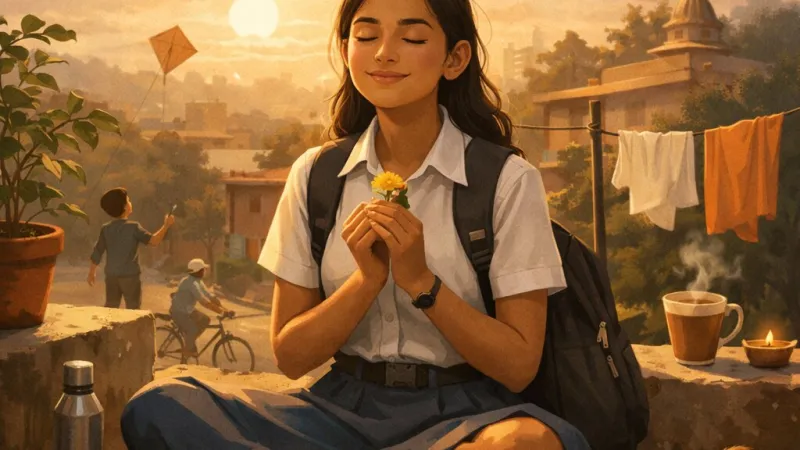
In the hush of early morning, when the golden rays touch the hibiscus blooming by the window or when a student bows before her teacher on the first day of class, a subtle yet profound emotion graces our lives—gratitude. It is rarely loud or ostentatious. Instead, gratitude seeps quietly into our days, like the gentle fragrance of jasmine, infusing ordinary moments with extraordinary lightness and joy. While it may appear to be a simple 'thank you? uttered in passing, in India's rich tapestry of customs and beliefs, gratitude goes far beyond words. It dwells in customs, in silent acts of respect, and in the shared understanding that every blessing—be it sunshine after rain or a friendly smile—deserves mindful acknowledgement.It is said that those who nurture gratitude find a wellspring of joy not only in life's grand celebrations but also in its ordinary rhythms. This pursuit is not merely a philosophical luxury; gratitude has profound implications for individual well-being, harmonious relationships, and social equilibrium. Across India, from rural hamlets to bustling metros, gratitude is woven into the very fabric of daily life, expressed more through action and ritual than declarations. Ultimately, a life suffused with gratitude provides a quiet joy that outlasts fleeting pleasures and grounds us in humility and service.
Philosophical Reflections: The Deep Roots of Gratitude and Joy
Throughout history, thinkers and sages have regarded gratitude as a central virtue. In the ancient Indian epic, the Mahabharata, the wise Vidura counselled Yudhishthira that contentment and gratitude are essential for peace. Aristotle, too, in faraway Greece, valued gratitude as a vital moral quality, asserting that cultivating thankfulness enriches character, fosters humility, and curbs envy.Joy, often mistaken for happiness, is much deeper in nature. While happiness wavers with circumstance—good marks in an exam or a fresh monsoon shower—joy is more enduring. Joy blooms in the heart of those who appreciate what they have, rather than lamenting what they lack. As Sri Sarada Devi, spiritual consort of Ramakrishna Paramahamsa, once said, "One must be grateful for even the smallest blessings, for joy lies hidden in contentment."
When gratitude is lived quietly, it doesn't require grand gestures or eloquent words. Instead, it can be seen in a neighbour watering another's tulsi plant, or a young student silently helping a classmate without expecting applause. This silent gratitude is luminous, like the unseen current that makes the lamp burn bright.
The Indian Tapestry: Cultural and Spiritual Foundations of Gratitude
India's many festivals and customs are testament to its deep-rooted appreciation for life's gifts. Consider Makar Sankranti—a festival that thanks the Sun for a plentiful harvest. Here, families prepare tilgul (sesame and jaggery sweets), symbolising warmth and sweetness exchanged with one another, expressing gratitude for community bonds and sustenance. Similarly, during Chhath Puja, devotees offer prayers and stand waist-deep in rivers, venerating the Sun for nurturing life. Such rituals reflect a collective gratitude that binds humans to the cosmos and the cycles of nature.Gratitude in the Indian context is inseparable from respect for elders, teachers, and gurus. On occasions like Guru Purnima, disciples bow to their teachers, acknowledging the quiet, persistent effort with which knowledge is imparted and lives are transformed. Touching an elder’s feet—a sight familiar in Indian homes—is not empty formality but a gesture of thankfulness for wisdom and guidance.
Philosophically, Indian traditions emphasise santosh (contentment), one of the niyamas in Patanjali's Yoga Sutra. Practising contentment means delighting in what one has, rather than yearning endlessly. This attitude sows the seeds of enduring joy. Another pillar is seva: selfless service. The spirit of seva is visible in the kitchens of gurdwaras, where hundreds are fed daily, and in children sweeping their temple premises. Each humble act speaks of gratitude—not only for having, but for being able to give.
Dr. A.P.J. Abdul Kalam epitomised these Indian values. His life, spanning humble beginnings to the Rashtrapati Bhavan, was not marked by pomp but modesty, discipline, and quiet service. He often derived joy not from accolades but from guiding school children and igniting young minds, reflecting gratitude for the opportunities afforded to him by society and a desire to give back manifold.
Mind and Spirit: Psychological and Eastern Perspectives
Gratitude is not just a virtue admired by philosophers; it is a balm for the mind. Stoic thinkers, like Seneca, taught that one must distinguish between what can be controlled and what must be accepted. Focusing on what is within our power, and being grateful for small mercies, shields the mind from restlessness. In Indian cities, where stress and competition are ever-present, this simple philosophy has profound mental health benefits. Today, psychologists recommend practices like gratitude journaling and mindfulness—mechanisms long embedded in Eastern wisdom.Buddhist philosophy gives us mudita, or sympathetic joy: a capacity to share in the happiness of others without envy. In India, this is witnessed when one’s heart swells at a sibling’s achievement or a neighbour’s good fortune. Mudita fosters a feeling that we rise and rejoice together, expanding gratitude beyond the self and nurturing a collective harmony.
Living Gratitude: Examples from Life, Past and Present
History and everyday life are replete with examples of gratitude etched not in words but in deeds. Mother Teresa, though born in Albania, made India her home. Her service to the destitute in Kolkata was a profound expression of gratitude towards life and the creator, whom she saw in every suffering face. Her smiling countenance, even amidst adversity, radiated joy rooted in thankfulness for the opportunity to serve.In today’s India, we find countless unsung heroes. Civil servants, healthcare workers, and soldiers who serve tirelessly in times of distress—be it during floods, riots, or the COVID-19 pandemic—embody silent gratitude. Their actions spring not from the desire for reward, but from the understanding that serving society is its own form of joy.
Even in our own homes, gratitude and joy abound quietly. The farmer, after a tough season, bows in prayer when the harvest is good. Teachers light up seeing their students succeed. A mother finds contentment in preparing simple meals for her family. None of these moments are chronicled with fanfare, but they speak powerfully of gratitude lived in love and duty.
The Social Media Paradox: Gratitude in Modern Times
Yet, in today's connected world, expressions of gratitude are easily swayed by the urge to appear grateful, rather than to be grateful. On social media, thankful posts sometimes ring hollow, seeking likes more than conveying genuine emotion. This performative gratitude does little to nurture inner joy.To cultivate authentic gratitude in a world drowning in noise, one must look inward. Simple practices like writing a gratitude journal, expressing thanks privately, or performing small, unnoticed acts of kindness help ground us. Students may find meaning in quietly helping a peer, or thanking a teacher through effort rather than flattery. Inner growth, not outward applause, is the hallmark of true gratitude.
Gratitude as an Ongoing Practice: Indian Perspectives
Within Indian society, gratitude lives in custom and conduct. It is seen in the ritual of offering the first roti to the cow or feeding the stray dog, in the careful arrangement of marigolds at the temple, and in daan (charity) to those in need. These actions go far beyond the spoken word, echoing the ancient conviction that thankfulness must be woven into the fabric of life.From festivals to community prayers, collective gratitude is a recurring motif. During festivals like Pongal in Tamil Nadu or Onam in Kerala, entire villages come together to thank nature and reinforce social bonds. Such occasions foster humility and mutual respect, ensuring that gratitude remains a living tradition.
Conclusion
In the interplay of service, humility, and contentment, gratitude quietly illuminates every corner of Indian life. It does not demand recognition; rather, it blossoms in small acts, silent prayers, and enduring bonds—cultivating a joy that is deep and sustaining. From philosophical teachings and spiritual practices to the everyday lives of teachers, farmers, and mothers, gratitude infuses Indian society with resilience, hope, and warmth.As we navigate the complexities of a changing world, let us remember that gratitude is not an outward show but an inner song. When we cultivate it, our days are touched by the gentle glow of joy, anchoring us to our roots, to one another, and to something larger than ourselves. In the quiet light of joy, gratitude becomes both our guide and our reward—a silent thread weaving us all into the ever-growing fabric of life.
Rate:
Log in to rate the work.
Log in