10 Key Facts About Galileo Galilei for Secondary School Students
This work has been verified by our teacher: 28.04.2026 at 15:50
Type of homework: Essay Writing
Added: 27.04.2026 at 13:42
Summary:
Discover 10 key facts about Galileo Galilei tailored for secondary school students in India to boost your essay and homework understanding effectively.
10 Lines on Galileo Galilei
In the vast tapestry of human history, few names stand so brilliantly as Galileo Galilei. Called the “father of modern science,” Galileo’s story is not just of telescopes and stars, but of a mind restless for truth and a heart courageous enough to question centuries-old beliefs. To study Galileo is to be inspired by his determination, his curiosity, and his unwavering commitment to knowledge—qualities revered in Indian educational tradition, where seeking truth (satya) and perseverance (sankalp) are given high esteem. In this essay, I will present in ten thoughtfully constructed lines the life, work, and impact of this exceptional scientist, drawing connections and lessons relevant to students in India.
---
Early Life and Background
Galileo Galilei was born in Pisa, a city in the heart of Italy, in the year 1564. His father, Vincenzo Galilei, was a mathematician and a musician—a rare combination that encouraged young Galileo to appreciate both art and logic. The Renaissance period, in which he grew up, was marked by a flurry of renewed interest in science and learning, much like the flourishing of mathematics and astronomy seen during the Gupta period in India. Though fate had initially directed him towards studying medicine at the University of Pisa, Galileo’s interest gravitated towards mathematics and physics. His father’s encouragement and his own relentless inquisitiveness sowed the seeds for a life devoted to scientific discovery.---
Academic Career and Pioneering Contributions
Galileo’s academic journey was not without hurdles. He left medical studies, defying family expectations, to pursue mathematics—a bold decision similar to what many Indian students face when choosing their passion over conventional paths. His first notable work, “La Bilancetta” or “The Little Balance”, displayed his knack for crafting scientific instruments and solving practical problems. He went on to become a professor at the University of Pisa and later at Padua, where he was known for his lively teaching style and for making complex concepts accessible, much as Dr. C.V. Raman did later in India. Galileo’s early studies notably challenged Aristotle’s age-old theories on motion and gravity, proving that all objects, regardless of weight, fall at the same speed—a concept familiar to anyone who has watched a mango and a leaf drop side by side from a tree during monsoon in India.---
Revolutionary Astronomical Discoveries
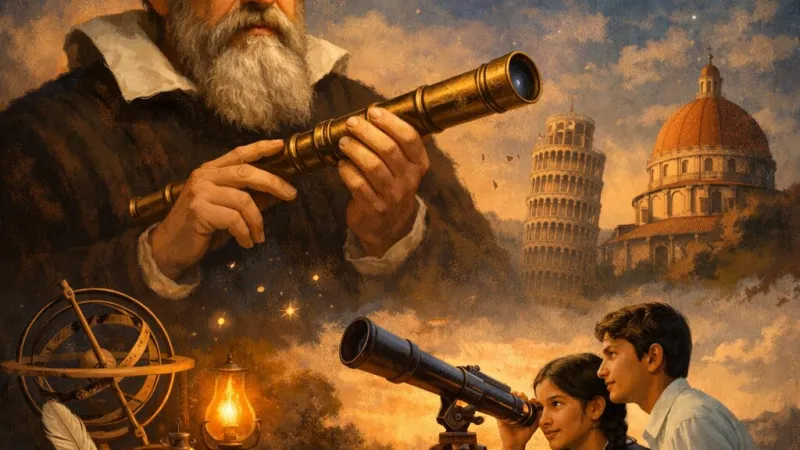
In 1609, news of a Dutch invention—a simple telescope—reached Galileo. Never content to simply accept, he improved the design, crafting a telescope that could magnify objects up to twenty times. With this, he turned his gaze skyward, unveiling cosmic wonders never before seen by human eyes. He observed that the Moon was not smooth but dotted with craters and mountains, much like the rugged Deccan plateau, upturning the belief that celestial bodies were perfect. Most famously, he discovered four moons orbiting Jupiter, now called the Galilean moons—a parallel to Aryabhatta’s revolutionary astronomical contributions in ancient India. He also saw sunspots and the phases of Venus, clear evidence that the Earth was not the centre of the Universe—a stance as radical in Europe as Aryabhatta’s heliocentric hints were in ancient Ujjain.---
Scientific Theories and Experiments
Galileo was a pioneer not just in observation but in experimentation. The famous story, possibly apocryphal but symbolic, tells of how he dropped two different weights from the Leaning Tower of Pisa and saw them hit the ground together, defying Aristotle’s teachings. This experiment echoes our own Indian tradition of “anubhava” (experience-based learning), which insists that knowledge must be tested through observation and practice, not merely received from authority. Galileo went on to formalise the law of uniform acceleration, laying the groundwork for Newton’s laws centuries later. He also contributed to hydrostatics, inventing devices to measure density and weighing objects in water, showing how scientific inquiry could impact everyday life, much like how Indian innovations shaped local livelihoods.---
Personal Life and Challenges
Behind the great scientist was a man of complex emotions and private struggles. Galileo never married, but he had three children with Marina Gamba, a decision that would be viewed differently in the social context of Renaissance Italy, just as Indian society has its own unique family traditions. His later years were marked by ill health, including blindness—a poignant reminder that even the brightest minds face human suffering. Yet, his passion for knowledge never dimmed. In letters to his devoted daughter, Sister Maria Celeste, he found comfort and encouragement, much as our ancient Indian scholars cherished their familial bonds despite social or spiritual demands.---
Conflict with the Church
Perhaps the most dramatic chapter in Galileo’s life was his clash with the Catholic Church. His support for the heliocentric theory—asserting that the Sun, not the Earth, was at the centre of the universe—was seen as heretical by church authorities. He was summoned to Rome and, after a highly publicised trial, placed under house arrest. In his old age and failing eyesight, he persisted in his research, translating his ideas into “Discourses and Mathematical Demonstrations.” Galileo’s courage in questioning doctrine in the face of persecution is reminiscent of our own Indian thinkers like Raja Ram Mohan Roy, who dared to confront prevailing orthodoxies for the sake of truth.---
Enduring Legacy
Galileo died in 1642, but his ideas changed the world forever. He is celebrated as the “father of modern science” because he championed observation and experimentation, values that inspired the scientific method now taught in Indian schools from primary to IITs. Albert Einstein himself called him the “father of modern physics.” Galileo’s relentless curiosity and resilience continue to inspire generations, from rural classrooms in Kerala where students look at the night sky, to ISRO scientists as they send probes to the Moon and Mars.---
Memorials and Recognition
Across the world, Galileo’s name is commemorated in museums, scientific institutions, and space missions. His original telescope is preserved in the Museo Galileo in Florence, Italy. In India, both amateur and professional astronomers remember him for opening the heavens for human comprehension—planetaria in Kolkata, Mumbai, and Delhi regularly recall Galileo’s legacy during science festivals. Even in school textbooks prescribed by CBSE and state boards, his story is retold as part of the building blocks of scientific inquiry.---
Ten Lines Summarising Galileo’s Life and Achievements
1. Galileo Galilei was born in 1564 in Pisa, Italy, into a family that valued music and mathematics. 2. Despite starting medicine, his love for maths and science led him to change his course, showing early signs of independent thinking. 3. He became a renowned professor, known for challenging established beliefs and inviting students to see the world with fresh eyes. 4. Galileo improved the telescope and, by peering into the cosmos, discovered Jupiter’s moons and the Moon’s rugged surface. 5. He provided evidence that the Sun was the centre of the solar system, not the Earth, revolutionising astronomy. 6. His experiments with motion debunked ancient misconceptions, laying the foundation for modern physics. 7. Despite significant achievements, he faced persecution by the Church for his views and spent his final years under house arrest. 8. Galileo never abandoned his quest for truth, even in adversity, leaving behind a treasure of scientific ideas. 9. He is hailed as the father of modern science, inspiring generations, including scientists and students in India. 10. Galileo’s life is a testament to the power of curiosity, courage, and the relentless pursuit of knowledge.---
Rate:
Log in to rate the work.
Log in