Brief and Informative: 10 Key Facts About the Lena River
This work has been verified by our teacher: 5.04.2026 at 10:17
Type of homework: Geography Essay
Added: 2.04.2026 at 13:01
Summary:
Discover 10 key facts about the Lena River, its origin, length, and ecological importance to deepen your geography knowledge for school homework. 🌍
Essay: 10 Lines on Lena River
Rivers have always played a central role in the story of human civilisation. They form the lifeblood of nations, nourishing both land and people, serving as crucial arteries for trade, agriculture, and culture. India, too, is rich in mighty rivers—from the Ganga and Yamuna in the north to the Krishna and Godavari in the south. However, if we look beyond our borders, the world is home to several other fascinating rivers, each with its own story. Among these, the Lena River of Russia stands out, known for its great length, cold climate, and ecological richness. Though far away from India, its features and history help us understand the diversity of our planet and the critical importance of rivers everywhere.
In this essay, I will discuss ten well-explained points about the Lena River, covering its origin, journey, natural characteristics, ecological significance, relationship with people, and its intriguing place in world geography. By drawing examples and comparisons relevant to us in India, I hope to make the Lena River an interesting subject for young learners.
---
1. The Lena River Originates in the Baikal Mountains
The Lena River begins its long journey in the remote Baikal Mountains of southern Siberia. These mountains are situated to the south of the vast Central Siberian Plateau. The exact location is not far from Lake Baikal, which is famous as the world’s deepest freshwater lake. Here, at a height of nearly 1,640 metres above sea level, melting snow and rainwater give birth to one of the greatest rivers on Earth. Just as the Ganga emerges from the Himalayas, the Lena finds its origin in the cold, rugged heartlands of Siberia. The high altitude and harsh climate here mean the river starts as a small stream, gradually increasing in strength as it journeys northwards.---
2. It is One of the Longest Rivers in the World
The Lena River stretches over a distance of about 4,472 kilometres. This makes it the 11th longest river globally and the third longest in Russia, after the Yenisei and Ob rivers. To give an idea of its sheer size, if we compare, the Ganga, the most famous Indian river, is about 2,525 kilometres long. The Lena is nearly twice as long! Its vast journey from the mountains to the Arctic Ocean takes it through some of the most challenging and untouched regions of the planet, making it unique among world rivers.---
3. The Lena River Flows Through Siberia and Empties Into the Arctic Ocean
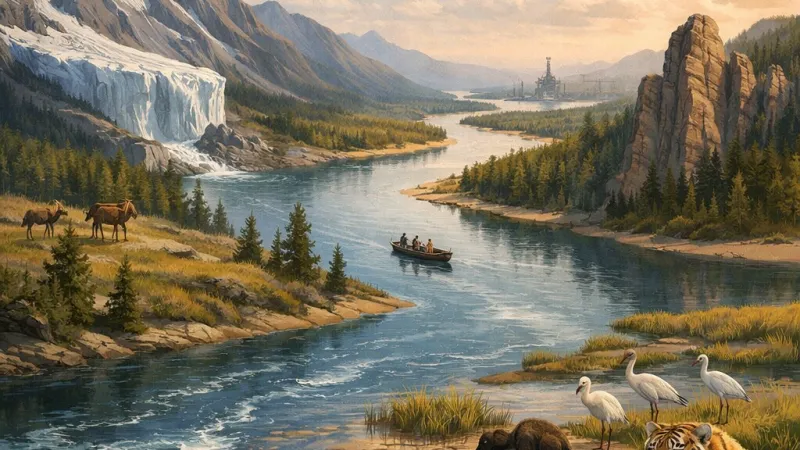
The river’s journey takes it from its source in the Baikal Mountains, northeast across eastern Siberia. As it flows, the Lena passes through thick forests known as taiga, wide plains, and finally empties into the Laptev Sea, which is a part of the icy Arctic Ocean. Near its mouth, it forms a huge delta before joining the sea. Similar to how the Ganga forms the fertile Sundarbans delta before meeting the Bay of Bengal, the Lena creates a vast, marshy delta in the far north, close to the Arctic Circle.---
4. The Lena River Basin is Enormous
The area drained by the Lena and its numerous small rivers and streams is gigantic—about 2.5 million square kilometres. For perspective, this is bigger than the entire state of Rajasthan multiplied several times, or nearly the combined area of ten Indian states like Uttar Pradesh or Maharashtra! This vast basin collects waters from rain, snowmelt, and underground springs, feeding the main river. The size of this drainage basin means it is home to a variety of landscapes, from mountains and forests to arctic tundra.---
5. The Lena Delta is the Largest Arctic River Delta
At its northern end, the Lena does something truly spectacular. It fans out into many channels, marshes, and islands, forming the largest river delta in the Arctic. Covering around 32,000 square kilometres, the Lena delta is bigger than many Indian districts. Deltas are formed when rivers slow down and deposit the soil and sand they have carried with them—just as we see in the mighty Sunderbans (of Ganga and Brahmaputra) in India and Bangladesh. The Lena delta’s wetlands are rich in peat and permafrost, and because of the extreme cold, the waters remain frozen for several months each year.---
6. The Lena River Supports Unique Flora and Fauna
Unlike Indian rivers flowing through tropical and subtropical climates, the Lena travels through dense conifer forests, cold deserts, and arctic tundra. Its delta and upper reaches are a haven for many rare animals and plants. Migratory birds, such as geese, swans, and ducks, come here during the brief summer to breed. Rare fishes like Siberian sturgeon and omul abound in its cold waters. The wetlands of the delta are also important for reindeer and arctic foxes. Just as the Ganga is revered for supporting unique life—from the Gangetic dolphin to the Hilsa fish—the Lena is ecologically invaluable for the northern part of our planet.---
7. The River is Crucial for the People of Siberia
The Lena is not just a geographical feature; it is central to the lives of the people in Siberia. Indigenous communities such as the Evenks and Yakuts have lived along its banks for centuries. They rely on the river for fishing, reindeer herding, transport, and daily water needs. Like Indian farmers who depend on the Yamuna or Krishna during dry seasons, Siberians use the Lena for irrigation and even for transporting goods during the brief, ice-free summer months. In areas where roads are almost non-existent, the river is the main highway connecting remote villages.---
8. The Lena River Basin is Rich in Natural Resources
Siberia is famous for its mineral resources, and the Lena basin is no exception. The land around the river holds gold, diamonds, natural gas, coal, and iron ore. Mining of these resources has brought wealth to Russia but also created environmental problems, such as pollution and habitat destruction. This is similar to concerns faced along the Damodar River in eastern India, where coal mining has brought both wealth and environmental challenges. Balancing economic gain with environmental protection remains a global challenge.---
9. The River Faces Environmental Challenges
Climate change is threatening the delicate environment of the Lena River, with rising temperatures causing the permafrost (permanently frozen ground) to melt and altering the river’s flow. Pollution from mining and industrial activities adds to the stress. The changing patterns of flooding due to warming winters and increased rain can harm both wildlife and people living by the river. Similar problems of pollution and water scarcity are faced by the Yamuna and many other Indian rivers. This shows that protecting rivers is a worldwide concern.---
10. Lena River has a Deep Cultural and Linguistic Connection
The name ‘Lena’ comes from the local Evenk language (“Elyu-Ene”), meaning “the larger river”. This reflects the respect local people have for this mighty river, similar to how Indian rivers like the Ganga and Narmada are given special names and revered in folklore and rituals. Stories and traditions related to the Lena remain alive among the native Siberian tribes, and the river is sometimes called the “Mother of Siberia”. Today, scientists study the Lena to understand the effect of global warming on cold regions, just as Indian researchers study the Gangs and Brahmaputra for flood management and climate research.---
Conclusion
In summary, the Lena River is a vast, ancient, and vital waterway that flows through one of the world’s coldest and most remote landscapes. From its origin near the Baikal Mountains to its grand delta on the edge of the Arctic Ocean, the Lena shapes the land and life of eastern Siberia. Its basin is vast, its wildlife unique, and its importance to people and science truly global. Just as our own Indian rivers are crucial for life, heritage, and the future, so too is the Lena River for the people of Siberia and the world.The Lena stands as a reminder that rivers, whether flowing through Indian villages or icy Russian tundra, connect nature, culture, and people everywhere. By learning about rivers like the Lena, we appreciate not only our own environment but also the interconnected world we all share. Taking care of our rivers—protecting their purity and respecting their power—remains a responsibility for current and future generations, locally and globally.
Rate:
Log in to rate the work.
Log in