Key Facts and Cultural Importance of Vasant Panchami in India
This work has been verified by our teacher: 17.05.2026 at 9:51
Type of homework: Essay Writing
Added: 14.05.2026 at 6:22
Summary:
Discover key facts and cultural importance of Vasant Panchami in India, including traditions, history, and its role in celebrating knowledge and spring 🌼.
The Significance and Celebrations of Vasant Panchami in India
India’s calendar is richly woven with festivals that reflect its diverse cultural, spiritual, and seasonal heritage. Among these, Vasant Panchami holds a special place, celebrated with both devotion and joy across the country. Marking the end of winter and heralding the onset of spring, Vasant Panchami generally falls in late January or early February, on the fifth day (panchami) of the bright half of the lunar month of Magha. The festival is deeply intertwined with the reverence of Goddess Saraswati, who in Hindu tradition is venerated as the embodiment of knowledge, learning, music, and the arts. More than just a ritual observance, Vasant Panchami signifies an awakening of intellect and spiritual energy, aligning mankind with the rejuvenation in nature. In the following essay, I explore the many facets of Vasant Panchami—its cultural, religious, and educational importance, traditional practices, regional varieties, and its resonance among Indians even today.
---
Historical and Mythological Background
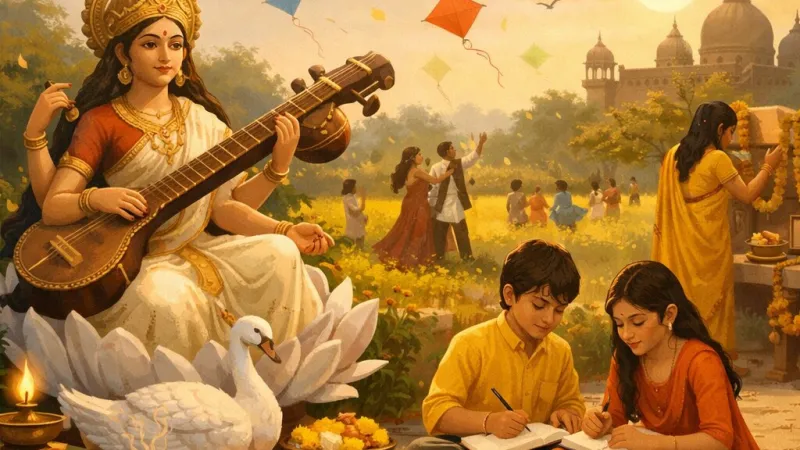
The Sanskrit word ‘Vasant’ translates to ‘spring’, and ‘Panchami’ refers to the fifth day, describing precisely the occasion: the fifth day of the welcoming spring season. The origins of Vasant Panchami are traced back to ancient scriptures and Puranas, where the festival is described as an occasion dedicated to Goddess Saraswati. Mythologies narrate that it was on this day the goddess appeared, adorned in radiant white, seated on a lotus with a veena (musical instrument) in her hands. Saraswati is personified in Hindu tradition as the wellspring of wisdom and creativity—the reason why Vasant Panchami is often called Saraswati Puja.In some texts, it is also said that Lord Brahma, the creator, observed a world so silent and bland that he created Saraswati to fill the universe with melody and knowledge. The tale signifies the harmony between creation and enlightenment. These myths are not merely old stories, but living currents in Indian society, as reflected in the way the festival aligns itself with the natural world’s renewal.
---
Seasonal Importance of Vasant Panchami
Vasant Panchami is a marker of transformation in climate, signifying the gentle but marked shift from winter to spring. After the cold and often misty mornings of January, spring brings a tender warmth and a burst of colour to the landscape. One of the most vivid sights during this period is the blooming of mustard flowers, carpeting fields in golden yellow, particularly in regions like Punjab and Haryana. The air carries the fresh scent of blossoms and the songs of returning birds, making the environment alive with promise and energy.In India, where agriculture is at the backbone of the rural economy, the onset of spring also has practical implications. Farmers prepare for the new sowing season, with the hope that the cycle of renewal will bring prosperity and nourishment. The yellow hues worn and displayed during the festival—be it in attire, flowers, or festive foods—symbolise not just the changing season, but also optimism, energy, and the vibrancy associated with Saraswati.
---
Religious Significance and Worship Practices
At the heart of Vasant Panchami lies the ritualistic worship of Goddess Saraswati, known as Saraswati Puja. Devotees begin by cleaning and decorating their homes and temples, setting up idols or symbolic images of the goddess, often clothed in white or yellow. The worship area is adorned with yellow flowers like marigold and laburnum. Offerings of seasonal fruits, yellow-coloured sweets like ‘boondi ke laddoo’, and rice dish ‘kesariya bhaat’ are made. Students, artists, musicians, and even parents place books, pens, musical instruments, and brushes before the goddess, seeking her blessings for knowledge, creativity, and prosperity.Recital of ‘Saraswati Vandana’—lines like “Ya Kundendu Tushara Hara Dhavala…”—fills the ritual with mantras believed to invoke intelligence and insight. Many observe a fast, while devotional songs or ‘bhajans’ are sung in gatherings. Temples and community spaces (Pandals) become centres of collective worship, echoing with Sanskrit hymns and positive energy. Wearing yellow garments is also common, as a mark of respect both for the season and Saraswati herself. This blend of simplicity and devotion in observance is one of the aspects that endears the festival to people of all ages.
---
Social and Cultural Celebrations
Vasant Panchami is not confined merely to prayer; it is a joyous social occasion as well. In towns and villages, people gather for melas (fairs), which feature local music, drama, and traditional crafts. In parts of North India, notably Punjab and Uttar Pradesh, kite flying becomes the highlight of community life. The sky is adorned with vibrant kites, fluttering in the spring breeze—a symbol of joy, freedom, and aspirations soaring high.Educational institutions play a significant role in the festivities. Schools and colleges organise special assemblies—children dress up in yellow, participate in singing competitions, perform dances dedicated to Saraswati, and contribute to rangoli creations. As part of the holiday spirit, many Indian households prepare festive foods—like ‘pakoras’, ‘sweet saffron rice’, and ‘halwa’—with a dash of turmeric or saffron adding the iconic yellow hue.
Each state brings its own flavour: in Bengal, Saraswati Puja is observed almost with the same fervour as Durga Puja, complete with community pandals and cultural shows; in Maharashtra, processions and collective poojas are common, while in Odisha and Bihar, homes and schools alike see early morning worship and feasting.
---
Educational Significance
Vasant Panchami is inextricably linked with education. For centuries, it has marked ‘Vidyarambh’ or ‘Hate-Khori’—the sacred occasion when young children are formally introduced to the world of letters and learning. In traditional ceremonies, a child is guided by elders or a priest to write their first letters, usually “Om” or “Saraswati”, on a slate or in a tray of rice grains, seeking the goddess’s blessings. This act signifies the value Indians place on learning and the role of divine grace in education.Throughout India, Saraswati finds a prominent place in schools and colleges—her portraits overseeing school libraries, classrooms decorated for her worship, and the annual Saraswati Vandana serving as a gentle reminder of the importance of wisdom. Teachers receive special respect, resonating with the traditional Indian idea of ‘Guru-Shishya Parampara’. The day also motivates students to make new academic resolutions, reinforcing the values of hard work and humility before knowledge.
---
Symbolism of Colours and Objects Used During the Festival
The use of yellow during Vasant Panchami is more than an aesthetic choice. Yellow is associated with clarity, intellect, and positive energy. Mustard flowers offered to the goddess, yellow sarees worn in homes and schools, and even yellow rice (poha or pulao) served during meals all reinforce the vibrancy and fertility of spring. White, often found in Saraswati’s attire, symbolises purity and peace.Placing musical instruments like veena, books, and tools of art before the goddess has deep significance—acknowledging the importance of learning in all fields, not just academics. The presence of a clay lamp (diya) in rituals stands for the illumination of the mind, while a conch shell (shankh) may be blown to mark an auspicious start. Holy texts, kept alongside the idol, symbolise the unity of spiritual and worldly knowledge.
---
Modern-Day Relevance and Observance
In contemporary India, Vasant Panchami continues to act as a bridge between generations, and between the rural and urban pulse of the nation. Social platforms are harnessed to spread awareness, with schools encouraging essay writing, drawing, and speech competitions on the festival. Increasingly, members of other faiths and even people overseas are drawn to the festival, charmed by its universality and the beauty of its customs.Some communities now take the opportunity to promote environmental awareness—organising tree planting drives or using bio-degradable decorations, reflecting a renewed respect for the natural cycle. Vasant Panchami thus becomes not only a religious observance, but also an occasion for social unity and responsible celebration.
---
Challenges and Contemporary Issues
While Vasant Panchami's core essence remains vibrant, modern challenges have arisen. The commercialisation of the festival—sale of ready-made idols, synthetic decorations, and ostentatious celebrations—at times overshadows authentic traditions. Environmental concerns related to plastic or non-biodegradable items are being acknowledged, with efforts directed towards eco-friendly celebrations.With increasing academic and work pressures, students and professionals often find it hard to celebrate in the old, leisurely way. Nonetheless, cultural organisations and teachers strive to retain the festival's values, conducting small but meaningful ceremonies, and encouraging the inner quest for wisdom over mere ritual observance.
---
Rate:
Log in to rate the work.
Log in