Dussehra Festival: Origins, Importance, and Celebrations in India
This work has been verified by our teacher: 23.04.2026 at 17:14
Type of homework: Essay Writing
Added: 22.04.2026 at 6:24
Summary:
Explore the origins, importance, and celebrations of the Dussehra festival in India to understand its cultural and spiritual significance in students’ homework.
Dussehra: A Comprehensive Exploration of its Origins, Significance, and Celebrations Across India
Dussehra, known also as Vijayadashami, is one of India’s most cherished and vibrant festivals, radiating joy, colour, and togetherness across the subcontinent. Steeped in mythology and history, it symbolises the eternal truth that good will ultimately triumph over evil, a message that resonates powerfully in the collective conscience of Indians. Though primarily a Hindu festival, its appeal extends well beyond religious boundaries, uniting millions in cities, towns, and villages. This essay explores the origins, significance, diverse practices, and contemporary relevance of Dussehra, while highlighting why it remains an enduring pillar of Indian cultural life.Mythological and Historical Origins of Dussehra
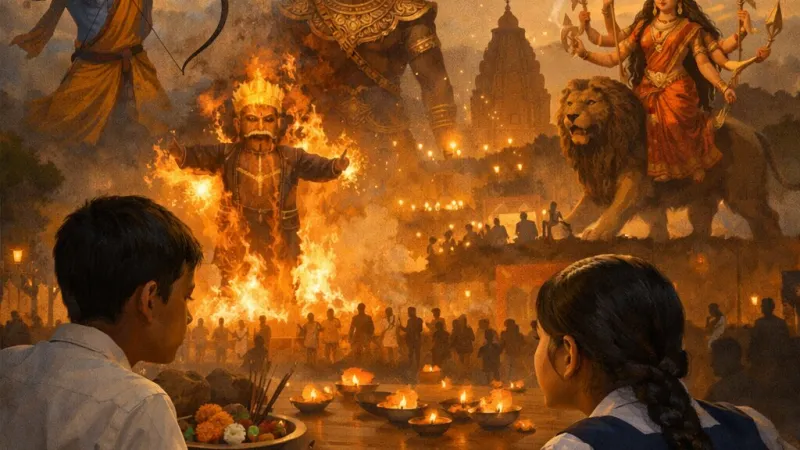
The roots of Dussehra can be traced to two profound legends celebrated with equal fervour in different regions of India. The first—and perhaps most widely known—is found in the epic Ramayana. Here, the festival marks Lord Rama’s triumph over Ravana, the ten-headed demon king of Lanka. The Ramayana, a text held in deep reverence in Indian society, narrates how Rama, aided by his devoted brother Lakshmana, the ardent Hanuman, and an army of vanaras (monkeys), waged war to rescue his wife Sita from Ravana’s clutches. Rama’s ultimate victory on the tenth day symbolises the victory of dharma (righteousness) over adharma (evil), casting Rama as the ideal king, son, and husband—a paragon of virtues that have provided moral guidance for generations.Equally significant is the legend associated with the Goddess Durga, particularly celebrated in the eastern and southern regions of India. According to the Devi Mahatmya, an important Hindu scripture, Durga incarnated to annihilate Mahishasura, a shape-shifting buffalo demon whose tyranny threatened cosmic balance. The fierce battle raged for nine days and nights; on the tenth day, Durga vanquished Mahishasura, restoring order and becoming a symbol of Shakti—the divine feminine power. Her victory, celebrated as Vijayadashami, underscores the role of the goddess as a protector, a compassionate mother, and an invincible warrior.
Interestingly, Dussehra unites both these narratives. The festival serves as the grand finale of Navratri—a nine-night period devoted to goddess worship—and, regionally, the stories of Rama and Durga seamlessly intertwine, epitomising the triumph of virtue.
Religious and Cultural Significance
Dussehra stands as a festival with profound ethical and spiritual meanings. At its essence, it extols the universal principle that evil, however powerful, is destined to fall before truth, courage, and righteousness. The burning of Ravana’s effigy, a spectacular sight across North India, is more than mere spectacle; it is a collective commitment to uprooting negativity and ego from within. Such symbolic gestures strike a deep chord in a society grappling with daily struggles—reminding all that every challenge, no matter how daunting, can be overcome by unwavering values.Spiritual practices during Dussehra are steeped in introspection and worship. The preceding Navratri period is marked by fasting, prayer, and devotional singing. Many households and temples install colourful idols of Durga, Lakshmi, and Saraswati, performing intricate pujas and reciting mantras like the Durga Saptashati. Fasting is undertaken not just as a ritual but as spiritual discipline, believed to cleanse the body and focus the mind.
Fire and light play a striking role. From the burning of towering effigies in open maidans to the flickering lamps adorning homes and temples, flames serve as metaphors for the destruction of ignorance and the illumination of wisdom. These collective rituals—where communities gather to pray, perform, and celebrate—foster unity, breaking social divisions and strengthening bonds.
Diverse Regional Traditions
India’s immense diversity finds vivid expression in the myriad ways Dussehra is observed.North India: Ramlila and The Festival of Effigies
In the Hindi heartland—Delhi, Varanasi, Lucknow, and many smaller towns—Ramlila plays become the centerpiece of Dasara festivities. These open-air, theatrical re-enactments of the Ramayana draw crowds of all ages. For days leading up to Dussehra, actors depicting Rama, Sita, Lakshmana, and Ravana enthrall audiences, their performances punctuated by music, dance, and narration in both Hindi and regional dialects. The climax arrives on Vijayadashami, when gigantic effigies of Ravana, his son Meghanada, and brother Kumbhakarna are set ablaze, often with dazzling fireworks lighting up the sky.South India: Celebrating Knowledge and Tools
In Tamil Nadu, Karnataka, Andhra Pradesh, and Kerala, Dussehra’s emphasis is slightly different. Here, the festival is deeply intertwined with Saraswati Puja—the celebration of the goddess of knowledge, arts, and wisdom. On the ninth day, children place their books and musical instruments before the goddess, seeking her blessings. In Kerala and parts of Karnataka, the ritual of ‘Vidyarambham’ initiates young children into the world of letters, with elders helping them trace their first alphabets in rice or sand. The tenth day also sees the observance of Ayudha Puja, where tools, vehicles, and instruments—whether ploughs, computers, or buses—are cleaned, decorated, and worshipped, recognising the dignity of labour.Eastern India: Durga Puja’s Grand Culmination
In West Bengal, Assam, Tripura, and Odisha, Dussehra coincides with the end of Durga Puja—arguably the region’s most exuberant festival. Artisans spend months crafting majestic clay idols of Durga slaying the demon, which are installed in elaborately themed pandals. Poetry and music competitions, drama, and traditional dances animate the days. On Vijayadashami, processions wind through city streets as Durga idols are taken for immersion in rivers, symbolising her return to her celestial abode. Celebrations here are as much about cultural expression as religious devotion, uniting people across communities.Western India and the Hill States: Unique Customs
In Maharashtra and Gujarat, Dussehra is associated with folk dances like Garba and Dandiya Raas during Navratri, culminating in community pujas, fairs, and the worship of vehicles and implements. Villages burst into life with local markets offering sweets, toys, and seasonal produce. Perhaps the most spectacular Dussehra is observed in Kullu, Himachal Pradesh, where deities from hundreds of surrounding villages are paraded through the valley in a week-long congregation, attracting thousands of pilgrims.Social and Cultural Impact
Dussehra is as much a social as a spiritual event. In towns and cities, the festival becomes an occasion for neighbours to interact, families to reunite, and children to learn from the stories of the Ramayana and the Devi Mahatmya. The vibrant fairs, bustling markets, and processions promote local employment and handicrafts.Schools and colleges in India regularly conduct Ramlila performances with active participation from students—fostering teamwork, artistic talent, and appreciation for India’s literary heritage. In textbooks and moral science classes, the teachings of Rama and Durga are emphasised, not as distant tales but as living values. Indeed, UNESCO’s recognition of Ramlila as a part of the world’s intangible cultural heritage attests to the festival’s artistic and ethical significance.
Modern Innovations and Evolving Traditions
Contemporary India’s Dussehra is an amalgam of tradition and innovation. In metro cities such as Mumbai, Bengaluru, and Hyderabad, laser light shows now compete with fireworks, and eco-friendly effigies made from papier-mâché or natural fibres have begun replacing those made of hazardous materials. The widespread use of social media enables live streaming of Ramlilas and idol immersions, making the festival accessible even to those living abroad or unable to attend in person.Environmental consciousness is steadily shaping celebrations. Both civic authorities and citizen groups now encourage the use of biodegradable materials, bar loud crackers, and promote artificial water tanks for idol immersion, as seen in cities like Kolkata and Pune. This shift underscores the adaptability and resilience that marks Indian festivals.
Finally, for the diaspora settled abroad—whether in Dubai, London, or Melbourne—Dussehra serves as a thread connecting them to their roots. Indian communities abroad recite the Ramayana, organise Dandiya nights, and burn symbolic effigies, passing on these rich traditions to the next generation.
Conclusion
Dussehra’s enduring relevance lies in its multidimensional nature—as a festival of myth, morality, community, and cultural vitality. Its stories inspire us to face our own Ravanas, reminding us that heroism begins with the courage to choose what is right. Across India’s geographic and cultural diversity, Dussehra emerges as a celebration not of uniformity but of unity—a festival that kindles hope and togetherness for young and old, rich and poor, men and women alike.As India strides forward in a rapidly changing world, Dussehra’s message—that truth and virtue will ultimately prevail—acquires even greater urgency. Far from being merely a colourful annual ritual, it remains a gentle yet persuasive call to lead lives of integrity and compassion, keeping alive a tradition cherished for centuries and relevant for all time.
Rate:
Log in to rate the work.
Log in