Mary Kom: Inspiring Journey of India's Legendary Woman Boxer
This work has been verified by our teacher: 19.05.2026 at 9:46
Type of homework: Essay Writing
Added: 18.05.2026 at 9:28
Summary:
Discover Mary Kom’s inspiring journey from humble beginnings to becoming India’s legendary woman boxer, showcasing resilience, strength, and success in sports.
Mary Kom: The Indomitable Spirit of India’s Boxing Legend
The roar of the crowd, the glint of medals, the relentless pursuit of excellence—sports, more than just a contest of power and skill, have the remarkable capacity to uplift individuals and nations alike. In a country as vast and varied as India, sporting icons often become symbols much greater than themselves, embodying dreams, aspirations, and the spirit of their people. Among these, the name Mary Kom shines not only for her extraordinary feats in the boxing ring but for her indomitable will, her journey of struggle, and her trailblazing role in women’s sports. Mary Kom’s story is a living testament to the power of perseverance, representing the strength of rural India and standing as a beacon for countless young girls aspiring to turn their dreams into reality. This essay explores her journey—from humble beginnings to global fame—and examines why Mary Kom remains an icon of discipline, resilience, and hope within the Indian consciousness.
Early Life and Background
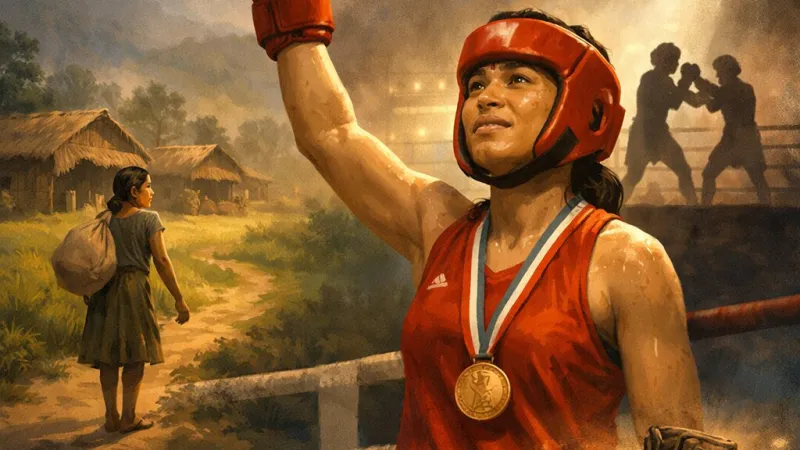
Mary Kom, known fully as Chungneijang Mery Kom Hmangte, was born on 24th November 1982 in the small village of Kangathei, located in Churachandpur district of Manipur. Her family, belonging to the indigenous Kom tribal community, faced persistent economic hardships. Her father, a tenant farmer in the jhum fields, worked tirelessly to sustain the family, often struggling to make ends meet. Despite these challenges, the community’s close-knit nature and the spirit of resilience that marked daily life deeply influenced young Mary.As a child, Mary Kom was inclined towards sports of all kinds. In the dusty fields around her village, she played football, volleyball, and ran sprints. During her school years at Loktak Christian Model High School, she excelled in athletics, particularly the 400-metre race and javelin throw. With limited provisions and little encouragement for girls’ sports, her passion grew quietly but steadily. Books and classrooms jostled for attention with fields and tracks, and balancing studies with training instilled in her a sense of discipline that would later set her apart. After her schooling, Mary continued her education at Churachandpur College, all the while nurturing her love for athletics—unaware that a greater calling awaited her.
Transition to Boxing and Sporting Career Beginnings
Mary Kom’s tryst with boxing was almost serendipitous. Inspired by the international success of Manipuri boxer Dingko Singh, who returned with a gold medal from the 1998 Asian Games, Mary found herself drawn to the ring—a rare and daring choice for a girl from her background in the late 1990s. At a time when ambitions in contact sports were seen as unorthodox for women, especially in conservative rural settings, Mary pressed on with quiet determination.Training under coach K. Kosana Meitei and later at the Sports Authority of India in Imphal, Mary’s days started before sunrise and ended late, filled with grueling routines. The facilities were basic, resources scarce, and family support initially lukewarm, as parents worried about her marriage prospects and physical well-being. But Mary’s resolve outweighed every hesitation.
Her participation in local and state-level tournaments marked the beginning of her sporting journey. Soon, she began making waves in national boxing championships. In 2000, barely in her teens, she clinched her first national gold. Each bout brought new recognition, and with every trophy, confidence and the flames of ambition grew stronger.
Major Achievements and Historic Milestones
Mary Kom’s list of laurels is long and illustrious, but certain milestones stand out as turning points—both for her and for Indian boxing. Foremost among these is her dominance at the World Amateur Boxing Championships. With a record six gold medals and one silver over the years, Mary etched her name in the annals of world sport. She became the only woman boxer to have won medals in seven consecutive world championships, a feat that still remains unmatched.Her prowess shone equally bright in continental tournaments. At the Asian Women's Boxing Championships held in Kazakhstan in 2003 and the Asian Games in Incheon, South Korea in 2014, Mary clinched the gold, repeatedly proving her mettle against Asia’s best. But perhaps her crowning moment was the 2012 London Olympics, where women’s boxing was included for the first time. Against all odds—age, inexperience on the Olympic stage, and the challenge of returning after motherhood—Mary won the bronze, inscribing her name forever in Olympic history and opening doors for many young Indian women boxers.
India acknowledged her with top civilian honours: the Arjuna Award in 2003, Padma Shri in 2006, Rajiv Gandhi Khel Ratna in 2009, and the Padma Bhushan in 2013. These awards not only decorated her achievements but also reflected a shift in societal attitudes toward women’s sports. The International Boxing Association (AIBA) gave her the moniker ‘Magnificent Mary’, further underlining her global reputation.
Personal Life and Balancing Roles
Beyond the ring, Mary’s life has reflected the classic Indian struggle of balancing personal aspirations with familial responsibilities. Her marriage to Karung Onkholer, a fellow Manipuri from the football fraternity, was built on mutual respect and understanding. As Mary once said, “My husband is my soul mate, my biggest supporter.”Motherhood, often held up as a barrier to women athletes, became just another challenge for Mary to conquer. After giving birth to twins in 2007, many assumed her career was over. However, she stunned critics by making yet another international comeback, her agility undiminished. This rare combination of champion athlete and devoted mother challenged societal stereotypes and set a soaring example for working mothers across India.
Mary’s autobiography, "Unbreakable", captures her journey with honesty and humility. Her story is one of overcoming heartbreak, injury, financial struggle, and doubt, all recounted in a way that inspires readers to find strength within themselves, no matter the odds.
Contributions Beyond the Ring
Mary Kom’s legacy is not confined to her sporting records. She has been a passionate ambassador for boxing and a vocal supporter of women athletes in India. As co-owner of North East Tigers, a franchise in the Super Fight League, she has promoted the sport across the country, turning the spotlight on boxing as a viable pursuit for youth.She has tirelessly worked for women’s empowerment in her home state and beyond, conducting self-defence workshops in Imphal and using her stature to draw attention to social issues, including gender equality and safety. These initiatives have helped countless young women develop confidence and an indomitable spirit.
In 2016, Mary Kom’s achievements received yet another recognition through her nomination to the Rajya Sabha. As a parliamentarian, she has used her position to speak up for sports infrastructure and the welfare of sportspersons, especially women from disadvantaged backgrounds.
Mary Kom as an Inspirational Figure
Mary Kom’s rise from muddy fields of Manipur to global podiums has become a source of hope for girls in every corner of India, especially in rural and northeastern regions where sporting opportunities are scarce. She has transformed into a living symbol of possibility, her life reminding many that greatness is not limited by geography, background, or gender.Her sheer grit, discipline, and relentless hard work have become case studies for schools and colleges. Students recite stories of her training sessions, where she would run at dawn and punch sandbags for hours, to learn lessons in perseverance. Young boxers idolise her not just for her medals but for her humility and grace, aspiring to follow in her footsteps.
Challenges Faced and Overcome
Mary’s journey was never easy. Training facilities in her early years were inadequate—equipment was borrowed, and travel for competitions required loans and support from well-wishers. Boxing, seen as a male preserve, brought its own set of stereotypes. Many in society questioned her choices, but her steely determination proved them all wrong.Injuries, fatigue, weight management, and the fear of failure were regular companions. Yet, Mary never used hardship as an excuse, instead moulding adversity into strength. Balancing roles as a daughter, wife, mother, athlete, and now parliamentarian, she showed that modern Indian women can don many hats with equal aplomb.
The Current Status and Future Aspirations
As of recent years, Mary Kom continues to train and compete, always hungering for new challenges. Despite facing setbacks in Olympic qualifications, her focus on the growth of Indian boxing remains unwavering. She dreams of transforming India into a world leader in women’s boxing, yearning for better infrastructure, transparent athlete support, and equal opportunities for sportspersons across the country.In her public life, Mary keeps working for social causes, expanding her boxing academy in Manipur, and mentoring new talent. Her vision for a better, fairer world remains alive through every young girl who ties her gloves and steps confidently into the ring.
Conclusion
From the humble fields of Manipur to the global boxing stage, Mary Kom has charted an extraordinary journey—one marked by hard-fought victories, broken stereotypes, and tireless service beyond her own ambitions. She stands as a symbol of hope, strength, and the boundless power of self-belief. Her achievements have given Indian women a new language of confidence and opened new vistas in the world of sports.Mary Kom’s legacy is not just about medals and awards. It is about the doors she has opened, the dreams she has awakened, and the courage she has inspired among millions. In the words of Kalpana Chawla, another Indian icon: “The path from dreams to success does exist.” For Indian students striving against odds, Mary Kom’s story remains a guiding light—encouraging them to rise, fight, and become ‘magnificent’ in their own right.
Rate:
Log in to rate the work.
Log in