Top 10 Facts About Owls for School Essays
This work has been verified by our teacher: 8.06.2026 at 18:19
Type of homework: Essay Writing
Added: 6.06.2026 at 8:27
Summary:
Discover the top 10 facts about owls for school essays and learn about their unique features, role in nature, and cultural significance in India 🦉.
10 Lines on Owls
Few birds capture the human imagination quite like the owl. These mysterious creatures have flitted through Indian forests, rural legends, sacred texts, and even the corners of our school textbooks, fascinating generations of learners. Whether it is their haunting calls during chilly winter nights or their sudden appearance in ancient stories, owls hold a special place in the natural and cultural worlds of India. In this essay, I will explore a detailed account of owls, their unique features, their value to humans and the environment, and why it is so important for us to know and care about them.---
Introduction
Owls are a fascinating family of birds, instantly recognised by many for their large, piercing eyes and almost ghost-like silent movements. These birds are most active at night—a lifestyle that has contributed to their air of mystery. In India, as in many other parts of the world except the icy continent of Antarctica, owls can be found in a variety of habitats, from dense forests to the fringes of farmlands.Beyond their beauty, owls carry great ecological and cultural importance. Their role as predators of rodents and insects makes them a natural friend to farmers and an important link in controlling pests that harm crops. At the same time, in Indian tradition, the owl has been both venerated and feared, appearing in folktales as a symbol of wisdom, mystery, and as a messenger of the goddess Lakshmi. Let us now discover more about what makes these birds so truly special.
---
Physical Characteristics of Owls
Owls come in many different sizes, but most are medium to large birds with a sturdy, stocky build and an air of silent power. Their legs are covered in feathers all the way to their sharp talons—these strong claws help them snatch up their prey in a matter of seconds. One of the most striking features of owls is their silky, soft feathers. This softness is not just for show; it allows them to fly almost noiselessly, sneaking up on their prey in the darkness with remarkable precision.Another important feature is their plumage. The colours of their feathers—shades of brown, grey, white, or black—help them blend into the tree bark or leaves, acting as natural camouflage against predators or while waiting patiently for an unsuspecting mouse. In fact, many species like the Indian scops owl are so well-camouflaged, they can be nearly impossible to spot among tree branches.
Eyes, of course, are the part most people notice first. Unlike other birds, owl eyes are large and round, facing forward like humans. This gives them excellent night vision—perfect for hunting in low light. Owls cannot move their eyes around, but they can twist their heads almost all the way around—up to 270 degrees—helping them look in different directions without moving their bodies.
Even their ears are unique. Owls have one ear higher than the other, allowing them to catch the tiniest sounds and locate exactly where that sound came from. This trait is especially developed in barn owls, which can hunt by sound alone on a dark night! One interesting fact is that in many owl species, the female is bigger than the male, which is quite rare amongst birds.
---
Behaviour and Diet
Owls are well known for their nighttime adventures. While the world sleeps, they roam quietly in search of food, preferring to rest or hide away during the day. This nocturnal lifestyle gives them an advantage, as there are fewer predators and rivals around, making hunting easier.Their menu is entirely carnivorous. Most Indian owls feed on rats, mice, shrews, bats, insects like beetles, grasshoppers, and sometimes even small snakes, frogs, or fish. By hunting such creatures, they help keep pests under control—a fact appreciated by rural farmers across India. There are stories in villages of barn owls keeping entire paddy fields safe from mice.
Owls are incredibly efficient hunters. Their keen sense of hearing, night vision, and silent flying skills help them approach prey without being noticed. Once they catch their food, they often gulp it down whole—bones, fur, and all! Later, they cough up the parts they cannot digest as small pellets.
Owls are mostly solitary birds. Unlike crows or parrots, they do not fly in flocks, preferring quiet one-on-one or family groups, particularly while nesting. Most do not build their own homes; instead, they use abandoned nests of other birds or natural holes in trees.
---
Reproduction and Lifespan
When it comes to raising families, owls have some simple habits. Usually, an owl mother will lay three to four eggs at a time. These eggs are round and white, hidden away in tree hollows, crevices in rocks, or even deserted nests of kites, crows, or mynas. The mother takes extra care in keeping the eggs safe and warm, as the babies are vulnerable to snakes and other predators.Owlets—baby owls—are helpless at birth, but they grow quickly thanks to a regular supply of food brought by both parents. Some barn owls nesting in the tiled roofs of old Indian houses have delighted generations of children with their cute, curious faces peeping out at dusk.
Owls live fairly long for birds. While the average wild owl in India can live up to 20 years, their actual lifespan can be influenced by many factors—such as the type of species, the safety of their habitat, and threats from humans or other animals.
---
Diversity and Species
The diversity of owls is truly impressive. Worldwide, there are around 200 species of owls, divided mainly into two broad categories: ‘true owls’ (Strigidae family) and ‘barn owls’ (Tytonidae family). In India, students might be familiar with the barn owl, with its distinctive white, heart-shaped face, seen sometimes in old wells and derelict buildings.Other common owls in India include the spotted owlet, Indian eagle owl, collared scops owl, and the brown fish owl. Each species has its own unique call, feathers, and habits. The smallest, like the jungle owlet, are hardly bigger than a sparrow, while some eagle owls can be as large as a house cat.
Sadly, many species are under threat. Clearing of forests, pollution from pesticides, and destruction of old trees and buildings where owls nest have all placed certain Indian owl species at risk. According to some studies, nearly a third of the world’s owl species face the danger of extinction.
---
Cultural Significance and Interesting Facts
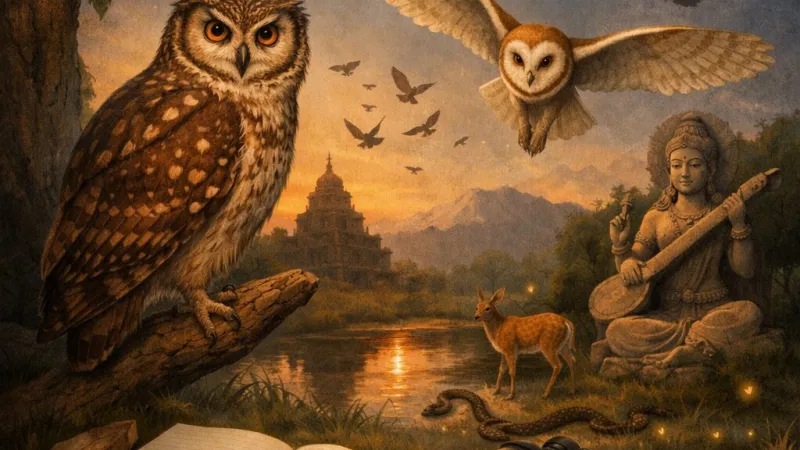
Owls are not just remarkable for their biology—our culture brims with references to them. Old tales from the Panchatantra advise us to be as wise as an owl. In Hindu mythology, the owl (Ullu) is the vahana (vehicle) of Goddess Lakshmi and is associated with good fortune and prosperity. Yet, in some parts of rural India, seeing an owl at night is still thought to be unlucky, showing the complicated relationship we have with these birds.In literature, owls appear in stories like “Chandamama,” and folk songs often mention their eerie calls during full-moon nights. Indian films occasionally use owls as symbols of wisdom or weirdness, and even teachers in schools sometimes affectionately call naughty children “ullu,” misunderstanding the bird’s real abilities.
Other interesting facts: Did you know that a single barn owl can eat up to 1,000 mice every year? Or that owls do not hoot only; they can screech, hiss, and whistle as per their mood or species? Some owls are even known to eat their own kind if food is scarce!
---
Conclusion
Owls are truly one of nature’s wonders, blending in silently with our fields and forests but playing extraordinary roles behind the scenes. With special adaptations for the night, incredible hearing, and stealthy hunting skills, they help keep the balance in our ecosystem while inspiring whole generations of story-tellers, poets, and artists.As students and future protectors of our environment, it is important to understand and appreciate owls—not just for their mysterious reputation but for the very real services they provide to us, especially in agriculture. Preserving our forests and learning to value these birds will ensure that their calls will echo across India for many years to come.
For your school project, you can make your essay colourful by adding a drawing or pasting a picture of a barn owl with its heart-shaped face. And remember, learning these ten lines is just the start—always try to go a little further to impress your teachers!
---
Ten Key Facts about Owls 1. Owls are mostly active at night and rest during the day. 2. They have very large eyes for excellent night vision. 3. Their soft feathers help them fly silently. 4. Owls help farmers by eating pests like rats and insects. 5. They can turn their heads nearly all the way around to look in different directions. 6. Owls use old nests or tree holes for laying eggs. 7. Female owls are usually bigger than males. 8. There are nearly 200 species of owls worldwide. 9. Some owls have heart-shaped faces, like the barn owl. 10. Owls are both respected and feared in Indian culture, symbolising wisdom and mystery.
---
In summary, owls are an essential and enchanting part of our natural and cultural heritage. Let us respect and protect them, for in their survival lies our own ecological wellbeing.
Rate:
Log in to rate the work.
Log in