Brief and Impactful Lines on Gandhi Jayanti for Students
This work has been verified by our teacher: today at 10:20
Type of homework: Essay Writing
Added: 8.06.2026 at 9:41
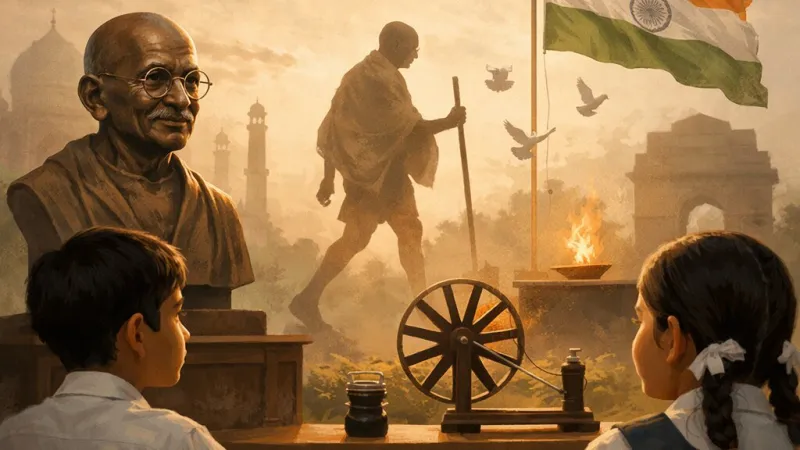
Summary:
Explore brief and impactful lines on Gandhi Jayanti for students to learn its history, significance, and the enduring legacy of the Father of the Nation.
Gandhi Jayanti: Honouring the Father of the Nation
In the rich tapestry of Indian festivals, national observances hold a special place, weaving together citizens from every corner of our diverse country. Among these, Gandhi Jayanti stands as a solemn and deeply meaningful occasion, evoking a collective sense of gratitude and purpose. Celebrated every year on 2nd October, Gandhi Jayanti is not just a holiday—it is a day to remember, reflect, and re-imbibe the ideals of Mahatma Gandhi, the father of our nation. Through this essay, I aim to explore the historical background, significance, celebrations, and continuing relevance of Gandhi Jayanti in India’s cultural and educational landscape.---
The Roots of Gandhi Jayanti: Tracing the Legacy
Mohandas Karamchand Gandhi was born on 2nd October 1869 in the quiet coastal town of Porbandar in present-day Gujarat. From his formative years, Gandhi was shaped by stories of courage and uprightness from ancient Indian texts, as well as the lessons of compassion from his mother, Putlibai. Later, Gandhi’s travels to London to study law and his experiences with racial discrimination in South Africa became turning points, nudging him towards a unique path of non-violent resistance.Upon returning to India in 1915, Gandhi united people across caste, class and religion under the banner of Satyagraha, wielding truth (Satya) and non-violence (Ahimsa) as weapons more powerful than swords. His philosophy drew deeply from the Bhagavad Gita and the teachings of sages like Swami Vivekananda and Leo Tolstoy, but it was presented in a uniquely Indian mould. Whether it was the famous Salt March or the Quit India Movement, Gandhi’s leadership changed the course of our freedom struggle, making non-violent resistance an instrument of the masses.
His birthday, 2nd October, began to be celebrated as Gandhi Jayanti soon after independence, acknowledging his immeasurable sacrifice and moral guidance. It was recognised as a national holiday along with Republic Day and Independence Day, as a permanent reminder of the values upon which our country was rebuilt after colonial rule.
---
The Ideals We Celebrate: Themes of Gandhi Jayanti
Non-violence (Ahimsa) and Satyagraha
Gandhi’s entire life was an experiment with truth and the practice of Ahimsa—doing no harm in thought, word, or deed. Instead of answering aggression with violence, he advocated for peaceful protest. The 1917 Champaran Satyagraha, where he led farmers against exploitative plantation owners, and the Dandi March, where he picked up a pinch of salt, breaking the law but not hurting anyone, are shining examples.Even in today’s India, marred by occasional communal flare-ups or political strife, the power of non-violence stands out as a means of protest and social change. When Anna Hazare sat on a fast demanding the Lokpal bill, or when students rally peacefully for justice, it is Gandhi’s spirit that lights the way.
Truth (Satya) and Transparency
Gandhi’s famous words, “Satyameva Jayate” (Truth alone triumphs), now inscribed at the base of the national emblem, have inspired generations. Unlike leaders who hid their agendas, Gandhi was always transparent—even admitting his mistakes openly in his autobiography, “The Story of My Experiments with Truth.” Stories abound of his insistence on honesty: In his school days, when his teacher encouraged him to cheat in order to pass a test, Gandhi refused, choosing truth over marks.Simplicity, Swadeshi, and Self-discipline
Gandhi lived by what he preached. He wore homespun khadi instead of exotic imported clothes, cleaned his own utensils, and led a life of utmost simplicity at Sevagram and Sabarmati ashrams. The charkha (spinning wheel), still a symbol of Swadeshi, features on our currency and is a reminder of the dignity of self-reliance.His campaigns against drinking, child marriage, untouchability, and his insistence on simple vegetarian food were not just personal choices but calls for social transformation. Even today, khadi stores across India see an upsurge in sales around Gandhi Jayanti, and many perform symbolic spinning as a tribute.
Cleanliness and Community Service
Gandhi believed, “Cleanliness is next to godliness.” This was not just about personal hygiene but also about community responsibility. His vision of a clean India inspired Prime Minister Narendra Modi to launch the Swachh Bharat Abhiyan in 2014, on Gandhi Jayanti. On this day, students and citizens participate in cleaning streets, railway stations, and public spaces—echoing Gandhi’s own habit of manual scavenging to set an example.Nationalism and Social Unity
Gandhi Jayanti goes beyond the person of Gandhi; it is a festival of national unity. His vision of India was not just political freedom, but communal harmony, inclusiveness, and brotherhood. The singing of his favourite bhajans like “Vaishnav Jana To” and “Raghupati Raghav Raja Ram” in different languages underscores India’s pluralism and spiritual inheritance.---
Celebrating Gandhi Jayanti: The Nation Pays Tribute
Nationwide Observance
Raj Ghat in Delhi, where Gandhi was cremated, is the central focus on 2nd October every year. Leaders from all political parties, the President, Prime Minister, and foreign dignitaries offer flowers and light lamps, observing a silence in his memory. The air is filled with devotional songs and the recitation of Gandhi’s teachings.Across states, schools organise speeches, debates, elocution contests, and essay writing. Children dress up as the “half-naked fakir” with a stick and a round of spectacles—a sight common on this day. In cities like Ahmedabad, processions move from Sabarmati Ashram, and museums display rare artefacts associated with Gandhi.
Community Participation
Local clubs and NGOs arrange prabhat pheris (early morning rallies), street plays highlighting Gandhian struggles, cleaning drives, and public exhibitions. “Shramdaan” (voluntary labour) by residents and students brings to life Gandhi’s message: every job has dignity and is vital to nation-building.Educational Impact
For educational institutions, Gandhi Jayanti is not just a routine event. Teachers encourage discussions about moral dilemmas, inviting students to share incidents where they practiced truth or non-violence. Art competitions often feature Gandhi’s iconic charkha, three monkeys, or scenes from Dandi March, making history come alive.International Recognition
Gandhi’s legacy transcends borders. In 2007, the UN declared his birthday as the International Day of Non-Violence. From Johannesburg to Moscow, and in Indian cultural centres worldwide, people organize peace marches, meditation sessions, and talks on non-violence. Global icons such as Martin Luther King Jr., Nelson Mandela, and the Dalai Lama have acknowledged their debt to Gandhi’s methods. Thus, Gandhi Jayanti is both a national festival and a gift from India to humanity.---
The Modern Relevance of Gandhi Jayanti
Gandhian Ideals in Contemporary India
As India strides into a digital world, problems such as economic disparity, intolerance, environmental crisis, and corruption persist. Here, Gandhi Jayanti prompts us to find solutions rooted in non-violence, ethical living, transparency, and sustainability.For instance, the ongoing popularity of organic farming, zero-waste movements, and advocacy for sustainable fashion (khadi, handloom) can be traced to Swaraj (self-rule) and Swadeshi principles.
Opportunity for Reflection and Education
On Gandhi Jayanti, schools and communities often take up a social cause—organizing blood donation camps, tree plantations, or drives against single-use plastic. This tradition not only celebrates Gandhi’s birth but also reaffirms the pledge to serve the nation selflessly.Media carries documentaries and interviews, ensuring that even young children, who may know Gandhi only as a figure on currency notes, understand his ideals in tangible ways.
---
Conclusion: Keeping the Lamp Burning
Gandhi Jayanti is not just a pause in the national calendar; it is an opportunity to renew our contract with the values that bind us—truth, non-violence, simplicity, and service. In a country as varied as ours, such days foster a sense of collective identity and hope.Let us remember that the best tribute we can pay the Mahatma is not mere rituals but by walking the path he showed. As students, teachers, and citizens, every small act of honesty, compassion, or selfless service becomes a mark of respect.
As Gandhi said, “The difference between what we do and what we are capable of doing would suffice to solve most of the world’s problems.” On each Gandhi Jayanti, let us pledge anew to bridge this difference—not just for a single day but as a daily way of life, lighting our personal and national paths ahead.
Rate:
Log in to rate the work.
Log in