Key Facts About the Battle of Plassey That Shaped Indian History
This work has been verified by our teacher: 8.03.2026 at 16:08
Type of homework: History Essay
Added: 6.03.2026 at 11:45
Summary:
Discover key facts about the Battle of Plassey that shaped Indian history and learn how this 1757 conflict changed India’s political and economic future.
The Battle of Plassey: Ten Lines That Changed Indian History
In the annals of Indian history, some events stand like great turning points, shaping and reshaping the destiny of the subcontinent. The Battle of Plassey, fought on the 23rd of June 1757, is undoubtedly one such epoch-defining moment. The mid-eighteenth century was a period of flux for India, as the once-mighty Mughal Empire was giving way to multiple regional kingdoms. Provinces like Bengal had emerged as extremely prosperous and politically significant, drawing the attention of ambitious European trading powers. Chief among them was the British East India Company, whose commercial pursuits soon took on a distinctly imperial character. While on the surface the battle at Plassey may seem just another confrontation between an Indian Nawab and a foreign company, its repercussions were so profound that they set the stage for nearly two centuries of British domination in India.
Political and Economic Landscape Before Plassey
Bengal in the eighteenth century was truly the jewel of the Indian crown. With its fertile soil watered by the Ganges and the Brahmaputra, Bengal was a land of unimaginable riches. Its textiles—especially muslin from Dhaka and silk from Murshidabad—were highly prized in global markets. The region was a vital nerve centre of trade, attracting not just British, but also French, Dutch, and Portuguese traders.At this time, Bengal was under the rule of Nawab Siraj-ud-Daulah, a young, energetic, and often controversial figure, who had inherited both great wealth and great trouble. The decline of central Mughal authority had left the regional Nawabs to navigate not only the competition from other Indian kingdoms but also the growing ambitions of European trading companies. Initially permitted only to conduct trade, the British East India Company rapidly began to flex its muscles, fortifying their trading posts and seeking greater autonomy from local authorities, especially in the city of Calcutta (now Kolkata).
The spark for conflict was lit when Nawab Siraj-ud-Daulah, angered by British duplicity and the unauthorised construction of fortifications at Fort William, marched upon Calcutta and captured it. The “Black Hole of Calcutta” tragedy, in which several British prisoners reportedly perished in captivity, became a rallying cry and justification for the Company to act forcefully.
Main Actors in the Drama of Plassey
The Battle of Plassey was not only a tale of military confrontation but also of deeply personal ambitions and rivalries. Nawab Siraj-ud-Daulah, still in his early twenties, found his court riven by jealousy, resentment, and intrigue. Many of his senior generals and court officials looked upon him with suspicion, if not outright hostility.The British force was led by Robert Clive, a figure whose life reads almost like a character from a historical novel. Starting his career as a lowly clerk, Clive’s ability and boldness saw him rise swiftly through the ranks. Regarded as intelligent and daring, he combined military skill with sharp diplomatic cunning. Clive soon realised that brute force alone would not suffice against the Nawab’s numerically superior army. Instead, he set about winning key support within Siraj-ud-Daulah’s court, most notably from Mir Jafar, the chief of the Nawab’s cavalry.
Mir Jafar, resentful of his treatment by Siraj-ud-Daulah and eager for power, was promised the throne of Bengal in return for supporting the British. This secret plot, abetted by merchants such as Jagat Seth and other disgruntled nobles, would prove decisive on the day of the battle.
The Course and Outcome of the Battle
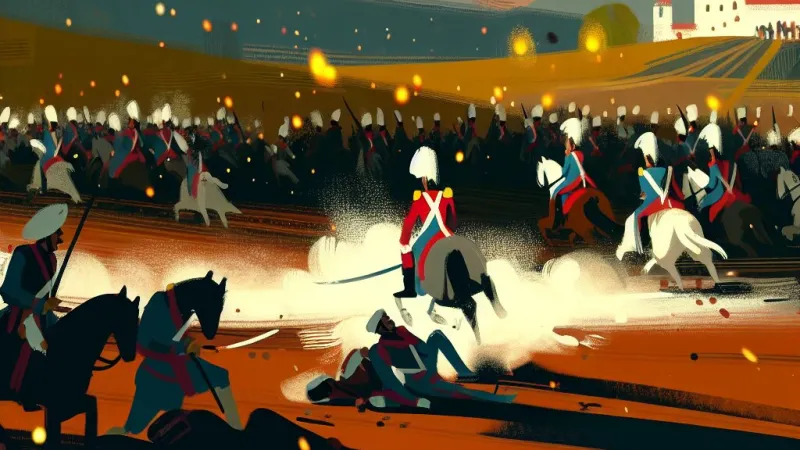
On the fateful morning of 23rd June 1757, the British army—numbering just over three thousand—faced a much larger Bengal force near the village of Plassey, close to the banks of the Bhagirathi river. On paper, the Nawab held every advantage: he had nearly 50,000 men, including cavalry and artillery. However, numbers alone do not win battles.As the fighting began, Mir Jafar and large sections of the Nawab’s army, following the prearranged conspiracy, held back their troops and refused to enter the fray. Many of Bengal’s artillery guns were rendered ineffective by the heavy rain the night before, leaving the Nawab’s forces demoralised and disorganised. The British, though smaller in number, had superior discipline, better weaponry, and crucially, the advantage gained from carefully plotted betrayal.
Within a few hours, the tide had turned irreversibly. Nawab Siraj-ud-Daulah, realising the magnitude of the treachery, fled the field. He was captured soon afterwards and tragically killed on the orders of Mir Jafar’s followers. With little real resistance remaining, Clive and the British East India Company had conquered not just a battlefield, but the future of an entire province.
Immediate and Far-reaching Consequences
The immediate effect of Plassey was the enthronement of Mir Jafar as a puppet Nawab, wholly reliant on the Company for his position. In reality, all major decisions and much of the province’s wealth now passed into British control. Bengal, once celebrated for its prosperity and vibrant cultural life, became a cash cow for the Company.The British gained not only the right to collect revenues but also the commercial monopoly of several lucrative trades, especially textiles, cash crops, and opium. Peter Mundy, an English traveller, once described Bengal as “the sweetest and most pleasant landscape in all the Indies.” Post-Plassey, this sweetness was to be squeezed for the enrichment of a foreign company, often resulting in terrible consequences for the local population. The infamous Bengal Famine of 1770, which caused massive loss of life, was a grim reflection of the new economic reality.
This victory provided the Company with the financial resources required to fund further military adventures, such as against the French at the Battle of Buxar and in the Carnatic wars. From being mere traders, the British were now the de facto rulers—setting a precedent that would soon spread to other parts of India.
The Broader Historical Significance
The Battle of Plassey represents a watershed in Indian history—a shift from commercial interaction to outright colonisation. Earlier European powers, including the Portuguese at Goa or the French in Pondicherry, had largely limited themselves to trading posts. Post-Plassey, however, British ambitions expanded to encompass direct political control, huge landholdings, and the shaping of administrative structures.This period also marked the beginning of the infamous “drain of wealth” from India, as described by economic thinkers like Dadabhai Naoroji. The plunder of Bengal’s resources bankrolled further colonial expansion and cemented the Company’s military dominance, paving the way for the eventual establishment of the British Raj.
Yet, the same event also sowed the seeds of resistance and a growing consciousness among Indians about the horrors of foreign rule. The story of Plassey—not just a story of defeat, but a cautionary tale of betrayal and lost unity—became a touchstone for later freedom fighters and reformers. For example, Bankim Chandra Chattopadhyay’s Anandamath and the song “Vande Mataram” drew inspiration from the sense of dispossession that battles like Plassey had fostered.
Reflections and Lessons
In critically examining Plassey, questions of morality, ethics, and national character naturally arise. The exploitation of court intrigues and personal ambition against the greater good is a recurrent theme in our history—not unlike the tale of Jaichand’s betrayal of Prithviraj Chauhan to Muhammad Ghori, which is recounted in many Hindi ballads and stories.Had the Nawab’s nobles stood together, had rulers like Siraj-ud-Daulah managed to inspire broader loyalty—perhaps a different path might have opened for India. But history, as we know, is not written in ‘ifs’ and ‘buts’. The story of Plassey is a stark reminder of how internal divisions and lack of political unity can open the doors to foreign domination.
For today’s students, the lesson is clear: the safeguarding of sovereignty, the importance of vigilance against outside interference, and the value of unity are not merely abstract ideals, but living necessities. Understanding the events of Plassey helps us appreciate the complex path India had to traverse before attaining freedom in 1947.
Rate:
Log in to rate the work.
Log in