Jallianwala Bagh Massacre: Key Event That Shaped India’s Freedom Struggle
This work has been verified by our teacher: 16.03.2026 at 13:11
Type of homework: History Essay
Added: 13.03.2026 at 11:47
Summary:
Explore the Jallianwala Bagh Massacre and learn how this key event shaped India’s freedom struggle, highlighting its impact on the nation’s quest for independence.
The Jallianwala Bagh Massacre: A Tragic Turning Point in India’s Freedom Struggle
The Jallianwala Bagh Massacre stands as a grim chapter in the journey of India’s independence. This incident, often recalled with pain and reverence, dramatically shifted the trajectory of the freedom movement and left an enduring scar on India’s collective conscience. At the turn of the 20th century, India was simmering with frustration under the harsh rule of the British Raj. Anger, disappointment, and a growing sense of betrayal pervaded the air, fuelled by injustices and discriminatory policies. Against this tense backdrop, the massacre at Jallianwala Bagh on 13 April 1919 became not just an isolated atrocity, but a defining episode that awakened millions, galvanising a whole nation’s struggle for liberty.
Historical Background
To truly comprehend the significance of Jallianwala Bagh, one must revisit the conditions leading up to it. The years before 1919 were riddled with repressive British laws. The Defence of India Act 1915, originally enacted during World War I, permitted extraordinary measures, from curbing publications to detaining suspects without trial. Even after the war ended, hopes for political reform were dashed when the colonial government introduced the Rowlatt Act in March 1919. Instead of granting self-governance, this cruel legislation extended wartime powers, such as arrests without warrants, secret trials, and stifling censorship.It was this betrayal—the denial of promised rights and the continued oppression—that sparked widespread protests. Leaders like Mahatma Gandhi, Bal Gangadhar Tilak, and Annie Besant called for non-violent resistance, leading to strikes and demonstrations across cities. Nowhere was the unrest more palpable than in Punjab. The region, which had sacrificed thousands of men for the British during the war, felt particularly let down. When local icons Dr Satyapal and Saifuddin Kitchlew were arrested in Amritsar for opposing these draconian acts, people’s patience snapped. Their detention became the spark that led to the tragedy at Jallianwala Bagh.
Events Leading to the Massacre
On 13th April 1919, which coincided with the auspicious Vaisakhi festival, thousands thronged Amritsar. For the Sikh community, Vaisakhi marks a sacred day of harvest and the foundation of the Khalsa by Guru Gobind Singh. Many rural families had entered the city to celebrate, while others gathered to protest against the Rowlatt Act and the arrest of their beloved leaders. The chosen venue was Jallianwala Bagh, a walled garden already symbolic of public life in Amritsar. Although martial law had been declared, owing to the sudden communication blackout, many festival-goers were unaware of the curfew and ban on assemblies.General Reginald Dyer, then the military chief of Amritsar, saw the crowd as a direct challenge to British authority. Intent upon displaying “firmness,” he decided to take a callous and irreversible step. On the fateful afternoon, he marched into Jallianwala Bagh with fifty soldiers and two armoured cars, determined to suppress what he perceived as rebellion by using force.
The Massacre Unfolds
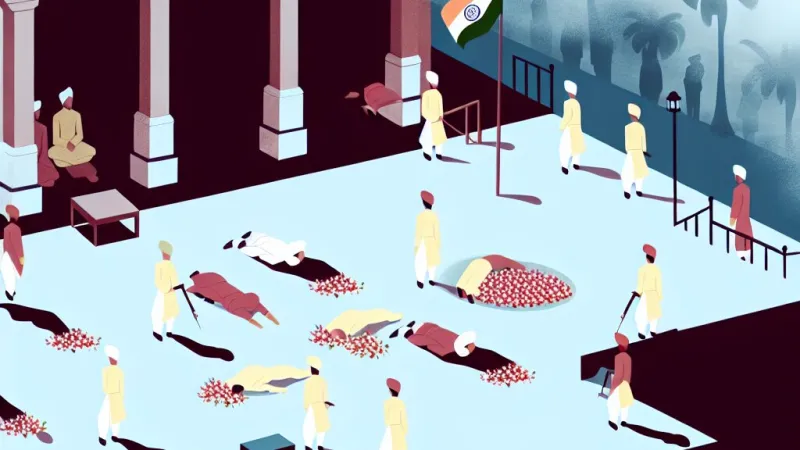
Jallianwala Bagh, at that time, was an enclosed area with buildings and narrow entrances. Once the crowd—estimated between 20,000 to 25,000—gathered, escape was virtually impossible. Without warning or an attempt to disperse or arrest, General Dyer ordered his troops to block the exits and open fire on the unarmed assembly. The troops, using rifles, did not shoot into the air or at the feet but aimed directly at the densest parts of the mass. For ten relentless minutes, around 1,650 rounds were fired.Eyewitnesses and survivors later recalled scenes of horror: men, women, and even children caught in the deadly barrage. In the desperate scramble to escape bullets, some tried to climb the walls, while hundreds leapt into a well at the far end of the garden, preferring drowning over death by bullet. Official British records put the toll at 379 lives lost, but Indian estimates suggest that nearly 1,000 perished, with many more wounded and left to die without help. The garden, with its blood-soaked earth and bullet-marked walls, became a testament to the brutality inflicted upon innocent people.
Reaction Across India and Abroad
The news of the massacre spread like wildfire, igniting grief and fury all over India. Rabindranath Tagore, a Nobel Laureate and symbol of India’s cultural renaissance, returned his knighthood in protest, declaring poignantly, “The time has come when badges of honour make our shame glaring in their incongruous context.” Leaders from all corners—Jawaharlal Nehru in Allahabad, Motilal Nehru in Uttar Pradesh, Lala Lajpat Rai in Punjab—decried the atrocity. Students and workers walked out of schools, colleges, and offices. The event united Indians across caste, creed, and province.The British Parliament was divided. While some condemned Dyer’s actions as cold-blooded murder and a disgrace to British values, others praised him as the “Saviour of the Punjab,” shocking Indians further with the lack of remorse. International media, especially in Europe, highlighted the massacre as emblematic of Britain’s oppressive imperial policies. The Hunter Commission, set up to investigate, later censured Dyer but spared him of any substantial punishment, strengthening Indian scepticism about British justice.
Long-Term Impact on the Freedom Movement
Jallianwala Bagh was more than a tragedy; it was a psychological tipping point. The faith that moderate leaders had in the British government’s willingness to grant reforms evaporated. The old strategies of petitions and loyal appeals now seemed futile. New leaders and revolutionaries emerged, feeling emboldened to adopt radical measures. Bhagat Singh, who grew up hearing tales of the massacre, visited the site as a young boy and was stirred to dedicate his life to national liberation. The idea of ‘Purna Swaraj’—complete self-rule—gained traction over mere home rule.The massacre directly led to the launch of the Non-Cooperation Movement by Mahatma Gandhi in 1920. Swadeshi, boycotts, and mass mobilizations became the new weapons. It was the first time that peasants, urban workers, lawyers, and students across India arose as one voice, filling the British with apprehension. The memory of Jallianwala Bagh became a rallying point, instilling a resolve to never tolerate such injustice again.
Lessons and Legacy
The massacre offers profound lessons on the perils of unchecked power and the necessity of upholding human rights. General Dyer’s justification, that he wanted to produce a “moral effect” and “teach a lesson,” remains a chilling reminder of how colonial rulers viewed Indian lives. However, the response of ordinary people—choosing unity and non-violence as their answer—redefined the course of history.Jallianwala Bagh also demonstrated that national unity could transcend religious, geographic, and social divides. For a moment, the divides of language and faith dissolved; all who suffered, suffered equally. Each year, the nation pauses in April to pay homage at the Bagh, where bullet holes are still preserved on the boundary walls. Schools and educational bodies, such as the NCERT, CBSE, and various state boards, include the massacre in history syllabuses—not merely as a fact to memorise, but as an episode from which to draw moral courage.
The site itself has been developed into a memorial, with a flame-shaped monument serving as a constant reminder for future Indians. The stories told in Amar Chitra Katha comics, the poignant scenes depicted in films like Shyam Benegal’s ‘The Making of the Mahatma,’ and the verses of poets like Amrita Pritam all keep this memory alive.
Conclusion
To sum up, the Jallianwala Bagh Massacre was an event of terrible injustice, but it awakened the soul of a nation. It broke the trust Indians had in the promises of the British government, uniting people in grief, anger, and ultimately, in determination. The sacrifices made in the Bagh changed the nature of India’s struggle, moving millions towards a dream of true freedom, which was eventually achieved in 1947.Today, as India stands as a sovereign republic, the lessons of Jallianwala Bagh urge us to respect human rights, uphold justice, and cherish freedom. By remembering this tragedy—not with hatred, but with a solemn vow to protect democracy and dignity—we pay the greatest tribute to those who lost their lives beneath the summer sky of Amritsar over a hundred years ago. Their courage remains a beacon, inspiring generations to cherish and defend the liberty so dearly won.
Rate:
Log in to rate the work.
Log in