An Insightful Essay on the Origins and Beliefs of Jainism
This work has been verified by our teacher: 29.04.2026 at 10:40
Type of homework: History Essay
Added: 27.04.2026 at 13:27
Summary:
Explore the origins and core beliefs of Jainism in this insightful essay, uncovering its history, philosophy, and impact on Indian culture and values.
Paragraph on Jainism
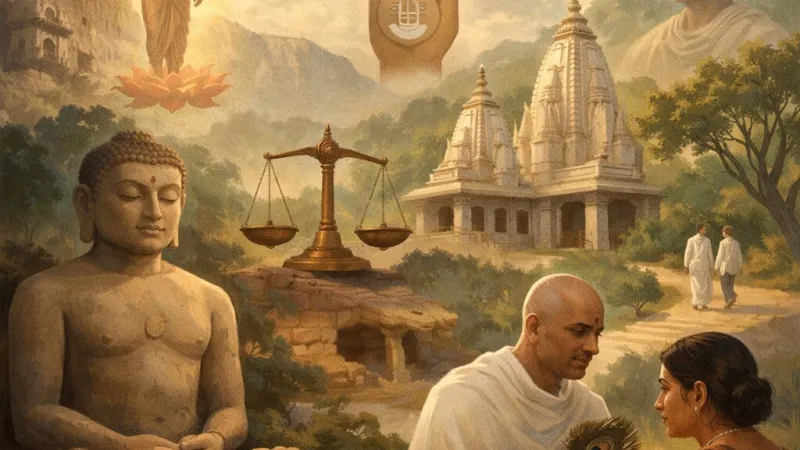
India, with her tapestry of religions and philosophies, stands as a testament to humanity’s quest for spiritual wisdom. Among the oldest living faiths that have taken root and flourished in this sacred land, Jainism holds a unique place. While often overshadowed in popular discussions by Hinduism or Buddhism, Jainism—known as ‘Jain Dharma’ in India—presents a profound system of beliefs and ethical guidelines deeply woven into the subcontinent’s history and society. Jainism’s core precepts of non-violence and truth have significantly influenced Indian thought, lifestyle, and even social movements. This essay will delve into the origins, philosophy, rituals, and enduring contributions of Jainism, aiming to foster a deeper appreciation for its role in shaping Indian culture and values.
Historical Background and Origins
Jainism’s roots are so ancient that they blend into the mists of early Indian civilisation. Evidence from sites like Mohenjo-daro and Harappa has suggested that certain motifs and practices that later became important in Jain rituals may have existed even before the Vedic age, showing that the faith may trace its ancestry to pre-Vedic times. What sets Jainism apart from other major Indian religions is its non-theistic approach—the Tirthankaras, or ‘Ford-makers’, are seen not as gods in the conventional sense, but as enlightened teachers who have attained perfect knowledge (Kevala Jnana) and guide others to liberation.There are said to be twenty-four Tirthankaras in this epoch, beginning with Rishabhdev (Adinath) and culminating with Lord Mahavira. While Rishabhdev is revered in early Jain texts, it is Mahavira, born in Kundagrama near Vaishali (present-day Bihar) in the 6th century BCE, who is widely regarded as the last and most significant Tirthankara. He lived a life of renunciation, intense austerity, and spiritual pursuit, eventually achieving Kaivalya or omniscience. Unlike many religious founders, Mahavira was not attempting to start a new movement but rather to re-establish and refine a timeless spiritual path.
Across centuries, Jain teachings transitioned from oral transmission to codified scriptures, most notably the Agamas, written in Ardhamagadhi and other Prakrit languages. Communities of monks, nuns, and lay followers formed the structure of Jain society, and beautiful temples were erected as centres of worship and learning—most famously, the Dilwara Temples at Mount Abu and the Ranakpur Temple in Rajasthan. Jain communities flourished particularly in Gujarat, Rajasthan, Madhya Pradesh, and Maharashtra, but gradually spread to other parts of India and, through diaspora, to all corners of the globe.
Core Philosophical Tenets of Jainism
At the heart of Jain philosophy lies an intricate understanding of the soul (jiva) and its entanglement in the cycle of birth and rebirth (samsara). According to Jain cosmology, every living being, from a worm to a plant, from human to deity, possesses a soul bound by karmic particles accrued through actions, thoughts, and words. The ultimate goal of life is to purify the soul by shedding all karmic matter, hence achieving liberation (moksha).This journey toward liberation is charted by what Jains call the ‘Three Jewels’ or Ratnatraya: Right Faith (Samyak Darshan), Right Knowledge (Samyak Jnana), and Right Conduct (Samyak Charitra). Right Faith involves having true perception of reality and trust in the teachings of the Enlightened Ones. Right Knowledge requires the disciplined pursuit of spiritual wisdom. Right Conduct encourages an ethical way of living, principally framed by the five great vows.
The central ethical law of Jainism is Ahimsa or non-violence, extending beyond mere physical harm to include refrainment from hurtful speech and thoughts. This rigorous commitment to non-injury is starkly visible in the Jain practice of vegetarianism; many Jains even avoid eating root vegetables (such as onions and potatoes) to prevent harm to tiny organisms. Other vows include Satya (truthfulness), Aparigraha (non-attachment to possessions), Asteya (non-stealing), and Brahmacharya (chastity or control over desires). These vows are observed strictly by monks and nuns and, to a less intense degree, by householders.
Another crucial Jain principle is Anekantavada, or the doctrine of multiplicity of viewpoints. This philosophy teaches that reality is complex and multi-faceted; no single person can claim an absolute hold over truth. A well-known illustration is the parable of the blind men and the elephant—each person, feeling a different part of the animal, describes it differently, showing that different perspectives can all hold validity. In a country as pluralistic as India, this spirit of tolerance and open-minded debate, exemplified in Anekantavada, bears contemporary relevance for peaceful coexistence amid diversity.
Practices and Rituals in Jainism
The religious life of a Jain, whether monk or layperson, focuses on cultivating self-discipline, humility, and spiritual awareness. Daily rituals typically begin with pratikraman (introspective meditation and repentance), recitation of sacred mantras like the ‘Namokar Mantra’, and offering prayer at home altars or ornate temples. Worship in Jainism is not supplication to gods for favour but reverence offered in memory of the Tirthankaras, with the aim of internalising their virtues.Among the galaxy of Jain festivals, Mahavir Jayanti holds pride of place—it marks the birth of Mahavira and is celebrated with processions, charity, and prayers. The eight-day festival of Paryushana is especially important, observed with fasting, meditation, scriptural study, and forgiveness. On Samvatsari, the final day, Jains seek forgiveness from all beings, uttering the words “Micchami Dukkadam”—a beautiful tradition of reconciliation and peace unmatched in its spirit.
Fasting occupies a special role in Jain devotion, ranging from skipping a meal to the rigorous ‘upvaas’ and elaborate ‘ayambil’ fasts. Monks and nuns undertake intense austerities, sometimes refraining from food and water for days, in pursuit of spiritual clarity and karmic purity. A unique, sensitive practice is Sallekhana, a voluntary religious fast to embrace death peacefully at life’s end, seen not as suicide but as a final act of spiritual letting-go, when performed under strict counsel and readiness.
Jain architecture and symbols possess their own distinctive identity. Temples like those at Shravanabelagola (Karnataka) or Palitana (Gujarat) are marvels of art and devotion. The Jain emblem—a crest symbolising the universe, non-violence, liberation, and interconnectedness—reminds devotees of the constant spiritual struggle and aspiration for moksha.
Jainism’s Contribution to Indian Society and Culture
Jainism’s legacy in Indian civilisation extends far beyond its temples and scriptures. The ethic of non-violence, vibrantly advocated by Jain seers, left a profound mark upon social reformers and freedom fighters. None other than Mahatma Gandhi acknowledged the debt he owed to Jain teachers for inspiring his philosophy of ahimsa—a weapon stronger than any sword in India’s fight for independence.The Jain respect for all forms of life has also influenced environmental consciousness—centuries before ecological movements gained traction. Their vegetarianism and conservation ethos offer solutions to global crises of animal welfare and sustainability.
In commerce and philanthropy, Jains have been exemplary—towns and cities across India bear witness to the endowments of Jain merchants who built schools, hospitals, libraries, and institutions. The community’s work in social upliftment, particularly in Gujarat or Karnataka, stands as a testimony of religious values translated into tangible good.
On the intellectual plane, the philosophical doctrines of Jainism—debates on non-absolute truth, logic, and ethics—have enriched Indian philosophy alongside Vedanta, Buddhism, and Nyaya. Literary gems in Prakrit, Sanskrit, and regional languages, including classics like the “Tattvartha Sutra”, have broadened the subcontinent’s literary tradition.
Jainism in Contemporary India
Though small in number, comprising less than 0.5% of India’s population, Jains exert an influence disproportionate to their size. Today, Jainism faces the challenge of preserving its heritage while adapting to a world altered by technology, urbanisation, and globalisation. However, its core ideals—non-violence, truth, tolerance, and simplicity—continue to resonate, offering guidance to a world fraught with division and ecological peril. Many Jains also engage actively in interfaith platforms, promoting dialogue and social harmony.Conclusion
To summarise, Jainism is not just a religion of ritual or dogma, but a living tradition that blends ancient wisdom with practical ethics. Its story stretches from the Indus Valley to the modern city, from silent meditative cells to bustling marketplaces. By upholding the dignity of every living being and advocating for peace, harmony, and self-restraint, Jainism offers timeless values needed by individuals and societies all over the world. In an era marked by conflicts and environmental crises, its message is more significant than ever. Let us strive to understand, respect, and perhaps even imbibe some of Jainism’s invaluable teachings in our own lives, thus contributing to a more compassionate and thoughtful society.---
*This essay is intended to provide a comprehensive but accessible understanding of Jainism for Indian students, drawing on local examples, traditions, and cultural references. For anyone seeking to explore India's heritage, a study of Jainism is essential—a mirror reflecting both our glorious past and the possibilities for a peaceful, ethical future.*
Rate:
Log in to rate the work.
Log in