Ugadi: South India's Auspicious Hindu New Year Celebration
This work has been verified by our teacher: 3.02.2026 at 17:25
Type of homework: Essay Writing
Added: 2.02.2026 at 16:03
Summary:
Explore Ugadi, South India’s auspicious Hindu New Year celebration, and learn about its history, rituals, and cultural importance for students in a clear, concise way.
Ugadi: The Auspicious New Year Festival of South India
In a nation as diverse as India, each region resonates with its own festive rhythm and unique way of celebrating the circle of life. Among the many festivals that mark new beginnings, Ugadi holds a place of special reverence in the southern states—predominantly Andhra Pradesh, Telangana, and Karnataka. Derived from the Sanskrit words ‘yuga’ (age or era) and ‘adi’ (beginning), Ugadi literally means the start of a new era. More than just welcoming the New Year in the Hindu lunisolar calendar, Ugadi is an outpouring of cultural heritage, spiritual cleansing, and collective joy. It sets the tone for the year ahead, urging families to refresh their relationships and society to sweep away the past year's negativity. Interestingly, similar new year celebrations—like Gudi Padwa in Maharashtra, Navreh in Kashmir, and Cheti Chand among Sindhis—exist across India, each reflecting local hues yet echoing the universal theme of renewal. As a tapestry woven with rituals, mythologies, food, and music, Ugadi stands as a living symbol of hope, awakening, and the vibrant legacy of South Indian traditions.
Historical and Mythological Background
To understand Ugadi’s deep roots, one must travel back several centuries, to the times when myths were history and history was poetry. Ancient texts such as the "Puranas" and references in Telugu and Kannada literature, including the "Panchangam," trace Ugadi’s origins to Vedic times, when lunar and solar movements dictated the agricultural and religious calendar. The Hindu lunisolar calendar, with its focus on nature’s cycles and astronomical events, forms the foundation of Ugadi.Mythologically, Ugadi is profoundly linked to the belief that Lord Brahma began the creation of the universe on this very day, embarking upon the intricate process of ‘Srishti’. The "Brahmanda Purana" and local legends retell how with the dawn of Chaitra month, life, time, and consciousness itself appeared from the primordial nothingness. Another revered tale narrates Lord Vishnu’s defeat of the demon Somakasura, the thief of the Vedas, and the restoration of knowledge to the world—signifying the triumph of wisdom over darkness. These stories infuse the festival with a sense of awe and reinforce symbolic meanings: the cyclical renewal of life, conquest of ignorance, and the gratitude for nature’s bounty.
Over the centuries, Ugadi has evolved, absorbing influences of changing dynasties, linguistic shifts, and socio-political changes across the southern landscape. Yet, at its heart, the festival remains an agricultural marker, coinciding with the end of winter and the start of a new sowing season, making it as much a cultural event as a farmer’s prayer.
Timing and Calendar Significance
Unlike the Gregorian New Year, which falls on 1 January, Ugadi marks its arrival based on the Indian lunisolar calendar. Specifically, it falls on the “Chaitra Shudhdha Paadyami”—the first day following the new moon in the month of Chaitra (March or April). This period, marked by nature’s fresh vitality, when the earth tilts favourably to the northern hemisphere and days begin to lengthen, holds cosmic importance.The calculated placement of Ugadi symbolizes rejuvenation. As farmers observe the subtle blossoming of mango and neem trees, the festival celebrates the restart of natural cycles. Panchangas (Hindu almanacs), meticulously prepared by astrologers, are recited in every town and village, predicting fortunes and warnings for the coming year. This merging of astronomical wisdom and local faith underlines Ugadi as both a celestial event and a human celebration.
Preparations and Customs Before Ugadi
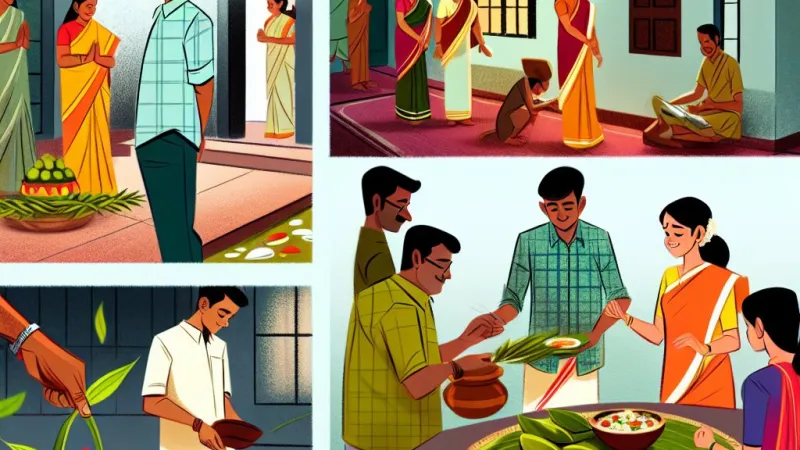
The days leading to Ugadi are filled with a palpable energy. Customarily, homes are cleansed top to bottom—a practice called ‘Gudikadige’ in Kannada and ‘Gadapa Tadigi’ in Telugu. This act, beyond its physical benefits, is seen as a purificatory ritual, erasing the dust and negativity of the past.Houses are then decorated with fresh mango leaves strung as torans (door hangings), symbolising prosperity and fertility, and vibrant rangoli (muggulu in Telugu, kolam in Kannada) patterns drawn with rice flour. In markets, the sale of new clothes booms as families believe that adorning oneself in fresh attire ushers good fortune.
A deeply valued tradition is the oil bath, where family members massage sesame or castor oil into their hair and bodies. This is more than a beauty regime; Ayurveda extols its health benefits, and culturally, it is thought to wash away physical and spiritual impurities.
Temples are swept and adorned with flowers. Community gatherings—once an event of rural unity and storytelling—dot the landscape. On Ugadi morning, the Panchanga Sravanam, or reading of the almanac and annual forecast, is conducted by priests or respected elders, lending a shared sense of anticipation for the year ahead.
Rituals and Worship on Ugadi Day
Dawn on Ugadi sparkles with devotion. Clad in new clothes, families gather before household deities—often images of Lord Vishnu, Lord Brahma, or family ishta devatas (tutelary gods). Offerings of flowers, incense, and fruits set an aromatic stage for prayers, known locally as ‘puja’.Mantras are chanted, sometimes in mellifluous renditions of Carnatic ragas or folk tunes, blending devotion with artistry. Where possible, a simple homam (fire ritual) is performed, believed to purify the environment and invoke blessings for peace and prosperity.
Temples, too, are abuzz—priests lead prayers, bells ring, and devotees circulate prasadam (sanctified food), reinforcing communal bonds. The spiritual atmosphere is thick with hope; Ugadi becomes not only a family ritual but an entire community’s collective wish for renewal.
The Special Ugadi Dish: Ugadi Pachadi
No South Indian festival is complete without its share of culinary delight, and Ugadi is celebrated through a dish that is as symbolic as it is flavourful—Ugadi Pachadi. This special preparation is a blend of six tastes—sweet jaggery (happiness), sour tamarind (challenges), bitter neem flowers (sadness), spicy chilli (anger), salty (interest), and tangy raw mango (unexpected moments).Served at the beginning of the meal, Ugadi Pachadi is more than a start to the palate: it is a philosophical statement. It reminds everyone that life is a tapestry of different experiences and emotions, and that true wisdom lies in accepting all with equanimity. In Telugu households, grandmothers lovingly explain the significance of every ingredient as families sit together to partake, reinforcing values and kinship.
Cultural Significance and Social Aspects
Ugadi’s cultural essence extends beyond ritual. It is a festival of togetherness—when relatives visit, friendships are renewed, and quarrels are set aside. For farmers, the festival’s timing aligns with the onset of new harvests, making it a day of hope and anticipation.Schools and educational institutions in Andhra Pradesh and Karnataka often mark Ugadi with cultural programmes—students enact mythological stories, sing folk songs, and perform traditional dances like Kolatam and Dollu Kunitha. This collective participation helps transmit heritage to younger generations.
Ugadi also sustains regional arts; poets present kavisammelanams (poetry gatherings), and musicians introduce new compositions. For many, Ugadi is a time to pen resolutions and reaffirm their dedication to improvement, echoing the essential spirit of renewal.
Similar Festivals across India and Comparative Insights
Although Ugadi is most closely associated with South India, its spirit reverberates across the nation. Maharashtra celebrates Gudi Padwa with the raising of ‘gudi’ (decorated flagstaff), marking a similar new year theme. In Kashmir, Navreh signals spring and a new beginning, with rituals involving special thalis and sacred texts. Chaitra Navratri in North India and Cheti Chand among Sindhis also coincide with Ugadi.These festivals share themes of new beginning, victory over adversity, and gratitude for nature’s cycles. Yet, each radiates locality—be it in the food, rituals, or music—enriching the splendid mosaic of Indian culture.
Contemporary Relevance and Modern Celebrations
Ugadi’s significance has grown even wider in today’s world. In urban areas, while traditions may adapt to modern schedules, the essence remains. Early-morning oil baths might be replaced by quick showers, yet the ugadi pachadi is still served. Social media amplifies the festival’s reach, with families sharing greetings and virtual panchanga shavanams.Environmental awareness has also grown; many communities now plant saplings or conduct cleanliness drives to mark the festival. Charity events, such as feeding the needy or distributing books, add a layer of social responsibility.
Youngsters, especially those living away from home, maintain connection with their roots through cultural associations, online programmes, or even preparing Ugadi treats abroad. Thus, Ugadi remains a strong pillar of cultural pride and inclusivity.
Conclusion
Ugadi stands as a living testament to the confluence of religion, culture, nature, and community. At its core, it is less about the rituals and more about the message: to let go of old grievances, accept life’s varied flavours, and embrace new challenges with serenity and hope. Through its melange of practices—from cleaning homes and preparing pachadi, to reading the almanac and celebrating through dance and song—Ugadi exemplifies the unity and resilience that characterise Indian society.May the spirit of Ugadi inspire us all to welcome each new year as a chance for renewal, kindness, and shared cultural pride, upholding the festival’s enduring legacy as an invaluable thread in India’s rich heritage.
Rate:
Log in to rate the work.
Log in