Key Facts and History Behind India's National Flag
This work has been verified by our teacher: 15.01.2026 at 20:00
Type of homework: Essay Writing
Added: 15.01.2026 at 19:38
Summary:
Indyjska flaga narodowa, Tiranga 🇮🇳, symbolizuje jedność, historię i wartości Indii; kolory mają głębokie znaczenie, a jej użycie reguluje prawo.
Facts about the National Flag of India
Few emblems can stir the collective conscience of a people as powerfully as a national flag. It is more than a piece of cloth fluttering atop buildings; it encapsulates the dreams, sacrifices, and identity of a nation. In India, the Tiranga—aptly named for its vibrant tricolour bands—echoes not just political independence, but centuries of shared struggle, diverse faiths, and undying hope. The tricolour flag has been a witness to India’s journey from colonial rule to a vibrant democracy. This essay aims to unravel the myriad facets of the National Flag of India, tracing its origins, symbolism, manufacturing, legal status, and the emotional connect it invokes amongst Indians.
---
Historical Evolution of the Indian National Flag
Early Flags and the Freedom Movement
The story of India's national flag is inseparable from the saga of its independence struggle. In 1906, amidst the fervour of growing nationalist aspirations, the first known Indian flag was unfurled at the Parsee Bagan Square in Calcutta (now Kolkata). It bore three bands—green, yellow, and red—adorned with symbols representing different religious communities and the word “Vande Mataram.” At a time when the country was still simmering under British rule, this flag symbolised a nascent desire for unity and freedom.As the freedom movement gained momentum, several versions emerged. In 1907, Madame Bhikaji Cama, a prominent nationalist and women's rights champion, hoisted a flag in Stuttgart, Germany, during the International Socialist Congress. This flag, though distinct, represented a continuation of the earlier spirit—asserting India’s rightful place among nations.
In 1917, with leaders like Dr. Annie Besant, Lokmanya Tilak, and Bal Gangadhar Tilak lending their voice to the Home Rule Movement, a new flag came into existence. Bearing five red and four green stripes and Union Jack in the corner, this version represented the political realities and alliances of the era.
The Role of Influential Personalities
The evolution of the national flag found its watershed moment in the figure of Pingali Venkayya, a freedom fighter, scholar, and farmer from Andhra Pradesh. Venkayya’s persistent efforts in designing and refining the flag, and his engagement with Mahatma Gandhi, resulted in the creation of a flag that could embody the ideals and diversity of India. Though Venkayya’s initial proposal included only the saffron and green bands symbolising Hindus and Muslims, Mahatma Gandhi’s emphasis on inclusivity led to the addition of the white band for all other communities.Official Adoption and Connection with Independence Day
After much deliberation, the Constituent Assembly formally adopted the present national flag on 22 July 1947, just weeks before India stepped into the dawn of independence. The inclusion of the Ashoka Chakra signified a significant shift—from sectarian symbols to an emblem rooted in ancient Indian ethos. When August 15, 1947, finally arrived, the Tiranga rose magnificently above the Red Fort, symbolising not just freedom, but the unity of a newly forged nation.---
Design and Symbolism of the National Flag
The Tricolour Pattern
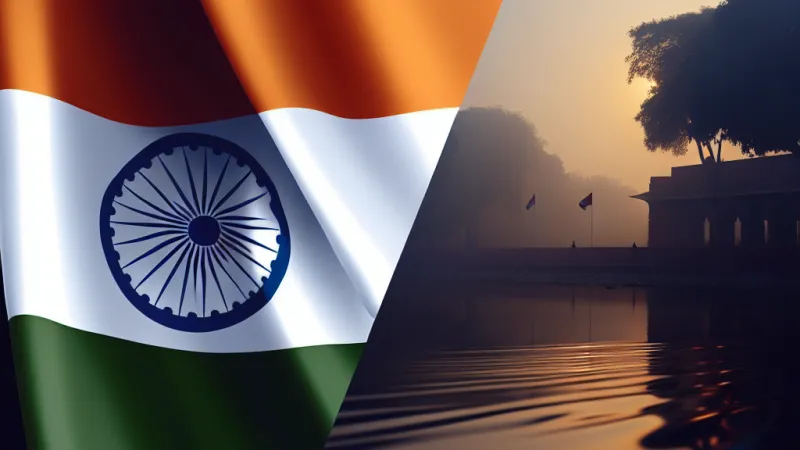
The national flag measures in a precise 3:2 ratio—length to breadth—as per the official Flag Code of India. The flag comprises three evenly-spaced horizontal bands: deep saffron at the top, white in the middle, and India green at the bottom. In the centre of the white band sits the navy blue Ashoka Chakra, a wheel with 24 spokes.Meaning of Each Colour and Cultural Resonance
Each colour in the Tiranga carries profound symbolism.Saffron stands for courage, renunciation, and the strength of sacrifice. It pays homage to leaders, rebels, and ordinary citizens who relinquished their comforts and, at times, their lives in pursuit of freedom. Saffron also draws from the robes of Indian sanyasis, who represent detachment and dedication to a higher cause.
White symbolises peace, truth and purity. It is the unifying thread in the tricolour, reminding citizens to uphold harmony amid diversity. This was especially significant to Gandhi, who saw truth—“Satya”—as the cornerstone of India’s ethos. In an India inhabited by people from different faiths—Hindu, Muslim, Sikh, Christian, Buddhist—white underscores the message of co-existence.
Green stands for fertility, growth and the bounty of the Indian land. With agriculture as the backbone of India’s economy, green celebrates the rural heartland and the prosperity springing from India’s fields. It also resonates with youthful hope and the need for ecological sensitivity.
The Ashoka Chakra
Deriving inspiration from the Lion Capital of Ashoka at Sarnath (the emblem of the Government of India), the wheel in the centre replaces the communalist charkha of earlier flag iterations. The 24 spokes represent virtues including love, courage, patience, peacefulness, selflessness, truthfulness, righteousness, justice, and faith, among others. The wheel is also symbolic of constant movement—reflecting the teaching from the Buddhist dharma chakra that stagnation leads to decline, while progress ensures life and vitality.---
Manufacturing and Specifications
Khadi: The Fabric of Revolution
It is deeply symbolic that the national flag must be made of hand-spun and hand-woven khadi. This natural fibre was at the heart of India’s Swadeshi Movement led by Mahatma Gandhi. Khadi came to represent self-reliance, economic freedom, and dignity of labour. The Flag Code specifies two types: khadi-bunting for the flag's body and khadi-duck for the canvas portion near the pole.Standard Dimensions and Strict Protocol
Flag manufacture in India is strictly regulated. There are nine standard sizes of the flag, ranging from grand banners for official buildings to small hand-held flags for ceremonies. Only those manufactured as per the Indian Standard IS 1: 1968 at licenced units are legal for official usage. This ensures uniformity and sanctity, irrespective of where the flag is hoisted.Exclusive Manufacturing Rights
The Karnataka Khadi Gramodyoga Samyukta Sangha (KKGSS) in Dharwad holds the unique distinction of being the sole licensed manufacturer authorised to produce the Indian flag. Carefully monitored to preserve authenticity, the process involves not only skilled craftsmanship but also strict adherence to codes.---
Legal Rules and Protocols
Etiquette and Respect
Indians are guided by the “Flag Code of India, 2002,” which stipulates how and where the flag may be displayed. The flag must always be flown with its saffron band on top, whether displayed vertically or horizontally. It must never touch the ground or water, nor be draped over vehicles or statues, except in designated ceremonies.Citizens' Rights and Responsibilities
Until 2002, hoisting the flag was largely a privilege of government institutions. That year, following a Supreme Court petition by industrialist Naveen Jindal, it became a fundamental right for every citizen to display the flag every day, on condition that it is done respectfully and in accordance with the code. Schools, private offices and even homes now routinely participate in flag-hoisting ceremonies on national holidays, linking millions to the flag’s significance.Penalties for Violation
Desecration or disrespect toward the national flag can invite punishment under the Prevention of Insults to National Honour Act, 1971. Fines and imprisonment serve as deterrents, ensuring that the flag is not used as drapery, clothing, costume, or for commercial purposes that diminish its dignity.---
Iconic Moments and Lesser-Known Facts
First Display Abroad
A little-known fact: decades before independence, Bhikaji Cama unfurled the Indian flag in Stuttgart, Germany, in 1907—signaling to the world that India aspired to sovereignty.Monumental Displays
India boasts several colossal flags. The largest is at the Attari-Wagah border near Amritsar. Towering over the Indo-Pak border, it is both a practical symbol and a subtle assertion of sovereignty.Evolution of Designs
Before the adoption of the current tricolour, at least six major prototypes were tried. Each reflected prevailing political moods: the emphasis shifted from religious imagery to inclusive, non-communal symbols, inspired by both ancient Indian and Gandhian philosophy.Tiranga: A Nickname Rooted in Affection
The word "Tiranga" flows easily from every Indian tongue. It is more than a descriptor—it signals endearment, familiarity, and pride, showing how deeply the flag resides in cultural consciousness.---
The Role of the National Flag in Modern India
Symbol of Integration
In a nation of more than 1.4 billion, speaking hundreds of languages and practising every major religion, the flag is perhaps the only unifying visual identity. On Republic Day, Independence Day and during times of national triumph or adversity, the Tiranga becomes a rallying point, whether held aloft by a cricket fan in Eden Gardens, a school student in rural Assam, or a soldier braving Himalayan winds at Siachen.Civic Pride and Patriotism
Stories abound of athletes wrapping themselves in the flag to celebrate victories, and of common citizens hoisting it on their rooftops, especially after 26th January or 15th August. For Indian soldiers, the flag is quite literally a matter of life and death—martyrs often go to their final journey wrapped in the Tiranga.---
Rate:
Log in to rate the work.
Log in