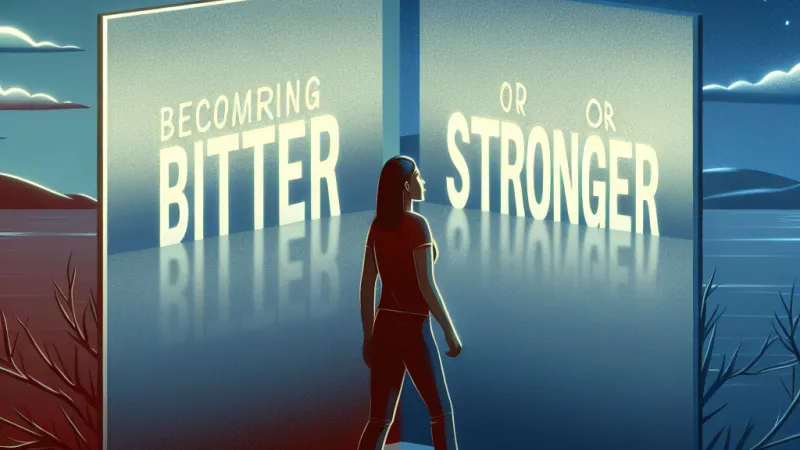
Przeciwności losu dają wybór: można stać się zgorzkniałym lub silniejszym—wszystko zależy od naszej reakcji i nastawienia.
Adversity Offers a Choice: To Grow Bitter or To Grow Better
When rain pounds relentlessly against the windows, some curse the weather, while others see in it an opportunity for new seeds to take root. This simple observation echoes a profound truth: adversity, in all its shapes and forms, is an ever-present companion on the journey of life. No individual, regardless of background or privilege, can claim a life untouched by setbacks. In India, we often hear the idiom _“Dukh ka samay sab par aata hai,”_ meaning that sorrow spares none. Yet, within the storm of difficulty, there lies a fork in the path—either to be hardened and embittered by pain, or to transform suffering into the soil from which strength and wisdom grow. This essay explores the profound choice adversity offers: to either grow bitter, harbouring resentment and despair, or to use challenges as stepping stones towards personal and collective betterment. Drawing from philosophical reflections, psychological understandings, Indian cultural context, and historical accounts, this essay establishes how adversity is both a trial and an opportunity, and how the response to it defines destinies.
Understanding Adversity and Human Response
The Many Faces of Adversity
Adversity rarely arrives announced or in one predictable form. For one student, it may be the sting of academic failure. For another, it could be the struggle of battling an illness, the pain of losing a loved one, or the everyday fight against social discrimination. The farmer in rural Maharashtra waiting for the monsoon, the final-year engineering graduate facing a competitive job market, the young girl in a city slum striving for education against all odds—adversities wrap themselves in the fabric of ordinary Indian lives.
Suffering is not merely an individual experience. Communal grief, as seen in natural disasters or in times of epidemic like the COVID-19 pandemic, reminds us that hardship is a shared element of human existence, binding people across ages, regions, and economic backgrounds.
The Dual Response: Growing Bitter or Better
How do humans respond when confronted by adversity? On one hand, some allow hardship to corrode their outlook, growing bitter, hostile, or withdrawn. This bitterness may manifest in the form of persistent resentment—against fate, society, or one’s own self. On the other, some respond by growing better: discovering reserves of patience, resilience, and empathy that may have otherwise lain dormant.
It is not the adversity itself, but the response to it, which ultimately shapes a person’s future. The great Hindi poet Harivansh Rai Bachchan wrote, _“Man ka ho toh achha, na ho toh aur bhi achha.”_ If things happen as you wish, it is good; if not, it is even better, because you have the chance to show what you are made of.
Agency and Mindset
Central to this discussion is the concept of agency. Humans possess, to a remarkable degree, the capacity to choose their response. This is the essence of the “growth vs. bitterness” decision. Psychologists describe this as mindset—the beliefs and attitudes with which we interpret events. Is the glass half-empty, or half-full? Are setbacks evidence of inherent flaws, or opportunities for learning and renewal?
Philosophical Perspectives: Lessons from East and West
Mastery Over Reaction: Stoic and Epicurean Thought
Ancient philosophers grappled with the same dilemmas we face today. The Greek philosopher Epicurus emphasised the inevitability of pain and advocated for self-mastery, suggesting that peace lies not in external circumstances but in the calmness of the mind. In India, Stoic ideas echo in the teachings of Gautama Buddha, who taught that suffering is an integral part of life, but attachment to that suffering is optional. The _Bhagavad Gita_ reinforces this by asserting, “You have a right to perform your actions, but never to the fruits of those actions”—an urging to focus on effort over outcomes, and to remain unmoved by both praise and pain.
Virtue Through Hardship: Aristotle's and Indian Philosophy
Aristotle, the Greek philosopher, believed that virtues like courage and patience are meaningful only when they are tested in difficult circumstances. Indian philosophy parallels this: the concept of _Tapasya_ (austerity or penance) requires willingly undergoing hardship to purify one’s intentions and develop strength of character. In Jainism, Lord Mahavira’s teachings emphasise _Ahimsa_ (non-violence) and _Aparigraha_ (detachment)—choosing forgiveness and compassion over vengeance, even when wronged. Tales from Indian epics, like the _Ramayana_ and _Mahabharata_, abound with characters who choose nobility and self-restraint instead of bitterness during adversity.
Psychological Perspectives: The Science of Transformation
Post-Traumatic Growth
Modern psychology has moved beyond seeing adversity only as a risk factor for trauma. The concept of Post-Traumatic Growth (PTG) highlights how, beyond resilience, individuals sometimes emerge from deep suffering with newly discovered perspectives and purpose. It is not mere recovery, but transformation—like the lotus blooming from the mud. Research shows such individuals report stronger relationships, greater self-appreciation, and more profound meaning in life.
The Role of Perception and Support
Our interpretations shape our experiences. Cognitive reframing—the practice of looking at a problem from a different perspective—can help people turn setbacks into learning moments. Indian education is gradually incorporating this through mindfulness practices and life skills workshops, helping students develop emotional intelligence and coping mechanisms. Moreover, the role of community—support from friends, family, and teachers—has been shown to buffer the negative effects of stress, making the path to “growing better” more accessible.
Risks of Bitterness
Choosing bitterness, on the other hand, is not just a philosophical failing; it has tangible consequences. Persistent resentment and a sense of victimhood erode mental well-being, sour relationships, and restrict personal achievement. Prolonged anger and bitterness can manifest as depression, anxiety, and health complications.
Historical and Cultural Exemplars from India
Emperor Ashoka: War to Compassion
Few stories illustrate transformation through adversity as powerfully as that of Emperor Ashoka. After witnessing the horrors of the Kalinga war, Ashoka was overwhelmed not by triumph but by remorse. Rather than sink into bitterness or further violence, he channelled his grief into a journey of self-transformation: adopting Buddhism, advancing the principles of non-violence, and instituting reforms for the welfare of his subjects. His pillars, inscribed with messages of tolerance, remain a timeless symbol of choosing empathy over enmity.
Raja Raja Chola I: Harnessing Hardship
Raja Raja Chola I faced repeated external threats, yet instead of succumbing to despair, he strengthened his state and enriched Tamil culture. Under his rule, not only were boundaries expanded, but magnificent temples—like the Brihadeeswara Temple—were constructed, testament to creativity blossoming during hardship.
Mahatma Gandhi: Suffering as Strength
The Indian independence struggle is perhaps the most vivid example of rising above adversity in modern times. Faced with the brutality of colonial repression, Mahatma Gandhi chose _Satyagraha_ (truth-force) and non-violent resistance. He endured imprisonment, ridicule, and personal pain, not with bitterness, but with the conviction that patient endurance would ultimately triumph over tyranny.
Practical Lessons for Daily Life
Building Resilience: Habits and Practices
How can ordinary individuals follow the path of “growing better”? Practices like journaling, expressing gratitude, and meditation—rooted in Indian tradition—cultivate self-awareness and emotional strength. For students, maintaining a diary, reflecting on both setbacks and successes, and practising mindfulness are simple but powerful steps.
Education and Community Matters
The Indian educational system, long criticised for a rigid focus on academic scores, is gradually recognising the value of mental health support. Schools introducing counselling, peer networks, and inclusive extracurriculars create safer spaces for young people facing adversity. Stories from _Panchatantra_ or _Akbar–Birbal_ tales, often recited in school assemblies, reinforce morale and problem-solving.
The Cultural Value of Perseverance
India’s festivals demonstrate resilience: from _Diwali_, celebrating the triumph of light over darkness after long trials, to _Durga Puja_, commemorating the goddess’s victory over evil. These traditions serve as annual reminders to choose hope and progress, not defeat.
Policy and Social Support
From the Right to Education Act to targeted schemes for marginalised communities, policy interventions attempt to create external conditions that make the choice to “grow better” more accessible. Midday meal schemes, free textbooks, and scholarships help children—especially from disadvantaged groups—overcome financial and social adversity.
Recognising Challenges and Limits
Not All Adversity Leads to Growth
It is crucial to recognise that not all hardships yield positive transformation. Chronic poverty, gender discrimination, and persistent caste prejudices can sometimes overwhelm individual effort. Without adequate support and social justice, “growing bitter” may be the only option people see.
Avoiding Oversimplification
The popular emphasis on “positive thinking” must be balanced with respect for genuine grief. It is neither possible nor healthy to demand optimism in the face of deep trauma. Support structures, empathy, and time are necessary for healing before transformation can occur.
Socio-Economic Barriers
Structural problems—such as lack of access to healthcare, education, or justice—can limit personal agency. Thus, society must share the responsibility of enabling everyone, not just a privileged few, to choose growth over bitterness.
Conclusion
Adversity confronts us all, as individuals and as a society. At every crossroad carved by hardship, we are offered a fundamental choice: to allow anguish to seep into our hearts, making us bitter and closed, or to draw from the well of endurance, emerging stronger, kinder, and wiser. Philosophers and psychologists, ancient texts and living examples from Indian history, all converge on the same wisdom—adversity is the crucible in which character is forged. By learning from those who turned suffering into strength, and by building communities and systems that encourage growth, we can create a society where adversity becomes the seed of progress, not the root of bitterness. In the end, while we may not choose our challenges, we can certainly choose our response, and this choice, more than anything, shapes the arc of our life’s story.
Frequently Asked Questions about AI Learning
Answers curated by our academic expert team
What are the main lessons from choosing growth over bitterness in adversity?
Choosing growth over bitterness teaches that adversity can become an opportunity for self-improvement, resilience, and wisdom, rather than just a source of suffering.
How does the essay 'Choosing Growth Over Bitterness' define adversity?
Adversity is described as an inevitable part of life taking many forms, such as academic failure, illness, social discrimination, or communal grief.
What historical examples from India show growth over bitterness after adversity?
Notable examples include Emperor Ashoka's turn to compassion after war, Raja Raja Chola I's cultural achievements during hardship, and Mahatma Gandhi's nonviolent resistance.
According to 'Choosing Growth Over Bitterness', what are the psychological benefits of overcoming adversity?
Overcoming adversity can lead to post-traumatic growth, resulting in stronger relationships, greater self-understanding, and a deeper sense of purpose.
Why does the essay emphasize mindset in facing adversity?
Mindset is crucial as it determines whether adversity results in bitterness or growth, highlighting personal agency and the ability to reframe setbacks as opportunities.
Rate:
Log in to rate the work.
Log in