Understanding the Vital Role of Education in India: A Comprehensive Essay
This work has been verified by our teacher: 18.02.2026 at 11:36
Type of homework: Essay Writing
Added: 16.02.2026 at 5:39
Summary:
Explore the vital role of education in India and discover its impact on personal growth, society, and the nation’s progress through this comprehensive essay. 📚
The Multifaceted Role and Importance of Education in India
Introduction
Education can be described as the gradual, lifelong process by which individuals gain knowledge, develop skills, and imbibe values necessary for their personal growth and the upliftment of society. In India, education is not merely about memorising facts from textbooks; it encompasses holistic development—nurturing the mind, cultivating character, and refining manners. As Gurudev Rabindranath Tagore once wrote, “The highest education is that which does not merely give us information but makes our life in harmony with all existence.” Education enables us to understand the world, question what is wrong, and contribute wisely to the progress of society.It is universally acknowledged that a country’s prosperity is intricately linked to the educational standard of its people. In the Indian context, education serves as a bridge between traditional values and modern challenges, acting as a catalyst for economic development, social harmony, and individual fulfilment. Through this essay, I aim to explore the multi-layered significance of education in India—from its illustrious history to current challenges, from personal transformation to societal change, and envisage the future that a sound educational system can craft for our nation.
Historical Perspective of Education in India
India’s relationship with education dates back thousands of years, rooted in ancient traditions that have shaped our collective consciousness. The Gurukul system was one of the earliest forms of organised education, where students resided in the ‘ashrama’ of their ‘guru’, learning not just scripture and mathematics but also life skills, ethics, music, and archery. This method promoted direct interaction with teachers and learning through observation, experience, and discussion. The role of this education system in shaping personalities is reflected in the ancient Indian epics: for instance, Lord Krishna is said to have spent his formative years in a gurukul.As Indian civilisation flourished, so did its seats of higher learning. Centres like Nalanda and Taxila stood as beacons of knowledge, attracting scholars from Asia and beyond. Here, rigorous studies in philosophy, astronomy, medicine, and languages fostered a climate of inquiry and debate.
However, with the influx of new rulers—the Mughals, and later the British—the fabric of Indian education underwent significant changes. While the Mughals introduced Persian as a medium of instruction and promoted arts and architecture, the British established schools suited to their administrative needs, focusing on English and a formalised curriculum. Figures like Raja Ram Mohan Roy advocated modern education and social reforms, while movements like the Aligarh Movement scaled access to education for minorities.
At the same time, social structures limited access to learning—gender and caste often dictated who could study. Only with the efforts of pioneers like Jyotiba Phule and Savitribai Phule, who started the first schools for girls and ‘lower’ castes, did education slowly become more inclusive. The struggle for universal education continues even in independent India, but the journey from exclusive to inclusive learning remains one of our greatest social transformations.
The Role of Education in Personal Development
Education is often called the “third eye” of human beings. It opens up ways to perceive and interpret the world. Firstly, education is vital for intellectual growth. It equips learners with scientific temper, logical reasoning, and the ability to question and solve problems. In today’s digital era, this trait is indispensable—be it in navigating technology or understanding the complexities of daily life.Additionally, education fosters creativity. From the ancient compositions of Kalidasa to the innovations of C.V. Raman, history proves that nurturing imagination leads to scientific inventions and artistic breakthroughs alike.
On the social and moral front, schools serve as laboratories for building relational skills, empathy, and respect for diversity. Emphasising values such as integrity, cooperation, and responsibility, education ensures that knowledge does not exist in a moral vacuum. Through collective activities like assemblies, sports, and cultural programmes, students learn to be team players and understand their role in a community. Social studies and moral science, integral parts of the curriculum, teach children about secularism, pluralism, and ethics—values critical in a land as diverse as India.
Emotional intelligence, too, develops best in a nurturing educational setting. Facing competitions, failures, peer pressure—all these situations teach children how to regulate emotions, build resilience, and adapt to life’s ups and downs. Subjects like yoga or physical education further bolster not just physical fitness, but mental well-being, echoing Swami Vivekananda’s belief that “a sound mind in a sound body” is the goal of true education.
Lastly, education is the foundation of self-reliance. It makes individuals confident to take risks, chase their ambitions, and make informed decisions—whether about careers, health, or morality. It thus not only prepares people for employment but also for responsible, independent living.
Education as a Catalyst for Societal Progress
The transformative power of education extends far beyond individuals—it is a cornerstone of nation-building. One of the most important social benefits of education is its role in promoting equality. By equipping every citizen with the tools of literacy and critical thinking, education weakens age-old barriers of caste, gender, and poverty. Dr. B.R. Ambedkar’s life stands testament to the ways education can enable marginalised communities to break free from oppression and contribute meaningfully to the country’s progress. Schemes like the Sarva Shiksha Abhiyan and Beti Bachao, Beti Padhao strive to extend education’s reach to those once left behind.A robust education system also cultivates engaged citizens, ready for democratic participation. Understanding civic rights and responsibilities, and the importance of voting or voicing opinions, are all outcomes of a strong curriculum. For instance, the spread of literacy and awareness through adult education campaigns, like the National Literacy Mission, has increased voter turnout and civic engagement in multiple regions.
On the economic front, education fuels employability and economic development. India’s recent strides in the IT industry and space research—think of ISRO’s Chandrayaan mission—reflect the strength of its scientific institutions like the Indian Institutes of Technology and National Institutes of Technology. Trained professionals in engineering, medicine, and teaching raise not only their own quality of life but that of the entire community.
Moreover, education keeps the nation’s cultural ethos alive. By including lessons on Indian art, traditions, languages, and history, schools bind students to their roots, instilling respect for their mother tongue and heritage. Programmes like ‘Ek Bharat Shreshtha Bharat’ encourage understanding of different cultures and foster unity in a land of many tongues and faiths.
Contemporary Education System in India
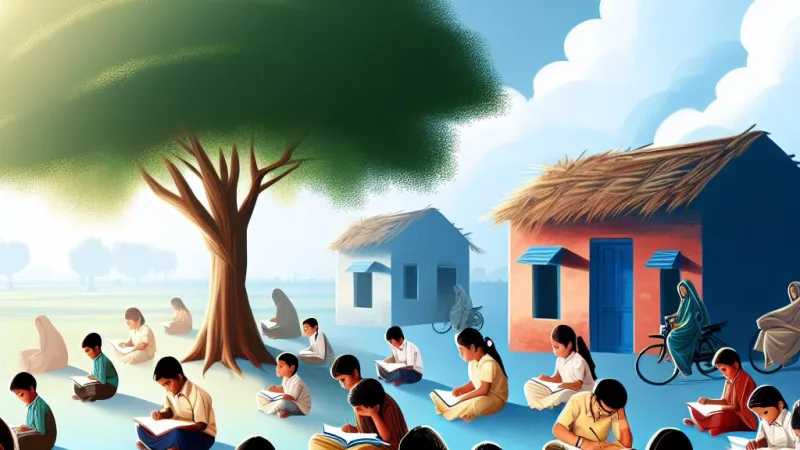
At present, Indian education is structured into several stages—early childhood, primary (classes 1–8), secondary (classes 9–12), and higher education (colleges and universities). Children can attend government-run, private, or alternative schools such as Navodaya Vidyalayas and Kendriya Vidyalayas. The government ensures free and compulsory education for all children aged 6 to 14 under the Right to Education Act, aiming to make learning accessible for every section of society.While these initiatives are praiseworthy, numerous hurdles remain. Even today, children in remote tribal and hilly areas struggle to access quality schooling. Girls and children from economically weaker sections often drop out due to social pressure or lack of resources, though efforts like the mid-day meal scheme and Kanyashree Prakalpa in West Bengal aim to counter these problems.
Another challenge is the varying quality of education. Some states like Kerala boast a literacy rate of over 96%, while others lag behind. Infrastructure gaps, outdated curriculum, and teacher shortages lower the learning standards for millions. However, the rapid spread of affordable internet and smartphones is bringing hope—digital classrooms, educational websites like Diksha, and YouTube tutorials are helping bridge the urban-rural gap. Interactive e-learning is making the process enjoyable and engaging.
Vocational and skill-based training is now receiving deserved attention. Government-sponsored skills mission, like Skill India, seeks to match education with industry needs—be it carpentry, computer training, or nursing. As a result, youth can aspire to employment in diverse fields, not just traditional white-collar jobs.
Future Trends and Recommendations
Looking to the future, it is clear that technology will play an even greater role in education delivery. Blended models that combine in-person classes and online modules can expand access to remote villages and underprivileged areas. Artificial Intelligence can provide customised feedback to learners, making education more effective for each child.The curriculum also needs regular updating. Besides textbook knowledge, students must be equipped with environmental awareness, digital literacy, financial skills, and a strong sense of ethics. Multilingual education should be encouraged—studying in mother tongues alongside Hindi and English preserves our literary heritage and enhances global communication abilities.
Inclusivity must remain a central goal. Policies and infrastructure improvements are essential for differently-abled students and children from marginalised backgrounds. NGOs and private institutions have a vital role to play in supplementing government efforts, whether by providing free tuition, scholarships, or well-equipped libraries.
Moreover, teachers are at the heart of the education process. Continuous training and motivation can help them adopt new teaching methods, inspire students, and promote lifelong learning. Communities and parents must also be encouraged to actively engage with schools, as education flourishes best when children learn in a supportive environment both at home and outside.
Conclusion
Education in India is a tapestry woven from ancient wisdom and modern science, tradition and innovation, discipline and creativity. It is the tool that sharpens minds, elevates morals, fosters curiosity, and unites a nation as diverse as ours. It is not only the passport to a better job but the key to becoming a responsible citizen and a compassionate human being.As a society, we must share the responsibility of nurturing our educational ecosystem—governments must invest wisely, teachers must evolve constantly, parents must support wholeheartedly, and students must strive continuously. Only then can India’s tryst with destiny—of becoming a truly enlightened, equitable, and prosperous nation—be fulfilled. Let us remember, as our former President Dr. APJ Abdul Kalam once said, “Education is the most powerful weapon which you can use to change the world.” For every Indian, education must remain a sacred pursuit, a lifelong journey towards knowledge, wisdom, and harmony.
Rate:
Log in to rate the work.
Log in