A Concise Essay on the Impact and Issues of Child Labour in India
This work has been verified by our teacher: 5.03.2026 at 14:35
Type of homework: Essay Writing
Added: 3.03.2026 at 6:02
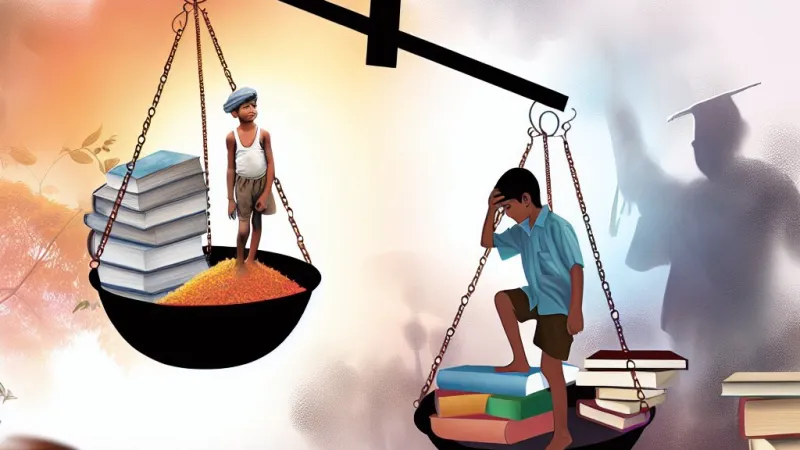
Summary:
Explore the impact and issues of child labour in India to understand its causes, consequences, and why protecting childhood education matters. 📚
Paragraph on Child Labour
Childhood, as Rabindranath Tagore once wrote, is “the time of endless curiosity and of dreaming big and bold.” Yet, for crores of children in India, this stage is snatched away by the harsh realities of child labour. Child labour means the employment of children, usually under the age of 14, in any work that is physically, psychologically, or morally dangerous and harmful, often making them sacrifice their education, health, and very childhood itself. It is crucial to distinguish between child labour and activities like helping at home or learning traditional crafts under safe conditions; it is only when children are forced, exploited, or deprived that mere work turns into labour.
Unfortunately, child labour is not just an abstract or distant problem. The sight of children mending punctures at a wayside dhaba, carrying bricks in construction sites, or polishing shoes at the local railway station is all too common in India. This issue is loaded with social, economic, and moral questions about the society we live in and the future that awaits these children. As citizens of a country that values “Satyamev Jayate” and the right to childhood, we have to acknowledge child labour as a problem that holds our national progress hostage. Its eradication requires urgent, collective effort from every corner of society.
---
I. Understanding Child Labour
To grasp the seriousness of child labour, we must first understand where and why it occurs. Child labour takes many forms in India. For many young boys and girls, daily life begins in the dim light of dawn at factories, weaving looms, brick kilns, stone quarries, or even fields tainted by pesticides and hazardous machines. Others work as domestic helpers, roadside tea sellers, ragpickers, or even in illegal networks like begging mafias.But it is important not to confuse child labour with the roles children play in their families or communities. Simple household chores, helping parents after school, or learning traditional arts, as seen in rural Rajasthan or Andhra Pradesh, can sometimes be part of healthy socialisation—when done within limits, under supervision, and with their welfare in mind. The real issue is exploitative labour: long hours of tedious or unsafe work, absence from school, abuse, and conditions which rob young ones of opportunities to grow and learn.
The roots of child labour run deep. At its core is the heavy shadow of poverty. In villages where a single daily wage is never enough, families are forced to send their children to work, sometimes simply for survival. Illiteracy and the lack of access to affordable or quality education turn school into a distant dream. Social traditions or peer pressure, especially among marginalised communities, sometimes normalise the exploitation, while some employers deliberately prefer child workers due to their vulnerability and lower demands. In the end, a grim combination of broken institutions and broken dreams keeps this cycle running.
---
II. The Consequences of Child Labour
The effects of child labour are catastrophic, both for the children involved and the society at large. The physical impact on these young workers is horrific. Whether it is the boy inhaling toxic fumes in a bidi factory, or the girl lifting heavy stones at a construction site, their bodies bear the cost—injuries, malnutrition, stunted growth, chronic illnesses, and even permanent disabilities. The child’s body, still fragile and growing, is not meant for such exertion.The wounds of child labour go far beyond the physical, often scarring the mind. Living under exploitation, harsh discipline, abuse, or outright violence, these children develop high levels of stress and anxiety. Away from the affection and nurturing environment a child needs, they can sink into deep inferiority complexes, lose confidence or become emotionally numb. Numerous studies by Indian social scientists, such as Kailash Satyarthi, have shown that child labourers are especially vulnerable to trauma, depression, and loss of hope.
Education, without which the cycle of poverty cannot be broken, is the first casualty. Many of these children drop out of school or never set foot inside a classroom. Their world shrinks to their workplace, missing out on basic literacy, knowledge, and even the simple joys of playing with friends. A society that allows its children to work instead of learn effectively surrenders its claim to a bright future.
If these individual consequences seem tragic, the long-term impact on the country is even graver. The repetition of the cycle—uneducated children growing up to become adults stuck in unskilled, informal, and often poorly paid jobs—strengthens the grip of poverty. Social evils such as crime, addiction, and violence often find fertile ground in communities where future prospects have been crushed early. This is not how our nation, which reveres Dr Kalam’s vision that “the ignited minds of the youth are the greatest resource,” can ever hope to grow.
---
III. Child Labour in the Indian Context
India is home to one of the world’s largest populations of child labourers, estimated by various sources to be around 10 million, though the actual numbers may be even higher due to underreporting. States like Uttar Pradesh, Bihar, Rajasthan, and Jharkhand have some of the highest rates, particularly in rural and tribal belts. Children are involved in sectors ranging from agriculture to carpet weaving in Mirzapur, fireworks manufacturing in Sivakasi, small roadside eateries in metropolitan cities, and domestic labour in apartments across Delhi and Mumbai.The legal framework in India is robust, at least on paper. The Child Labour (Prohibition and Regulation) Act 1986, amended over the years, prohibits children below 14 from working in hazardous occupations. The landmark Right to Education Act 2009 makes free and compulsory education for every child aged 6–14 a legal right. The government’s National Child Labour Project (NCLP) attempts to rescue and rehabilitate child workers and provide them with non-formal education and healthcare.
However, the ground reality often falls short of legal ideals. Weak enforcement, bureaucratic delays, loopholes in law (such as exceptions for family enterprises), low levels of reporting from rural areas, and sometimes the complicity of employers and middlemen mean thousands of children miss out on protection. COVID-19, too, has hit livelihoods and pushed more disadvantaged children into work.
Deep underlying problems remain: Rural and urban poverty, unemployment among adults, the migration of families due to climate disasters or economic pressures, death or abandonment of parents, and lack of a social safety net keep the wheels of child labour turning.
---
IV. Role of Society in Combating Child Labour
The responsibility to end child labour cannot rest solely on the law or government officials. It is a social problem, demanding a social solution.Families, especially among economically weaker sections, need to be supported and educated about the long-term value of schooling, not just for their children but for the upliftment of the whole family. Government and NGO schemes which offer scholarships, free books, uniforms, or financial support can reduce their immediate need for additional income.
Communities and local authorities must remain vigilant, reporting cases of child abuse or exploitation. Panchayati Raj institutions, anganwadis, and self-help groups can play vital roles in spotting and rescuing children. The example of Bachpan Bachao Andolan’s rescue operations shows how community awareness often triggers official response.
Educational institutions must fight stigma and help integrate rescued child labourers into mainstream education. Efforts like bridge courses, flexible school timings, mid-day meals, counselling for children who suffered exploitation, and teacher training programmes are essential. Schools can conduct community outreach—explaining rights and benefits, celebrating days like *Bal Diwas* or *Children’s Day* with purpose, and building connections with local families.
NGOs and civil society—from Sulabh International to Pratham—have repeatedly shown how coordinated action leads to miraculous recovery stories. Whether it is the rehabilitation of children from Mumbai’s red-light areas, or providing vocational training and psychological support to rescued labourers in Hyderabad, these groups form the on-the-ground backbone of the fight.
---
V. Steps Towards Eradication
Laws must bite, not just bark. The existing protections should be enforced stringently, with regular inspections, tracking of high-risk industries, and stringent penalties—be they fines or even jail—for those who profit from child exploitation. Anonymous helplines and digital reporting tools must become more widespread and responsive.Education remains the great liberator. Expansion of government schools, improvement in the quality and approachability of teachers, and schemes like the Mid-Day Meal incentivise schooling. Scholarships, free uniforms and notebooks, and flexible school timings for working children are practical steps.
The family’s economic status must be improved. Self-employment schemes, MNREGA (Mahatma Gandhi National Rural Employment Guarantee Act), and adult skill development projects can ensure that parents do not have to make the grim choice of sending their wards to work. Widows’ pensions, social security, and support for single-parent families or orphans are necessary.
Awareness is as crucial as action. Street plays, television ads, posters in railway stations and bus stops, grassroots campaigns on “Child Labour Prohibition Day,” and inclusion of anti-child-labour themes in popular shows can shape public opinion. Inspirational stories of people like Nobel Laureate Kailash Satyarthi and movements like Save the Childhood prove that when society comes together, change is possible.
---
Conclusion
To allow children to labour is to rob them, not only of their present joys, but also our nation of its future hope. If our vision is to see a Viksit Bharat, where every child can stand tall—educated, healthy and confident—we must act collectively.The end of child labour requires that everyone plays a part—governments enforcing the law, society spreading awareness, families prioritising education, and children knowing their own rights. Let our dream be that in the near future, the only work our children do is to build castles in the sand, chase kites on Independence Day, and dream big for themselves and India. Only when every child is freed from the burden of unjust labour, can our country truly hold its head high in the community of nations.
Rate:
Log in to rate the work.
Log in