MCQs with Answers for The Best Christmas Present in the World - Class 8 English
This work has been verified by our teacher: 30.04.2026 at 17:19
Type of homework: Essay Writing
Added: 28.04.2026 at 11:29
Summary:
Explore MCQs with answers for The Best Christmas Present in the World Class 8 English to master its themes of war, hope, and humanity effectively. 🎓
The Best Christmas Present in the World: An Insightful Exploration of War, Humanity, and Hope
“The Best Christmas Present in the World,” as included in the NCERT Class 8 English textbook, is a powerful narrative that draws students into the emotional and historical tapestry of World War I. This story, written by Michael Morpurgo, is not just about the glories or miseries of war, but reflects upon humanity’s undying hope and the innate goodness that can surface even amidst conflict. Set in the chilly trenches of Europe, the plot revolves around a remarkable incident—the spontaneous Christmas truce of 1914, where British and German soldiers, adversaries by circumstance, found themselves united by their shared humanity. The story’s inclusion in the curriculum aims to provide Indian students not only with a lesson in language but also with insights into empathy, memory, and the legacies of history.
As we analyse the text in detail, we will delve into its historical background, examine its significance, and also provide tips and relevant MCQ-oriented pointers to help students engage deeply with the lesson.
---
Historical and Cultural Context
Understanding the historical backdrop is vital for grasping the true essence of “The Best Christmas Present in the World.” The story is set during World War I, a catastrophic event that changed the face of the globe. Millions of young men, drawn mostly from rural backgrounds, were plunged into a conflict for causes far removed from their personal lives. Europe in 1914 was a complex web of alliances and nationalism; when war erupted, it came down with unprecedented brutality.Soldiers, often portrayed as mere pawns of battle, were subjected to unspeakable hardships—living in muddy trenches, enduring biting cold, and facing a constant threat of death. In the Indian context, it is worth noting that about 1.3 million Indian soldiers served overseas during WWI. Letters from home, songs, and small tokens—much like in the story—were their only solace amidst the horror.
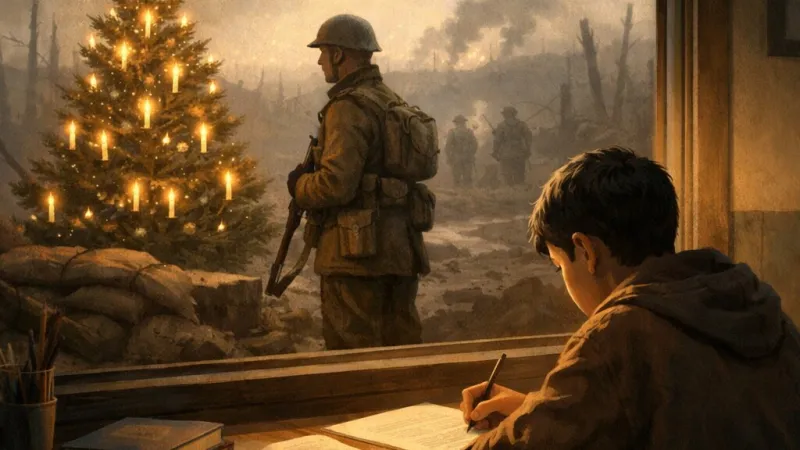
Amidst this bleakness, the Christmas truce of 1914 stands as a symbol of hope. On Christmas Eve, soldiers from both sides called an unofficial ceasefire, ventured into the dangerous “No Man’s Land,” and forged friendships, even if only for a day. They sang carols, exchanged simple gifts, and, most famously, played football. This incident is remembered worldwide and has even been likened to Indian tales of festivals bringing together feuding families or villages, reminding us that the call of the heart often supersedes divisions.
---
Summary and Plot Analysis
The story’s narrator is an ordinary person, who, out of curiosity, purchases an old roll-top desk from a junk shop, reminiscent of how artifacts in Indian households often carry the weight of family histories. While refurbishing the desk, he discovers a secret compartment containing a faded letter, dated Christmas Eve, 1914. This letter, penned by Jim Macpherson, a British soldier, is addressed to his wife, Connie.In the letter, Jim describes the extraordinary event of the Christmas truce. Despite orders and expectations, the British and German soldiers left their trenches, shook hands, shared food and drink, sang songs, and played a friendly football match. For a brief window, animosity was forgotten, and bonds of friendship were formed, as if their homefront festivals like Eid or Diwali had momentarily touched the battlefield.
Beyond the truce, the story also follows the narrator’s decision to return this priceless letter to Connie, Jim’s wife. When he locates her in an old age home, confusion and memory blend together for an emotional climax—a testament to how memories and emotions outlast even lifetimes.
---
Character Sketches and Symbolism
Jim Macpherson
Jim, the author of the letter, is a British officer, but more importantly, he embodies the everyman. His melancholy, longing for home, and hope for peace make him relatable to any reader, especially students who may know family members working or studying far from home. The letter he writes is not just a wartime record, but a heartfelt conversation with his wife, full of tenderness and optimism.Hans Wolf
On the opposite side of the battlefield, Hans Wolf, a German soldier—once a cellist in Dusseldorf—befriends Jim. Their conversation reflects shared human interests: Beethoven, baked bread, family, and future dreams. Hans, like many characters in Indian classics, underscores the belief that everyone has a story, beyond what politics or propaganda claim.The Roll-Top Desk and the Letter
Both the desk and the letter serve as powerful symbols. The desk is like an heirloom in a Bengali household, brimming with unspoken stories. The hidden compartment is a literal and figurative repository of the past, preserving hopes, anxieties, and emotions that surface across generations.---
Themes Explored in the Story
War and Peace
The narrative juxtaposes the brutality of war with the sudden flowering of peace. Through Christmas, the festival of goodwill, the story asks us to question the very meaning of conflict. Why must soldiers die fighting each other, when moments of joy are possible? This resonates with Mahatma Gandhi’s philosophy of “Ahimsa,” a concept that forms the bedrock of Indian value systems.Friendship and Humanity
Humanity’s strength lies in collective experiences. When Jim and Hans shake hands, or when soldiers swap plum cakes, it is a reminder of Raksha Bandhan or Holi, festivals where even foes are invited home. War can force men to act as enemies, but the fundamental urge for connection always prevails.Hope and Optimism
Jim’s letter, like so many messages penned by Indian soldiers during Partition or the Kargil War, serves as a lantern in the dark. The hope that things will return to normal, that peace will trump violence, is never extinguished. Hope, in fact, becomes the real “best Christmas present.”Memory and Legacy
The past does not disappear. The old lady’s careful preservation of Jim’s letter, just as Indian families preserve ancestral photos or letters, reveals how personal memories shape our understanding of history, far more than facts or dates.---
Literary Devices and Narrative Techniques
Morpurgo employs a first-person narrative, which lends immediacy and authenticity to the story. The reader walks alongside the narrator, feels his curiosity, and experiences his emotional turmoil while handing over the letter to Connie.Descriptions are vivid; the author recreates the icy trenches, the glow of shared cigarettes, and the warmth of Christmas carols just as R.K. Narayan might paint a bustling street in Malgudi.
Symbolism is seamlessly woven in—the desk, the letter, the truce—all function as tangible connections across time and space.
The tone shifts effortlessly: from the narrator’s initial excitement to somber reflection, to the upliftment found in moments of peace—a technique that keeps the reader engaged and empathetic.
---
Moral and Educational Significance
The story emphasizes the higher value of peace over conflict. In modern India, where regional, religious, or linguistic differences sometimes lead to discord, “The Best Christmas Present in the World” is a resonant plea for understanding and compassion, echoing sentiments expressed by poets like Rabindranath Tagore in “Where the Mind is Without Fear.”It also demonstrates the importance of learning from history—not merely memorising battles, but understanding the human cost and moral lessons therein. The act of returning the letter to Connie is an act of restorative justice, something that can be equated with the Indian practice of returning lost property unopened—a matter of ‘dharma’ or duty.
Most importantly, the story encourages students to value personal stories and handwritten letters, which are often more meaningful than any textbook chapter.
---
Tips for Students Preparing for MCQs and Exams
1. Know the key characters and their significance—Jim Macpherson, Hans Wolf, Connie, and the narrator.2. Remember dates and events—Christmas Eve, 1914; the Christmas truce; details of the football match.
3. Master the vocabulary—Terms like ‘No Man’s Land,’ ‘truce,’ ‘fraternisation,’ and ‘roll-top desk’ may be referenced.
4. Practice inference—MCQs often test understanding of implied meanings: Why did Jim treasure the truce? What did the desk symbolise?
5. Answer writing—Be concise, factual, but include relevant examples, just as you would cite the exact food items or songs shared during the truce if asked.
6. Relate to values—Mention how the story’s lessons apply to Indian society when relevant.
---
Conclusion
“The Best Christmas Present in the World” is far more than a tale of old wars and forgotten letters. It is a beacon of hope—a reminder that kindness, compassion, and shared humanity can transcend even the greatest of divides. For Indian students, the story is an invitation not only to score marks in English exams, but to carry forward its spirit into their own lives, fostering peace in their schools, families, and communities.Ultimately, it teaches that the greatest gifts in life are not material, but moments of understanding and goodwill—truly, the best presents in any world.
Rate:
Log in to rate the work.
Log in