Top 10 Key Facts About Mathematics for Secondary School Students
This work has been verified by our teacher: 9.04.2026 at 18:52
Type of homework: Essay Writing
Added: 7.04.2026 at 14:56
Summary:
Discover the top 10 key facts about mathematics for secondary school students to boost understanding of numbers, logic, and India’s rich math heritage.
10 Lines on Mathematics
Mathematics is a subject that has shaped the mindset and progress of societies like ours for thousands of years. In every classroom from Ladakh to Kanyakumari, students have encountered the world of numbers, shapes, patterns, and logic. Through generations, mathematics has grown far beyond being just a tool for calculations—it has become the very language of science, reasoning, and innovation. The following essay unfolds the essence of mathematics through ten insightful lines, each elaborated upon to show its relevance, charm, and importance, especially in the Indian context.---
1. Mathematics is the Science of Numbers, Logic, and Patterns
Mathematics starts with something as basic and universal as counting: ek, do, teen. But it also includes far more—reasoning about shapes, discovering patterns, understanding symmetry, and making logical arguments. When we add, subtract, multiply, or divide, we are using rules that remain the same everywhere, whether you are in Chennai or Shillong. This universality makes mathematics a special language understood across the globe. The great Indian mathematician, Aryabhatta, once pointed out that “numbers are the highest degree of knowledge” and his words still ring true for students discovering the subject today.---
2. Mathematics Is Rooted Deep in Indian Heritage
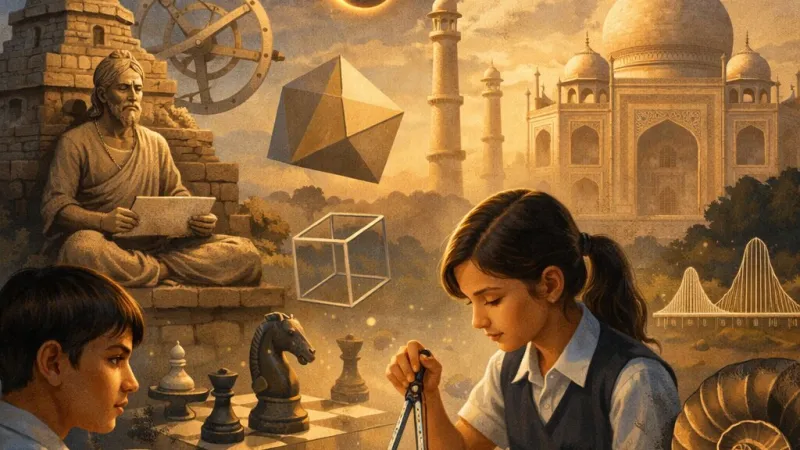
India’s rich mathematical legacy runs from Vedic times through luminaries like Brahmagupta, who described the concept of zero, to Srinivasa Ramanujan, whose work continues to inspire mathematicians across the world. The decimal system, which is now used internationally, found its roots in our own soil. Ancient Indian scriptures like the Sulba Sutras dealt with geometrical ideas long before formal mathematics entered the western world. For example, the concept of ‘Shunya’ (zero) revolutionised not only Indian but global mathematical thinking.---
3. Mathematics Develops Critical Thinking and Problem-Solving
Unlike subjects where memorising facts may suffice, mathematics encourages students to think, reason out solutions, and develop logical arguments. When we tackle puzzles, solve riddles, or play traditional brain games like 'Ganjifa', we are subconsciously training our brains to break down problems into manageable parts. In school, when we prove a theorem or solve a complex equation step by step, we are exercising mental muscles, much like athletes train their bodies in sport.---
4. Mathematics in Everyday Life
Far from being limited to textbooks and examination halls, mathematics supports our day-to-day existence in ways we rarely notice. Have you ever helped your mother measure rice for dinner, calculated expenses during Diwali shopping, checked the time to avoid missing the school bus, or played the carrom board where geometry helps you take the perfect shot? Each of these is mathematics at play in ordinary Indian life. Even planning a train journey involves reading timetables and calculating durations, all thanks to basic maths.---
5. Mathematics is the Backbone of Modern Technology
The world of gadgets, computers, mobile phones, and even quick online payments would be unthinkable without mathematics. The patterns woven into silk sarees, the symmetry in Mughal architecture like the Taj Mahal, and the codes that keep our online transactions safe are all based on mathematical concepts. Indian IT professionals and engineers routinely use applied mathematics in software design and problem-solving, strengthening the country’s global reputation as a technical powerhouse.---
6. Mathematical Patterns Are Found in Nature
Nature too, follows the rules of mathematics. The intricate arrangement of petals in a marigold flower resembles the Fibonacci sequence, a numerical pattern familiar to every science student. The hexagonal shapes of honeycombs, the spiral of a conch shell (Shankha), and the rhythm of a peacock dancing in monsoon display the same order that mathematicians study in classrooms. This shows us that mathematics is not something artificial but woven into the fabric of the natural world around us.---
7. Mathematics Is Essential in the Indian Education System
From the very first year of school, children in India are introduced to numbers, counting, and basic shapes through rhymes and colourful charts. As years progress, concepts like algebra, geometry, and statistics become prominent. CBSE, ICSE, and state boards all treat mathematics as a core subject, understanding its foundational value. Unfortunately, many students develop a fear of maths, sometimes due to rote learning or lack of proper guidance. This is why teachers encourage fun activities, puzzles, and group learning—methods that have shown to improve mathematical understanding, as seen in successful math clubs and olympiads hosted in cities like Mumbai and Kolkata.---
8. Overcoming Mathematics Anxiety
It is common to hear students say, “Maths is tough!”, but this fear can be conquered with regular practice and the right mindset. Breaking problems down, using visual aids like number lines and abacus, and discussing doubts with friends can make concepts clearer. Famous mathematicians such as Shakuntala Devi, who was named the “human computer” of India, proved that with passion and persistence, one can master even the most challenging problems. Her life is an inspiring reminder that mathematics, like a puzzle, becomes enjoyable when approached with patience and curiosity.---
9. Mathematics Creates Opportunities for the Future
Strong mathematical skills open the doors to many careers: engineering, data science, architecture, economics, banking, and teaching, to name a few. Indian students excelling in mathematics have gone on to win international recognition in Olympiads and even contribute to ISRO's missions, including the Chandrayaan and Mangalyaan. Even for those who do not pursue “math-heavy” careers, the logical reasoning developed through mathematics is useful in decision-making, planning, and managing daily life challenges.---
10. Mathematics is Celebrated and Valued in India
To honour legendary minds like Srinivasa Ramanujan, India observes National Mathematics Day on 22nd December each year. Schools host maths exhibitions, quizzes, and fun-filled activities to foster a love for the subject. Whether it’s the pride of cracking a tough Sudoku or the thrill of seeing your solution match the teacher’s answer on the blackboard, the joy of learning mathematics is immense. Just as literature is celebrated through poetry competitions, mathematics is cherished through talent hunts, math olympiads, and even local fairs.---
Conclusion
Mathematics is more than just a subject—it is a way of thinking and reasoning that fills our lives at every step. Its roots run deep through our culture, history, and ambitions as a nation. A strong foundation in mathematics gives us the ability to solve problems, reason independently, and pursue excellence in any field. If approached with excitement and openness, mathematics transforms from a source of anxiety into a lifelong companion.In the words of the great teacher Dr. APJ Abdul Kalam, “Excellence happens not by accident. It is a process.” Mathematics is that continuous process—a journey, not a destination. Every challenge solved, every theorem proved, and every pattern discovered is a step forward. If you nurture curiosity and put in honest effort, mathematics will not only help you succeed in school exams but also open up a world of wonder and possibilities for you. Let’s embrace maths, make it our friend, and watch ourselves grow into thinkers who shape the future.
---
Fun Riddle to End: *I am a three-digit number. My tens digit is five more than my ones digit, and my hundreds digit is eight less than my tens digit. What am I? (Answer: 194)*
---
This set of ten lines, expanded with examples and stories from our Indian experience, aims to kindle a new appreciation for mathematics among students. Remember, every big discovery in maths started with a simple question and a curious mind. Let yours be one of them!
Rate:
Log in to rate the work.
Log in